
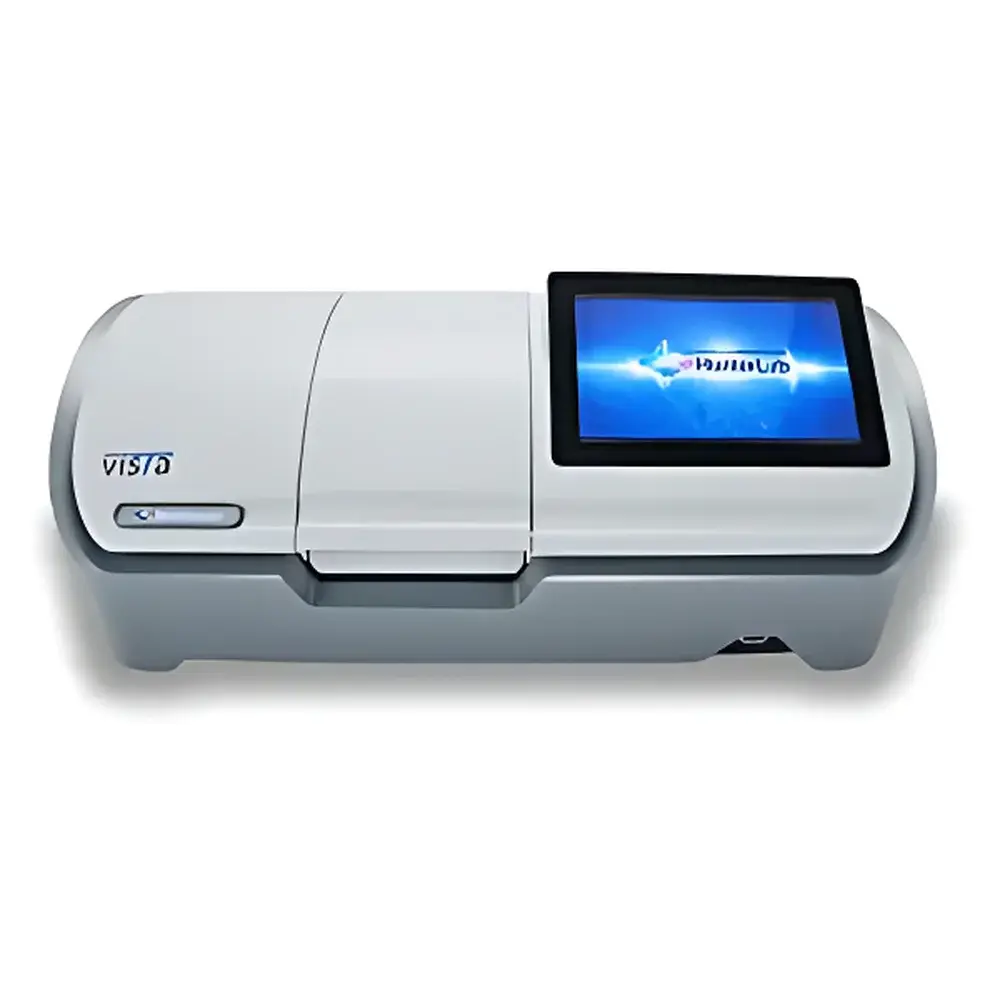
HunterLab Vista BPA Melt Colorimeter
| Brand | HunterLab |
|---|---|
| Origin | USA |
| Model | Vista BPA Melt Colorimeter |
| Instrument Type | Benchtop |
| Optical Geometry | d/8° integrating sphere |
| Light Source | Full-spectrum LED array |
| Spectral Range | 400 nm – 700 nm |
| Repeatability | < 0.025 ΔE* (30 measurements) |
| Compliance | ASTM E1164, ASTM D1003, CIE 15:2004, DIN 5033-7, JIS Z 8722 Condition E, ISO 7724, USP <631>, EP 2.2.29 |
Overview
The HunterLab Vista BPA Melt Colorimeter is a purpose-engineered benchtop spectrophotometer designed for precise, standardized color and haze measurement of thermally molten organic chemical intermediates—particularly bisphenol A (BPA) and structurally analogous compounds that are solid at ambient temperature but form optically clear melts upon heating. Unlike general-purpose colorimeters, the Vista integrates dual-mode optical metrology to simultaneously quantify both spectral transmittance color (in CIE L*a*b*, Yellowness Index, APHA, etc.) and turbidity-corrected haze in a single acquisition cycle. Its optical architecture conforms to ASTM D1003 for haze and ASTM E1164 for colorimetric performance, enabling traceable compliance with global quality control protocols in fine chemical, polymer precursor, and pharmaceutical excipient manufacturing. The instrument employs a double-beam spectrophotometric design with a 256-element diode array detector and high-resolution concave holographic grating, delivering <3 nm effective spectral resolution across the 400–700 nm visible range. All measurements are referenced to CIE standard illuminants (D65/10° primary; C/2° secondary) and observer functions, ensuring metrological consistency across laboratories and regulatory audits.
Key Features
- Simultaneous color + haze measurement in one scan (<5 s total), eliminating sequential repositioning and thermal drift errors during melt analysis
- Dual optical path capability: Total transmittance (TTRAN), regular transmittance (RTRAN), and ASTM D1003-compliant haze quantification
- Full-spectrum LED source with >5-year operational lifetime and stable spectral output—no warm-up time or lamp replacement required
- Integrated 76 mm integrating sphere with 18.5 mm illumination / 9.1 mm measurement area optimized for high-pathlength (100 mm) molten sample cells
- Automatic calibration validation and drift compensation using onboard reference tiles and real-time photodiode monitoring
- Spill-resistant sample compartment with precision-machined, thermally stabilized cuvette holder compatible with standard 100 mm pathlength quartz or borosilicate cells
- 1280×800 high-resolution capacitive touchscreen interface with intuitive workflow navigation and on-device data review
Sample Compatibility & Compliance
The Vista BPA Melt Colorimeter is validated for use with high-purity organic melts exhibiting no visible particulates or phase separation at elevated temperatures (typically 140–180 °C for BPA). It supports routine testing of bisphenol A, phenol, phthalic anhydride, maleic anhydride, trimellitic anhydride (TMA), dimethyl terephthalate (DMT), di-octyl phthalate (DOP), ethylenediamine, and related industrial intermediates where APHA/Hazen color and ASTM D1003 haze serve as critical purity indicators. The system meets GLP/GMP documentation requirements through built-in audit trail logging (user actions, calibration events, measurement timestamps) and optional 21 CFR Part 11 compliance mode with electronic signatures and role-based access control. All color scales—including YI E313, YI D1925, Gardner, Saybolt, Lovibond Red/Yellow, and ADMI—are calculated per published standard equations without interpolation or vendor-specific weighting.
Software & Data Management
Vista instruments ship with Vision software (v5.x), a Windows-based platform supporting method-driven SOP execution, statistical process control (SPC) charting, and automated report generation compliant with ISO/IEC 17025 documentation standards. Raw spectral data (31-point nm intervals, 10 nm bandwidth) is exportable in CSV, XML, and ASTM E2902-compliant formats. The software enables batch comparison against master spectra, tolerance banding per color difference metric (ΔE*, ΔE₀₀, ΔCMC), and haze/color correlation analysis. Network deployment supports centralized instrument management via Ethernet or Wi-Fi, with secure HTTPS API integration for LIMS and MES systems. All calibration records, measurement logs, and user audit trails are stored with SHA-256 hashing to ensure data integrity and regulatory defensibility.
Applications
- QC release testing of BPA batches per ASTM D6166 and manufacturer specifications
- Monitoring thermal degradation onset during melt processing or storage stability studies
- Raw material qualification for epoxy resin and polycarbonate synthesis feedstocks
- Root-cause analysis of yellowness excursions linked to oxidation, metal contamination, or residual catalyst
- Supporting ICH Q5, Q7, and USP color specification submissions for pharmaceutical-grade intermediates
- Inter-laboratory method transfer validation under ISO 5725-2 precision criteria
FAQ
What sample cell pathlength is required for BPA melt measurements?
A 100 mm pathlength cell is recommended to achieve optimal signal-to-noise ratio for low-absorbance, high-clarity melts. Standard quartz or heat-resistant borosilicate cells with polished optical faces are compatible.
Does the Vista support temperature-controlled sample measurement?
The instrument itself does not integrate active heating; it is designed for use with externally heated sample cells maintained at stable melt temperature by dedicated hot blocks or ovens. Thermal stability of the sample during measurement is user-managed per ASTM D6166 protocol.
Can haze and color be reported in a single exported file?
Yes—Vision software generates consolidated reports containing both CIE L*a*b* values and ASTM D1003 haze (%) in configurable templates, with optional PDF/A-1a archival output.
Is firmware upgradable in the field?
Yes—firmware updates are delivered via USB drive or network push and include version-locked calibration verification to maintain metrological traceability.
How is instrument-to-instrument agreement verified?
HunterLab provides inter-instrument agreement (IIA) characterization using NIST-traceable transmission filters. Typical ΔE* (D65/10°) agreement is <0.15 (average) across a set of certified transmittance standards.



