
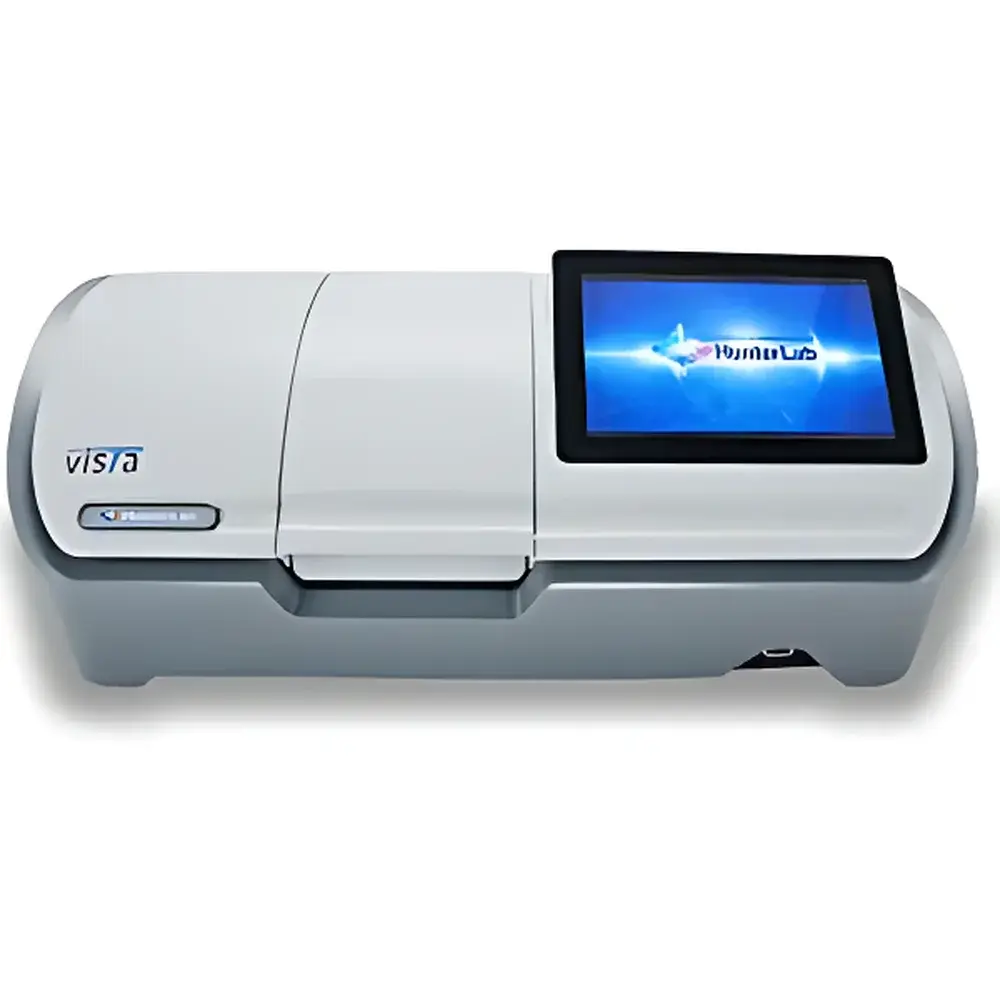
HunterLab Vista Electrolyte Additive Colorimeter
| Brand | HunterLab |
|---|---|
| Origin | USA |
| Model | HunterLab Vista Electrolyte Additive Colorimeter |
| Instrument Type | Benchtop |
| Optical Geometry | d/8° integrating sphere |
| Light Source | Full-spectrum LED array |
| Spectral Range | 400 nm – 700 nm |
| Repeatability | < 0.025 ΔE* (30 measurements) |
| Compliance | ASTM D1003 (haze), ASTM E1164, CIE 15:2004, ISO/CIE 11664, JIS Z 8722 Condition E, DIN 5033-7 |
| Color Scales | CIE L*a*b*, LCh, Yxy, XYZ |
| Measurement Modes | Total transmittance (TTRAN), Regular transmittance (RTRAN), Haze, Color, Yellowness, Turbidity indices |
| Spectral Resolution | < 3 nm FWHM |
| Effective Bandwidth | 10 nm |
| Photometric Range | 0–150% |
| Measurement Time | < 2.5 s (color), < 5 s (haze) |
| Illuminant/Observer | D65/10°, C/2° |
| Display | 1280 × 800 high-res color touchscreen |
| Power | 100–240 VAC, 47–63 Hz, 60 W |
Overview
The HunterLab Vista Electrolyte Additive Colorimeter is a high-precision benchtop spectrophotometer engineered for quantitative optical characterization of transparent and semi-transparent liquid electrolytes—particularly those used in lithium-ion battery manufacturing, electroplating, and specialty chemical synthesis. Operating on dual-beam spectrophotometric principles with a 76 mm integrating sphere and 256-element diode array detector, the Vista captures full spectral reflectance and transmittance data across the visible spectrum (400–700 nm) at <3 nm optical resolution. Its d/8° geometry complies with ISO/CIE 11664 and ASTM E1164 for diffuse illumination and hemispherical collection, ensuring metrological traceability in colorimetric analysis. Unlike conventional colorimeters, the Vista simultaneously quantifies multiple optical parameters—including CIE L*a*b*, APHA/PtCo, ASTM D1500, Saybolt, Gardner, YI E313, ADMI, Lovibond Red/Yellow (LovR/LovY), and haze per ASTM D1003—in a single measurement cycle (<5 seconds). This capability enables rapid assessment of raw material purity, batch-to-batch consistency, and degradation onset in electrolyte formulations—critical for quality control in regulated electrochemical production environments.
Key Features
- Dual-beam optical architecture with high-stability full-spectrum LED source (rated >5 years lifetime), eliminating lamp drift and enabling long-term calibration stability.
- Integrated haze measurement compliant with ASTM D1003 Method A (parallel beam, 100 mm path length), supporting simultaneous reporting of total transmittance (TTRAN), regular transmittance (RTRAN), and haze percentage.
- Automatic self-calibration routine with NIST-traceable ceramic tile and liquid reference standards, reducing operator dependency and minimizing inter-instrument variability.
- Compact footprint (W × D × H: 33 × 38 × 25 cm) and spill-resistant sample compartment optimized for low-volume electrolyte handling (minimum 10 mL fill volume required for 100 mm path length cuvettes).
- High-resolution 1280 × 800 capacitive touchscreen interface with intuitive workflow navigation, real-time spectral graphing, and on-device pass/fail threshold evaluation against user-defined limits.
- Robust mechanical design featuring thermally stabilized optics and vibration-damped base—engineered for continuous operation in QC laboratories with ambient temperature fluctuations ±2°C.
Sample Compatibility & Compliance
The Vista accepts standard 10 mm, 20 mm, 50 mm, and 100 mm path-length quartz or borosilicate glass cuvettes (supplied with optional cuvette holder kit), accommodating both low-viscosity aqueous electrolytes and higher-density organic solvent systems (e.g., EC/DMC, PC-based blends). All reported color and haze values are computed per internationally recognized standards: CIE 15:2004 for colorimetric computation; ASTM E1164 for spectral data reduction; JIS Z 8722 Condition E and DIN 5033-7 for illuminant/observer specification; and ASTM D1003 for haze methodology. Instrument performance is validated against NIST SRM 930e (filter glass) and certified APHA liquid standards, with documented repeatability <0.025 ΔE* (D65/10°, 30 replicates) and inter-instrument agreement ΔE* <0.15 (average) across a set of five units—meeting GLP audit requirements for instrument qualification (IQ/OQ/PQ).
Software & Data Management
Vista operates natively on HunterLab’s EasyMatch QC software platform (v5.5+), which supports FDA 21 CFR Part 11-compliant electronic records via configurable user roles, digital signatures, and immutable audit trails. Raw spectral data (.csv and .spc formats), color coordinates, haze values, and pass/fail status are exportable to LIMS or ERP systems via secure FTP, USB, or Ethernet. The software includes built-in statistical process control (SPC) charts, trend analysis over time, and automated report generation aligned with ISO 9001 documentation requirements. All firmware updates are delivered via signed OTA packages, ensuring cryptographic integrity and version-controlled deployment—critical for GMP-regulated battery electrolyte release testing.
Applications
- Quantitative verification of electrolyte additive purity (e.g., LiPF₆ solutions, FEC, VC, LiDFOB) via APHA/PtCo and YI E313 trending to detect hydrolysis or oxidation byproducts.
- Batch release testing of commercial-grade electrolytes against OEM-specified color/haze limits prior to cell filling.
- Stability studies tracking color shift (ΔL*, Δb*) and haze growth during accelerated aging (45°C/75% RH) per IEC 62660-1 protocols.
- Raw material incoming inspection for solvents (ethylene carbonate, dimethyl carbonate) and conductive salts to ensure conformance with ASTM D1500 or Gardner scale specifications.
- Root-cause analysis of discoloration events in production lines—correlating spectral deviations with FTIR or IC data to identify trace metal contamination or residual catalyst residues.
FAQ
Does the Vista support measurement of colored electrolytes in opaque or highly scattering media?
No—the Vista is optimized for transparent to semi-transparent liquids. For turbid or opaque samples, a dedicated transmission-haze spectrophotometer with extended dynamic range (e.g., HunterLab UltraScan VIS) is recommended.
Can haze and color be measured independently—or must they be acquired simultaneously?
Both modes are fully decoupled. Users may select “Color Only”, “Haze Only”, or “Color + Haze” in the measurement setup menu without hardware reconfiguration.
Is method validation documentation provided for pharmaceutical or battery-grade electrolyte applications?
Yes—HunterLab supplies a complete IQ/OQ protocol package, including installation checklist, operational test scripts, and performance verification reports aligned with USP , ASTM E2918, and IEC 62660-2 Annex B requirements.
What cuvette materials are compatible with aggressive lithium salt solutions?
Quartz cuvettes (UV-grade fused silica) are recommended for long-term exposure to LiPF₆-containing electrolytes; borosilicate glass is acceptable for short-term screening but may leach alkali ions under prolonged contact.
How does the Vista handle temperature-dependent spectral shifts in electrolyte measurements?
While the instrument itself lacks active thermal control, it supports external Peltier-controlled cuvette holders (sold separately) and allows manual input of sample temperature for CIE colorimetric corrections per CIE 15:2004 Annex D.




