
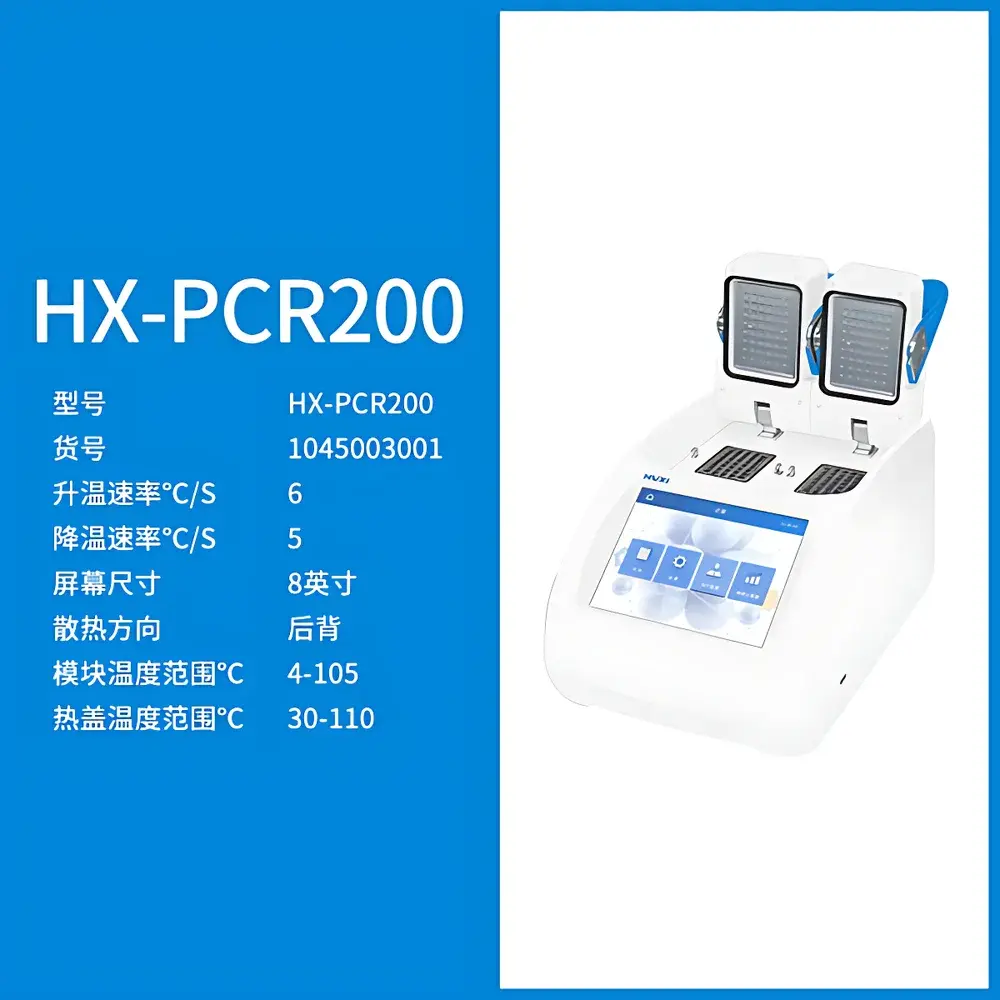
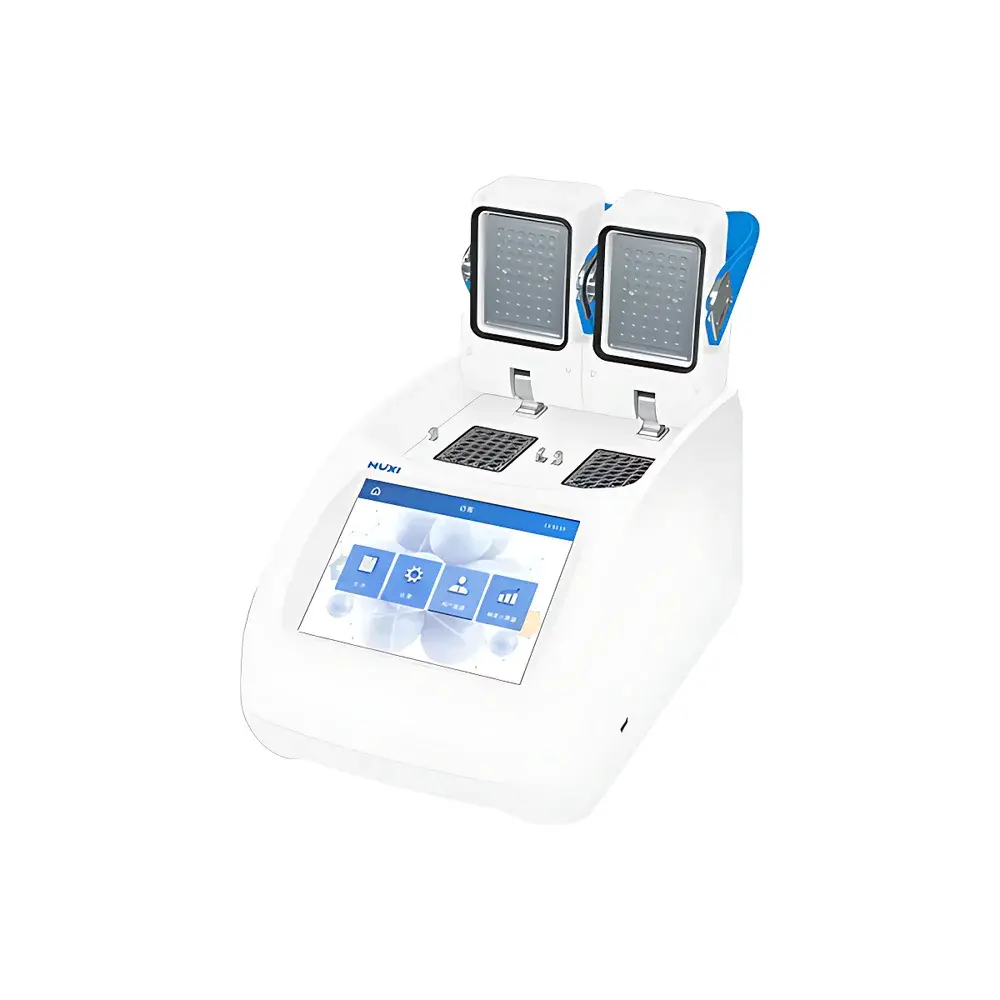

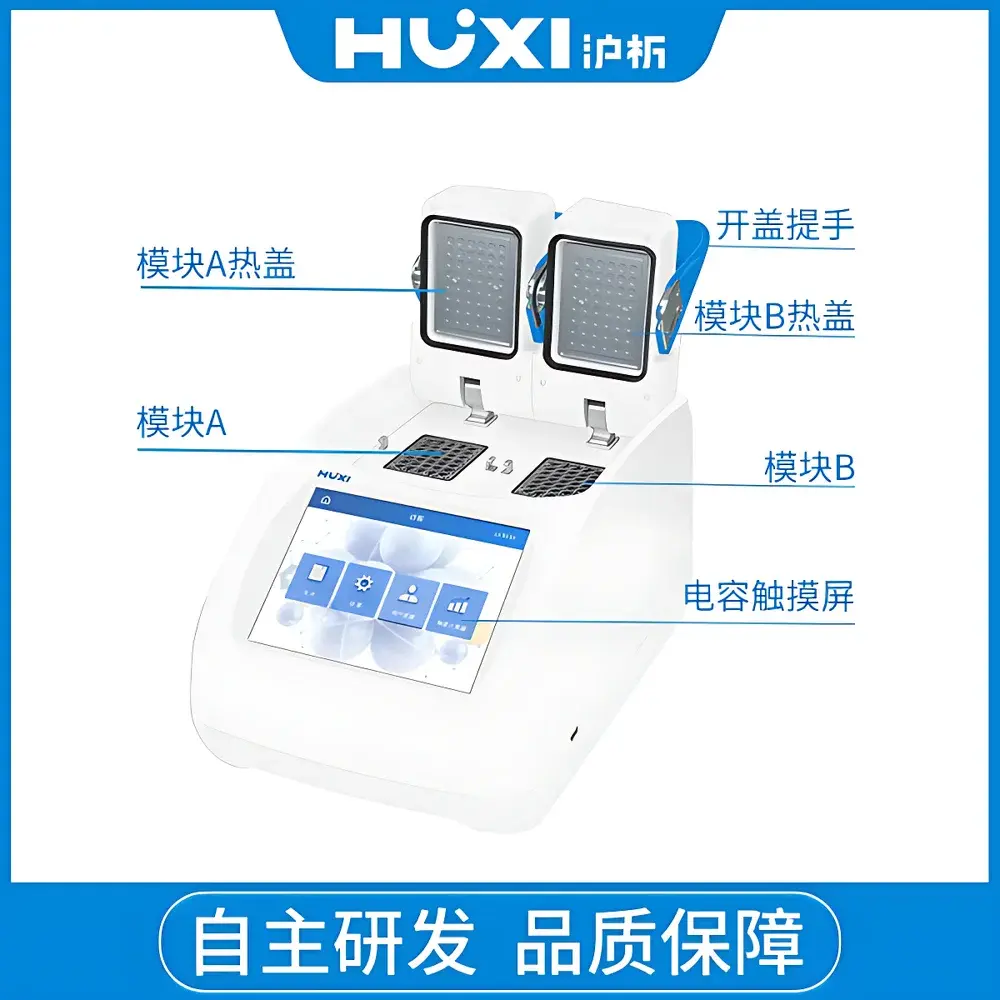


HUXI HX-PCR200 Dual-Block Gradient Thermal Cycler
| Brand | HUXI |
|---|---|
| Origin | Shanghai, China |
| Manufacturer | HUXI Scientific Instrument Co., Ltd. |
| Model | HX-PCR200 |
| Sample Capacity | Dual 48×0.2 mL (individual tubes or 8-tube strips) |
| Max Heating Rate | 6 °C/s |
| Temperature Accuracy | ≤ ±0.2 °C (block), ≤ ±0.3 °C (gradient) |
| Block Uniformity | ≤ ±0.25 °C |
| Gradient Range | 30–105 °C |
| Gradient Span | 0.1–30 °C |
| Gradient Uniformity | ≤ ±0.3 °C |
| Thermal Lid Temperature | 30–110 °C |
| Temperature Resolution | 0.1 °C |
| Ramp Rate Adjustment | 0.1–6 °C/s |
| Max Cycles | 99 |
| Max Steps per Program | 30 |
| Program Storage | >10,000 protocols |
| Touchdown & Long PCR Modes | Yes |
| Operating System | Embedded Linux |
| Display | 8-inch capacitive touchscreen (1024×768) |
| Power Input | AC 100–240 V, 50/60 Hz |
| Max Power | 800 W |
| Dimensions (W×D×H) | 260×390×230 mm |
| Net Weight | 9 kg |
Overview
The HUXI HX-PCR200 Dual-Block Gradient Thermal Cycler is an engineered solution for high-throughput, reproducible nucleic acid amplification in research and quality control laboratories. Designed around dual independent Peltier-based thermal blocks—each integrating three precision semiconductor elements—the instrument enables simultaneous execution of two distinct PCR protocols without cross-interference. Its core thermodynamic architecture leverages rapid solid-state heating and cooling (up to 6 °C/s ramp rate) with active thermal lid control (30–110 °C) to minimize evaporation and ensure consistent reaction kinetics across all wells. The system operates on a real-time block temperature feedback loop, achieving ≤ ±0.2 °C accuracy and ≤ ±0.25 °C inter-well uniformity—critical for quantitative endpoint detection, genotyping, and assay development where thermal consistency directly impacts amplification efficiency and specificity.
Key Features
- Dual independent thermal blocks allow parallel optimization of primer annealing temperatures or concurrent processing of different sample sets under divergent cycling conditions.
- Triple-Peltier architecture per block enhances thermal responsiveness and spatial homogeneity, mitigating edge effects commonly observed in single-heater systems.
- 30 °C programmable gradient range (30–105 °C) with 0.1 °C resolution supports robust assay optimization—including multiplex PCR, SNP discrimination, and RT-PCR condition screening—without hardware reconfiguration.
- Industrial-grade embedded Linux OS ensures deterministic timing, automatic power-fail recovery, and uninterrupted cycle continuation upon grid restoration—fully compliant with GLP audit trails when paired with external logging.
- Capacitive 8-inch HD touchscreen (1024×768) provides intuitive navigation, real-time temperature profiling, and direct access to advanced modes including Touchdown PCR and Long PCR with adjustable ramp rates (0.1–6 °C/s).
- Comprehensive safety architecture includes overtemperature cutoff, lid-sensor interlock, and continuous thermal monitoring—meeting IEC 61010-1 requirements for laboratory equipment safety.
Sample Compatibility & Compliance
The HX-PCR200 accommodates standard 0.2 mL thin-wall PCR tubes and 8-tube strips across both blocks (48 wells per block), supporting common consumables from major global vendors. Its thermal design minimizes condensation and ensures stable tube-to-block contact across full-load configurations. The instrument complies with ISO/IEC 17025-relevant thermal validation practices and supports user-performed IQ/OQ documentation. While not FDA 510(k)-cleared, its operational parameters align with ASTM E2500-13 guidelines for thermal cycler qualification. Data integrity features—including timestamped protocol execution logs and non-volatile memory retention—facilitate adherence to 21 CFR Part 11 principles when integrated into validated workflows.
Software & Data Management
Local operation is fully self-contained via the onboard Linux interface; no PC dependency is required for routine use. All programs—including gradient profiles, touchdown ramps, and long-cycle templates—are stored in flash memory (>10,000 protocols). USB 2.0 port enables secure export of run logs (CSV format) and firmware updates. For centralized lab management, third-party LIMS integration is supported through standardized serial command protocols (ASCII-based SCPI subset). Audit trail functionality records operator ID (if configured via external authentication), start/stop timestamps, parameter modifications, and thermal deviation alerts—enabling traceability in regulated environments.
Applications
- High-efficiency DNA amplification for cloning, sequencing library prep, and CRISPR construct verification.
- Optimization of annealing temperatures in multiplex PCR assays targeting co-amplified genomic regions.
- Robust cDNA synthesis and qRT-PCR pre-amplification steps requiring precise thermal ramp control.
- Diagnostic assay development where inter-run reproducibility and gradient-based primer screening are essential.
- Educational labs requiring durable, low-maintenance instrumentation with intuitive interface and fail-safe operation.
FAQ
Can the two blocks run entirely different protocols simultaneously?
Yes—each block has independent temperature control, timing logic, and program memory, enabling true asynchronous operation.
Is the gradient function available on both blocks at once?
Gradient mode is configurable per block; either or both may operate in gradient mode concurrently.
What validation documentation is provided for regulatory use?
Factory calibration certificates and thermal uniformity test reports are included; users may perform additional IQ/OQ using NIST-traceable reference probes.
Does the system support remote monitoring or network connectivity?
No built-in Ethernet or Wi-Fi; however, USB-hosted data export and ASCII command interface enable integration with lab automation platforms.
How is thermal stability maintained during extended long-PCR runs?
The system employs adaptive PID control with dynamic duty-cycle modulation, ensuring <±0.25 °C uniformity over multi-hour cycles at elevated denaturation temperatures.
Related Products



