
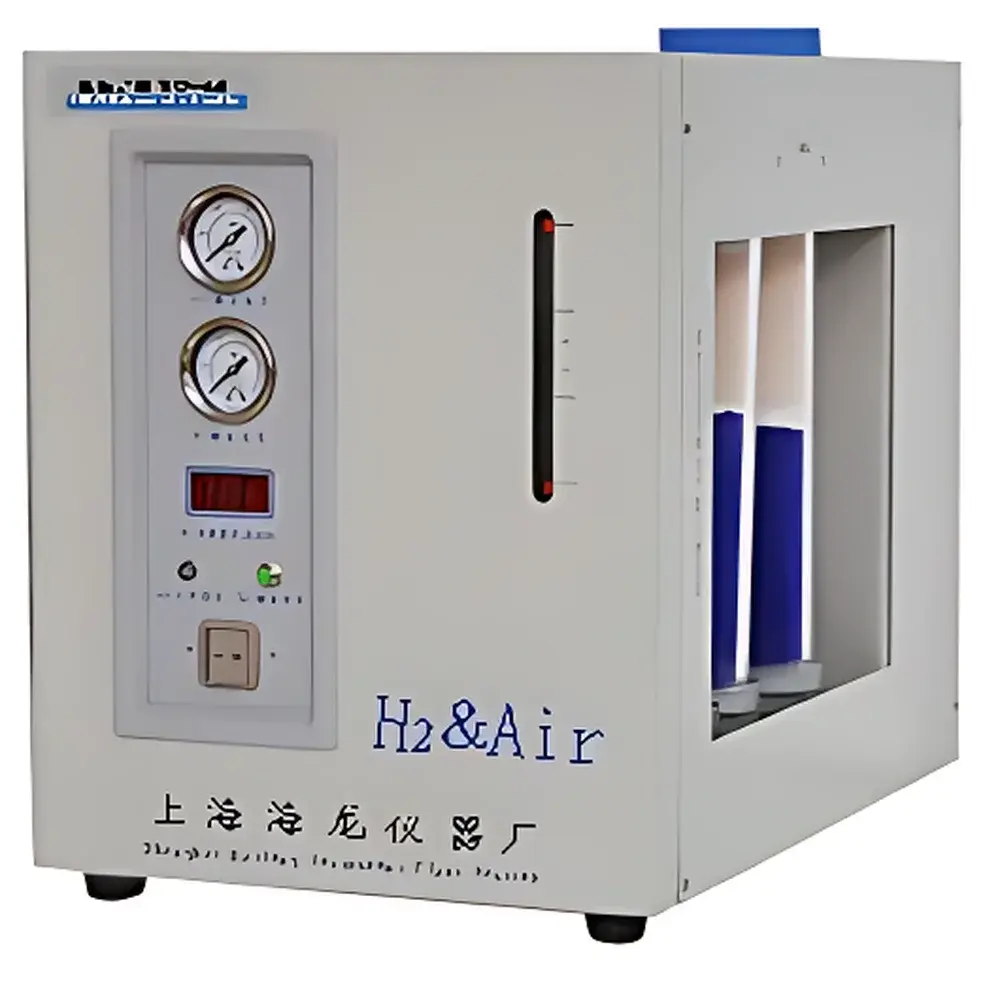
Hydrogen-Air Integrated Gas Generator HLHA-500II
| Brand | Hailong |
|---|---|
| Origin | Shanghai, China |
| Model | HLHA-500II |
| Hydrogen Purity | 99.999% |
| Hydrogen Flow Rate | 0–500 mL/min |
| Hydrogen Output Pressure | 0–0.4 MPa (factory-set at 0.3 MPa) |
| Air Flow Rate | 0–5000 mL/min |
| Air Output Pressure | 0–0.5 MPa |
| Air Hydrocarbon Content (Output) | <0.1 ppm |
| Max Input Air Hydrocarbon Content | <100 ppm |
| Pressure Stability (H₂) | <0.0001 MPa |
| Max Power Consumption | 350 W |
| Operating Temperature | 0–40 °C |
| Operating Humidity | <85% RH |
| Electrolyte Type | Aqueous KOH |
| Compressor | Domestic Diaphragm-Type |
| Warranty | 1-year system warranty, 3-year electrolyzer warranty |
Overview
The HLHA-500II Hydrogen-Air Integrated Gas Generator is an engineered solution for laboratories requiring simultaneous, on-demand supply of high-purity hydrogen and clean, dry compressed air—primarily for gas chromatography (GC) carrier gas, detector fuel (e.g., FID, NPD), and auxiliary air applications. It employs alkaline electrolysis (KOH-based) to generate hydrogen from deionized water, while integrated air compression and multi-stage purification deliver hydrocarbon-free air meeting stringent GC-grade specifications. Unlike cylinder-based systems, the HLHA-500II eliminates logistical constraints, pressure fluctuations, and contamination risks associated with bulk gas handling. Its compact footprint, closed-loop electrolyte management, and automatic anti-alkaline-backflow design ensure stable, maintenance-conscious operation in regulated analytical environments.
Key Features
- Integrated dual-output architecture: Simultaneous generation of ultra-high-purity hydrogen (99.999%) and low-hydrocarbon air (<0.1 ppm total hydrocarbons), eliminating need for separate generators or cylinders.
- Electrolytic hydrogen generation with tubular cell design: Optimized electrode surface area and thermal management ensure consistent output across the full 0–500 mL/min flow range; factory-calibrated pressure setpoint of 0.3 MPa with ±0.0001 MPa stability.
- Robust air subsystem: Domestic diaphragm compressor paired with two-stage pressure regulation and three-stage filtration—including activated carbon, molecular sieve, and coalescing stages—to meet ASTM D6299 and ISO 8573-1 Class 2 purity requirements for instrumental air.
- Hydrogen post-processing: Triple-stage drying and filtration (desiccant + particulate + hydrocarbon adsorption) ensures dew point ≤ –40 °C and particulate removal down to 0.01 µm.
- Passive safety engineering: Overpressure relief valves on both H₂ and air circuits; automatic electrolyte level monitoring; fail-safe shutdown upon abnormal temperature, current, or pressure deviation.
- Space-efficient chassis: Dimensions optimized for benchtop integration in QC labs, pharmaceutical R&D suites, and environmental testing facilities where floor space is constrained.
Sample Compatibility & Compliance
The HLHA-500II is compatible with all major GC platforms requiring 500 mL/min hydrogen fuel flow and up to 5000 mL/min clean air—such as Agilent 7890/8890, Thermo Scientific Trace 1300/1600, and Shimadzu GC-2030. Its hydrogen output complies with ASTM D4057 (standard practice for laboratory sampling) and meets USP <621> and EP 2.2.47 requirements for carrier gas purity in pharmaceutical residual solvent analysis. Air output satisfies ISO 8573-1:2010 Class 2:2:2 for particles, water, and oil, ensuring compatibility with flame ionization detectors (FID) and nitrogen-phosphorus detectors (NPD). The unit supports GLP/GMP workflows via optional audit-trail-enabled firmware (not included by default) and is designed for seamless integration into validated laboratory systems under FDA 21 CFR Part 11 compliance frameworks when paired with compliant data acquisition software.
Software & Data Management
The HLHA-500II operates via embedded microcontroller logic with LED status indicators and tactile membrane keypad—no external PC interface required for standard operation. Real-time monitoring includes H₂ pressure, air pressure, electrolyzer temperature, and cumulative runtime. While the base model does not include USB/Ethernet connectivity or proprietary software, its analog voltage outputs (0–5 V DC) for H₂ flow, air pressure, and system fault status are compatible with third-party SCADA systems and LIMS interfaces. Optional RS-485 Modbus RTU communication module (sold separately) enables remote parameter readout, alarm logging, and integration into centralized facility monitoring systems. All operational logs—including startup cycles, pressure excursions, and maintenance alerts—are stored in non-volatile memory for retrospective review during internal audits.
Applications
- Gas chromatography: Primary hydrogen source for FID, TCD, and NPD detectors; carrier gas for capillary columns in volatile organic compound (VOC) analysis, petrochemical profiling, and food flavor compound screening.
- Environmental testing labs: Continuous supply for EPA Method 8260/8270 GC-MS systems where cylinder dependency introduces scheduling bottlenecks and cross-contamination risk.
- Pharmaceutical quality control: Compliant hydrogen and air delivery for dissolution testing support gases and residual solvent quantification per ICH Q2(R2) validation guidelines.
- Academic research: Stable, low-cost gas supply for method development, column conditioning, and long-duration unattended runs—particularly in teaching labs where cylinder handling poses safety and training overhead.
- Industrial process labs: On-site generation for catalyst evaluation studies, hydrogenation reaction monitoring, and purity verification of synthetic intermediates.
FAQ
What electrolyte is used in the HLHA-500II, and how often must it be replenished?
The unit uses a 30% aqueous potassium hydroxide (KOH) solution. Under typical operating conditions (8 hrs/day, 500 mL/min H₂), electrolyte top-up is required approximately every 6–8 months; full replacement is recommended annually or after 2000 hours of cumulative operation.
Is the air output suitable for use with mass spectrometry (MS) sources?
No—the HLHA-500II air stream is optimized for GC detector support and auxiliary air, not high-vacuum MS inlet systems. For MS applications, dedicated zero-air generators with sub-ppb hydrocarbon removal and oil-free scroll compressors are recommended.
Can the hydrogen pressure setpoint be adjusted by the user?
Yes—via the front-panel keypad and menu navigation. The system allows field adjustment within the 0–0.4 MPa range; however, values exceeding 0.35 MPa may reduce long-term electrolyzer membrane integrity and are not covered under warranty.
Does the generator require external cooling or ventilation?
No active cooling is needed. The unit relies on natural convection and heat-sink design. Ambient airflow of ≥0.5 m/s around the chassis is recommended when operating continuously above 400 mL/min H₂ output in enclosed cabinets.
How is compliance with ISO/IEC 17025 documented for this instrument?
The HLHA-500II ships with a factory calibration certificate traceable to NIM (National Institute of Metrology, China) for hydrogen flow and pressure. Full ISO/IEC 17025 accreditation requires on-site verification by an accredited lab using certified flow meters (e.g., Brooks 5850E) and pressure calibrators (e.g., Fluke 729).



