
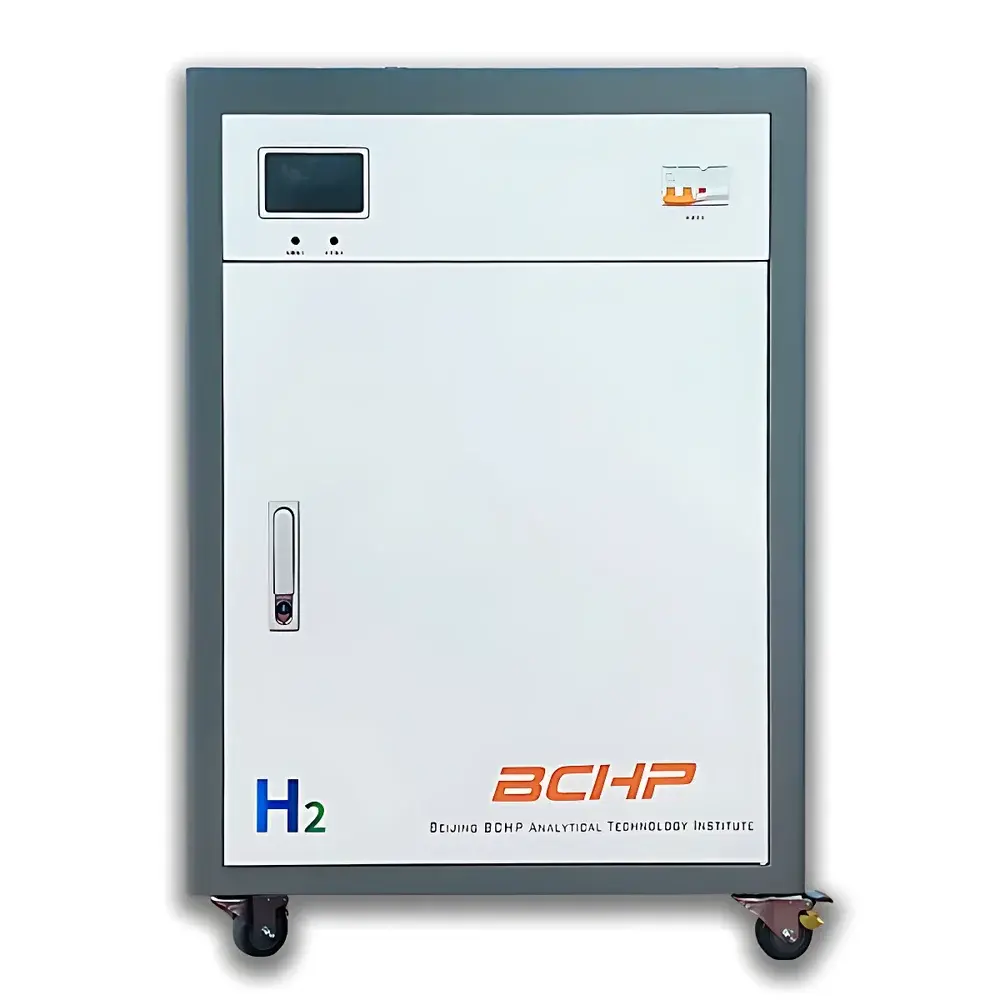
Hydrogen Generator TH-3000PSA
| Brand | Zhonghui Pu |
|---|---|
| Origin | Beijing, China |
| Manufacturer Type | Direct Manufacturer |
| Country of Origin | China |
| Model | TH-3000PSA |
| Hydrogen Generation Principle | Pure Water Electrolysis |
| Output Flow Rate | 0–3000 mL/min |
| Output Pressure | 0–0.4 MPa |
| Hydrogen Purity | 99.999% |
| Power Consumption | 2800 W |
| Operating Temperature | 1–40 °C |
| Relative Humidity | ≤85% RH |
| Input Voltage | 220 V ±10% |
| Dimensions (W×D×H) | 680 × 680 × 900 mm (height excludes casters) |
| Net Weight | ~105 kg |
| Certifications | CE-compliant |
Overview
The TH-3000PSA Hydrogen Generator is a high-capacity, on-demand laboratory-grade hydrogen source engineered for continuous, safe, and reliable operation in analytical instrumentation environments—particularly gas chromatography (GC), flame photometric detection (FPD), and nitrogen-phosphorus detection (NPD). It employs proton exchange membrane (PEM)-compatible solid polymer electrolyte (SPE) technology, utilizing deionized water as the sole consumable feedstock. Unlike traditional alkaline electrolysis systems, this design eliminates corrosive KOH solutions, significantly reducing maintenance burden and operator exposure risk. The core electrochemical process generates ultra-high-purity hydrogen (≥99.999%) with oxygen as the only byproduct, which is safely vented. Integrated pressure regulation and flow control ensure stable delivery across variable demand profiles—from idle standby to full 3000 mL/min output—while maintaining constant pressure (0–0.4 MPa) without external regulators or buffer tanks.
Key Features
- Solid polymer electrolyte (SPE) stack: Enables zero-alkali operation, corrosion-free electrolysis, and long-term electrode stability.
- Integrated oxygen scavenging system: Built-in low-sulfur catalytic oxygen removal module ensures consistent 99.999% H₂ purity without periodic activation or regeneration.
- Intelligent microcontroller-based control: Real-time monitoring of electrolyte level, temperature, pressure, and flow; automatic water replenishment, dry-run prevention, and over-flow shutdown.
- Advanced dual-stage drying: Combines imported desiccant media with pressure-swing adsorption (PSA) technology to deliver dew point ≤ –40 °C; typical service life exceeds 12 months under standard lab conditions.
- Low-sulfur internal wetted materials: All fluid-path components—including tubing, seals, and valves—are constructed from sulfur-free elastomers compatible with trace-sensitive detectors (e.g., NPD, FPD).
- CE-certified architecture: Complies with EN 61000-6-3 (EMC emission), EN 61000-6-1 (immunity), and EN 61010-1 (safety), supporting integration into GLP- and GMP-regulated laboratories.
Sample Compatibility & Compliance
The TH-3000PSA is designed for compatibility with all major GC manufacturers’ hydrogen-dependent detectors, including but not limited to Agilent, Thermo Fisher, Shimadzu, and PerkinElmer platforms. Its ultra-low sulfur and hydrocarbon content (<0.1 ppb total hydrocarbons, <0.5 ppb total sulfur) meets ASTM D7622 and ISO 8573-1 Class 1 requirements for instrument-grade hydrogen. The generator supports both single-instrument and centralized multi-point distribution via stainless steel or electropolished tubing networks. As a CE-marked device, it satisfies essential health and safety requirements for use within EU member states and aligns with U.S. OSHA 1910.101 guidelines for compressed gas generation equipment. No special ventilation or explosion-proof housing is required when installed per manufacturer instructions in well-ventilated laboratory spaces.
Software & Data Management
While the TH-3000PSA operates autonomously via embedded firmware, optional RS-232/RS-485 serial interface enables integration with laboratory information management systems (LIMS) or building automation platforms for remote status monitoring (flow, pressure, temperature, fault codes). Event logs—including startup/shutdown timestamps, alarm triggers (e.g., low-water, over-pressure), and cumulative runtime—are stored internally and retrievable via terminal command. Audit trail functionality supports compliance with FDA 21 CFR Part 11 where electronic records are mandated, provided the host LIMS implements appropriate user authentication and electronic signature controls. No proprietary software installation is required for basic operation.
Applications
- Carrier and fuel gas supply for capillary and packed-column GC systems.
- Hydrogen source for flame ionization detectors (FID), thermal conductivity detectors (TCD), and specialized detectors requiring ultra-high purity (e.g., pulsed discharge helium ionization).
- On-site hydrogen generation for portable GC-MS field deployments where cylinder logistics are prohibitive.
- Continuous feed for catalytic hydrogenation reactors in synthetic chemistry labs requiring precise stoichiometric control.
- Backup or primary hydrogen supply in central utility plants serving multiple analytical workstations.
FAQ
What type of water is required for operation?
Deionized water with resistivity ≥15 MΩ·cm and total organic carbon (TOC) < 50 ppb is mandatory. Tap water, distilled water, or reverse-osmosis-only water must not be used.
Does the unit require periodic maintenance beyond water refills?
Yes—annual inspection of the PSA dryer cartridge and electrolytic cell performance verification is recommended. Filter replacement is typically needed every 12–18 months depending on ambient humidity and usage frequency.
Can the TH-3000PSA be integrated into an existing hydrogen manifold system?
Yes—standard 1/4″ VCR or Swagelok fittings allow direct connection to stainless steel distribution lines. A pressure regulator and particulate filter should be installed upstream of end-use instruments.
Is hydrogen purity verified in real time?
No—purity is validated through factory-certified gas chromatographic analysis prior to shipment. In-line purity sensors are not included but can be added as a custom option upon request.
What safety interlocks are built into the system?
Five independent hardware-level safeguards: electrolyte level sensor, over-temperature cutoff, pressure relief valve (set at 0.45 MPa), flow-based dry-run detection, and automatic shutdown upon power interruption or communication failure.



