
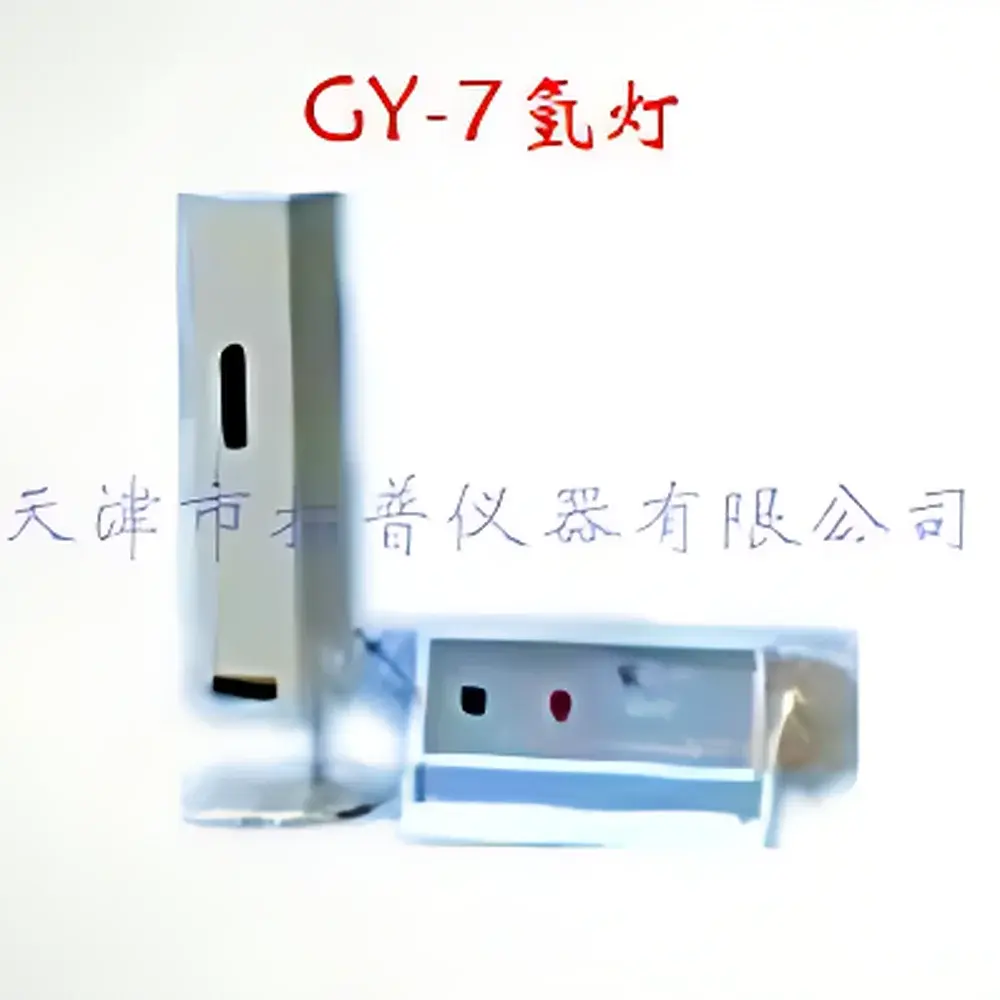
Hydrogen Lamp GY-7 by TOP (Tianjin)
| Brand | TOP (Tianjin) |
|---|---|
| Origin | Tianjin, China |
| Manufacturer Type | Direct Manufacturer |
| Product Origin | Domestic (China) |
| Model | GY-7 |
| Light Source Type | Atomic Emission Hydrogen Lamp |
| Illumination Mode | External Illumination Configuration |
| Spectral Output | Primary Balmer Series Lines (Hα: 656.3 nm, Hβ: 486.1 nm, Hγ: 434.0 nm, Hδ: 410.2 nm) |
| Operating Voltage | 5–12 V DC (typical) |
| Filament/Discharge Type | Low-pressure DC gas discharge lamp |
| Lifetime | ≥ 1,000 hours (under rated operating conditions) |
| Cooling | Passive air-cooled housing |
| Mounting | Standard M27×1 or SMA-compatible optical flange |
Overview
The TOP GY-7 Hydrogen Lamp is a precision-calibrated, low-pressure DC gas discharge lamp engineered for stable and reproducible atomic emission in the visible Balmer series. Designed specifically for metrological-grade optical instrumentation—including V-prism refractometers, Michelson and Fabry–Pérot interferometers, and wavelength calibration systems—the GY-7 delivers discrete, narrow-linewidth spectral output with high spectral purity and minimal continuum background. Its operation relies on controlled electron excitation of molecular hydrogen (H₂) within a sealed quartz envelope, resulting in characteristic line emission at 656.3 nm (Hα), 486.1 nm (Hβ), 434.0 nm (Hγ), and 410.2 nm (Hδ). Unlike broadband sources or filtered lamps, the GY-7 provides intrinsic wavelength traceability to atomic transitions defined by fundamental physical constants, making it suitable for applications requiring SI-traceable spectral references in academic, metrology, and R&D laboratories.
Key Features
- Stable DC discharge architecture ensuring consistent line intensity and minimal temporal drift (< ±0.5% over 30 min at thermal equilibrium)
- Quartz envelope with UV-transmissive grade fused silica (≥90% transmission from 185–700 nm) to preserve Balmer line fidelity
- Integrated current-regulated driver circuit (5–12 V DC input) optimized for low-noise operation and extended electrode life
- Mechanically robust housing with M27×1 threaded mounting interface for direct integration into optical benches and spectrometer alignment stages
- No external filters or monochromators required—line isolation achieved intrinsically via atomic emission physics
- Compliant with IEC 61000-6-3 (EMC emission limits) and RoHS Directive 2011/65/EU for hazardous substances
Sample Compatibility & Compliance
The GY-7 is compatible with standard optical components including collimating lenses (f = 50–200 mm), beam splitters (VIS-coated), and diffraction gratings (1200–2400 l/mm). It is routinely deployed in setups conforming to ISO 10110-5 (optical element surface imperfection specification) and ASTM E275 (standard practices for describing and measuring ultraviolet, visible, and near-infrared spectra). While not classified as a medical or industrial safety-critical device, its housing meets IP20 ingress protection rating for indoor laboratory environments. For GLP/GMP-aligned calibration workflows, the lamp’s spectral output can be validated using NIST-traceable reference photodiodes (e.g., Hamamatsu S1337 series) and calibrated spectroradiometers (e.g., Ocean Insight HDX with cosine corrector).
Software & Data Management
As a passive atomic light source, the GY-7 requires no embedded firmware or proprietary software. However, when integrated into automated optical test stations (e.g., motorized refractometer platforms or interferometric alignment rigs), its trigger and status signals can be synchronized via TTL-level control lines (optional add-on module). LabVIEW™, Python (with PyVISA), and MATLAB® instrument control toolboxes support direct interfacing with compatible power supplies. Audit trails for lamp usage duration, operating cycles, and thermal history may be logged externally via timestamped serial communication or analog voltage monitoring—fully compliant with FDA 21 CFR Part 11 requirements when implemented within validated system architectures.
Applications
- Wavelength calibration of spectroscopic instruments (e.g., CCD-based spectrometers, FTIR accessories)
- Refractive index measurement using V-prism refractometers per ISO 7884-2
- Fringe analysis in Michelson and Twyman–Green interferometers for optical path difference quantification
- Teaching laboratories: demonstration of Bohr atomic model, Rydberg formula verification, and quantum energy level transitions
- Verification of dispersion curves in prism and grating monochromators
- Reference source for optical flatness testing and surface figure evaluation using phase-shifting interferometry
FAQ
What is the typical warm-up time to achieve spectral stability?
Approximately 8–12 minutes after initial ignition, during which H₂ dissociation and plasma stabilization reach steady-state emission intensity.
Can the GY-7 be operated continuously for extended periods?
Yes—rated for continuous duty up to 8 hours per session; recommended duty cycle is ≤ 6 hours with ≥30-minute cooldown intervals to maximize electrode longevity.
Is the lamp compatible with vacuum or purged optical enclosures?
The standard GY-7 is designed for ambient air operation; optional vacuum-compatible variants (quartz-to-Kovar seal, bake-out rated to 150°C) are available upon request.
How is spectral line width characterized?
Full width at half maximum (FWHM) is ≤ 0.08 nm for Hβ under nominal current (80 mA), limited primarily by Doppler broadening and instrumental resolution—not lamp design.
Does TOP provide NIST-traceable calibration certificates?
Yes—certificates of spectral line position (±0.02 nm uncertainty) and relative intensity ratios (Hα:Hβ:Hγ ±3%) are available as an optional service, issued by an ILAC-MRA accredited calibration laboratory.




