
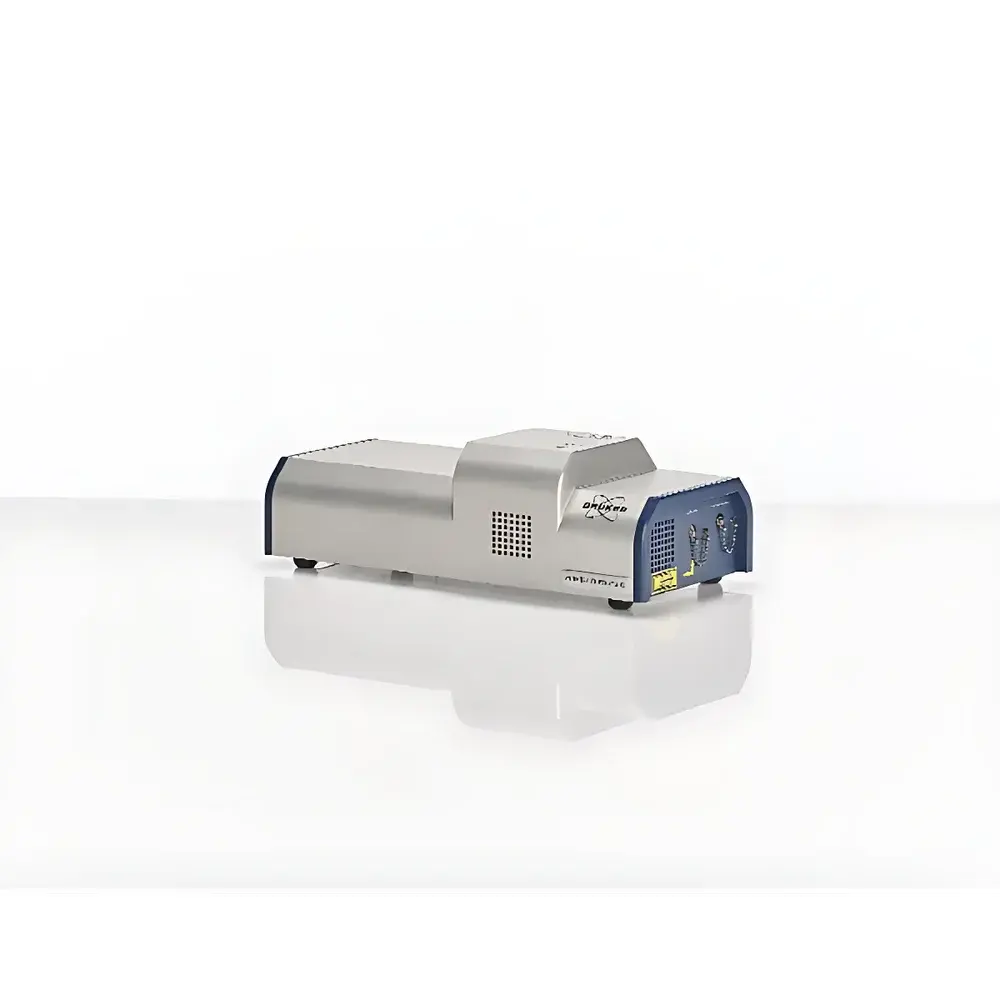
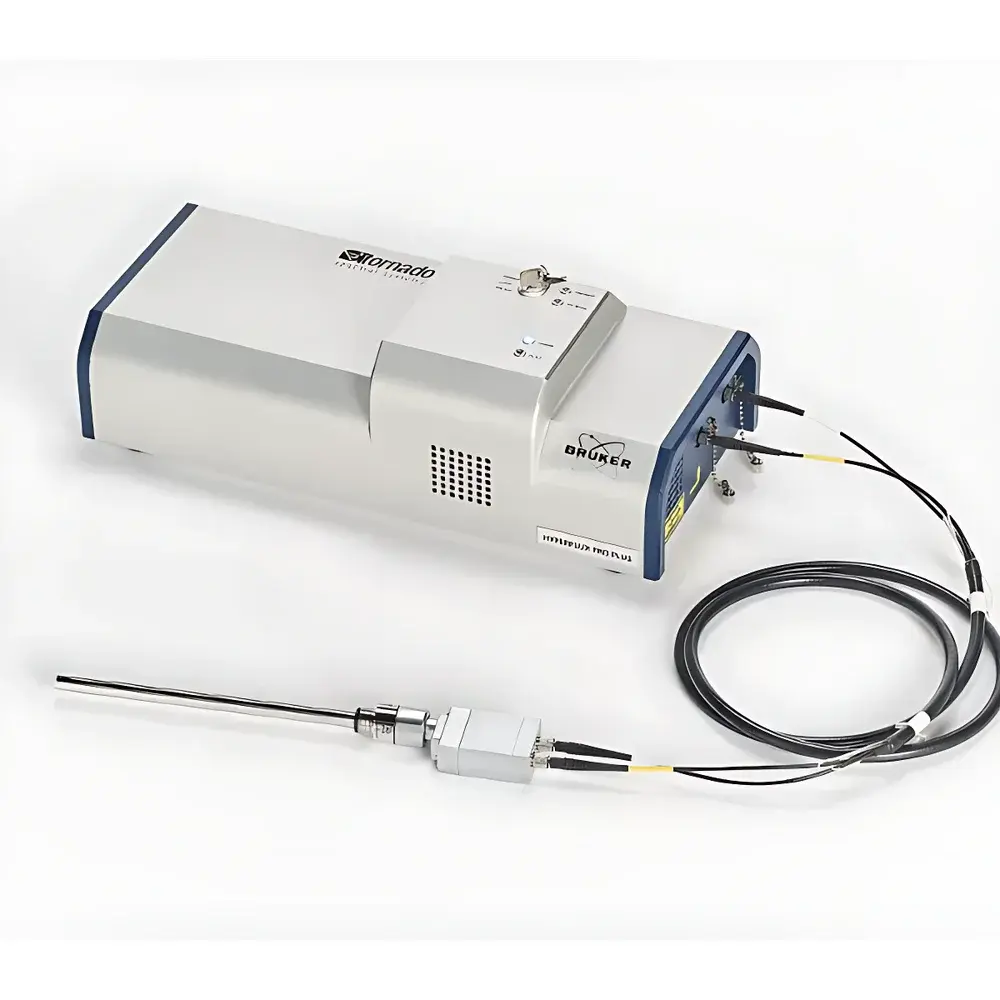
HyperFlux™ PRO Plus Online Raman Spectrometer by Bruker
| Brand | Bruker |
|---|---|
| Origin | Germany |
| Model | HyperFlux™ PRO Plus (HFPP) |
| Laser Wavelength | 785 nm |
| Safety | Integrated laser interlocks |
| Optical Architecture | HTVS™ (High-Throughput Virtual Slit) Technology |
| Spectral Resolution | High (maintained under high-throughput conditions) |
| Deployment | Benchtop & In-line Process Monitoring |
| Compliance | FDA 21 CFR Part 11, ATEX/IECEx for hazardous areas |
| Software | SpectralSoft™ v5.x |
Overview
The HyperFlux™ PRO Plus (HFPP) is a purpose-engineered online Raman spectrometer developed by Bruker for real-time, non-invasive molecular characterization in both laboratory and industrial process environments. Operating at a stabilized 785 nm excitation wavelength, the HFPP leverages resonance-suppressed Raman scattering to minimize fluorescence interference—particularly critical for pharmaceutical intermediates, polymer melts, aqueous solutions, and hydrocarbon streams. Its core optical innovation lies in the HTVS™ (High-Throughput Virtual Slit) architecture—a proprietary design that replaces conventional physical slits with a dynamically optimized virtual aperture, enabling >10× higher photon throughput without sacrificing spectral resolution. This architecture directly translates into improved signal-to-noise ratio (SNR), lower limits of detection (LOD), faster spectral acquisition (sub-second averaging), and enhanced reproducibility across extended measurement campaigns. The system is engineered for continuous duty in GMP-compliant manufacturing settings and supports seamless integration into distributed control systems (DCS) and SCADA platforms via OPC UA and Modbus TCP protocols.
Key Features
- Stabilized 785 nm diode laser with active temperature and current regulation for long-term spectral fidelity
- HTVS™ optical engine delivering >10× photon throughput versus conventional Czerny–Turner spectrometers while preserving <2 cm⁻¹ resolution (FWHM)
- Integrated hardware safety interlocks compliant with IEC 60825-1:2014 Class 1 laser product requirements
- Compact, vibration-insensitive benchtop form factor (<350 mm × 250 mm × 180 mm); suitable for mobile deployment or permanent in-line installation
- Modular fiber-coupled probe interface supporting multiple configurations: immersion, flow-cell, reflection, and explosion-proof (ATEX Zone 1 / IECEx Zone 1) variants
- No moving parts in the optical path—ensuring operational robustness and minimal maintenance over >50,000 hours MTBF
- Real-time spectral preprocessing: cosmic ray removal, dark current subtraction, and baseline correction executed on-board FPGA
Sample Compatibility & Compliance
The HFPP accommodates diverse sample states—including liquids, slurries, powders, gels, and semi-crystalline polymers—via interchangeable fiber-optic probes with configurable working distances (5 mm to 200 mm) and spot sizes (50 µm to 2 mm). It meets stringent regulatory expectations for process analytical technology (PAT) implementation: full audit trail, electronic signatures, and data integrity controls aligned with FDA 21 CFR Part 11, EU Annex 11, and ISPE GAMP 5. All firmware and SpectralSoft™ software modules undergo periodic verification per ASTM E2500-13 and ICH Q5A(R2) principles. System qualification packages (DQ/IQ/OQ/PQ) are available with documented traceability to NIST-traceable Raman standards (e.g., cyclohexane, silicon).
Software & Data Management
SpectralSoft™ v5.x provides an intuitive, role-based interface for method development, calibration model deployment, and multivariate analysis (PLS, PCA, SIMCA). It supports secure user authentication (LDAP/Active Directory), encrypted local database storage (SQLite with AES-256), and automated backup to network shares or cloud repositories (AWS S3, Azure Blob). All spectral acquisitions, processing steps, and operator actions are timestamped and logged with immutable audit trails. Calibration models built on one HFPP unit can be transferred to another with identical hardware configuration using standardized .calx file format—enabling consistent cross-site batch release decisions. Raw spectra are stored in open-format HDF5 containers compliant with ASTM E131-22 for long-term archival and third-party reanalysis.
Applications
- Real-time monitoring of API crystallization endpoints and polymorphic transitions in continuous manufacturing trains
- In-line quantification of blend uniformity in solid-dose production (per USP )
- Hydrocarbon composition analysis in refinery streams (e.g., olefin/paraffin ratios, sulfur speciation)
- Reaction progress tracking in catalytic hydrogenation and esterification processes
- Raw material identification and counterfeit detection at warehouse receiving docks
- Bioreactor monitoring of glucose, lactate, and viable cell density in mammalian cell culture
FAQ
Is the HyperFlux™ PRO Plus validated for GMP environments?
Yes. The system supports full computerized system validation (CSV) with documented test scripts, risk assessments (per ISO 14971), and traceability matrices linking requirements to test evidence.
Can calibration models developed offline be deployed directly to the online unit?
Yes—provided probe geometry, laser power, and integration time are matched; SpectralSoft™ includes model transfer diagnostics and residual error mapping.
What fiber optic probe options are certified for Zone 1 hazardous areas?
The EX-RP series (stainless steel armored, IP67-rated) with integrated intrinsically safe barrier (entity parameter compliance: Ui = 28 V, Ii = 93 mA, Pi = 0.65 W) is certified for ATEX II 2G Ex ib IIB T4 Gb and IECEx Ex ib IIB T4 Gb.
Does the system support remote diagnostics and firmware updates?
Yes—via secure TLS 1.2-enabled web interface; all updates require digital signature verification and rollback capability.
How is spectral drift compensated during extended unattended operation?
Automatic daily reference acquisition using an internal silicon standard (520.7 cm⁻¹ peak) triggers real-time wavenumber recalibration; optional external reference gas cells (e.g., neon) available for ultra-stable calibration.



