
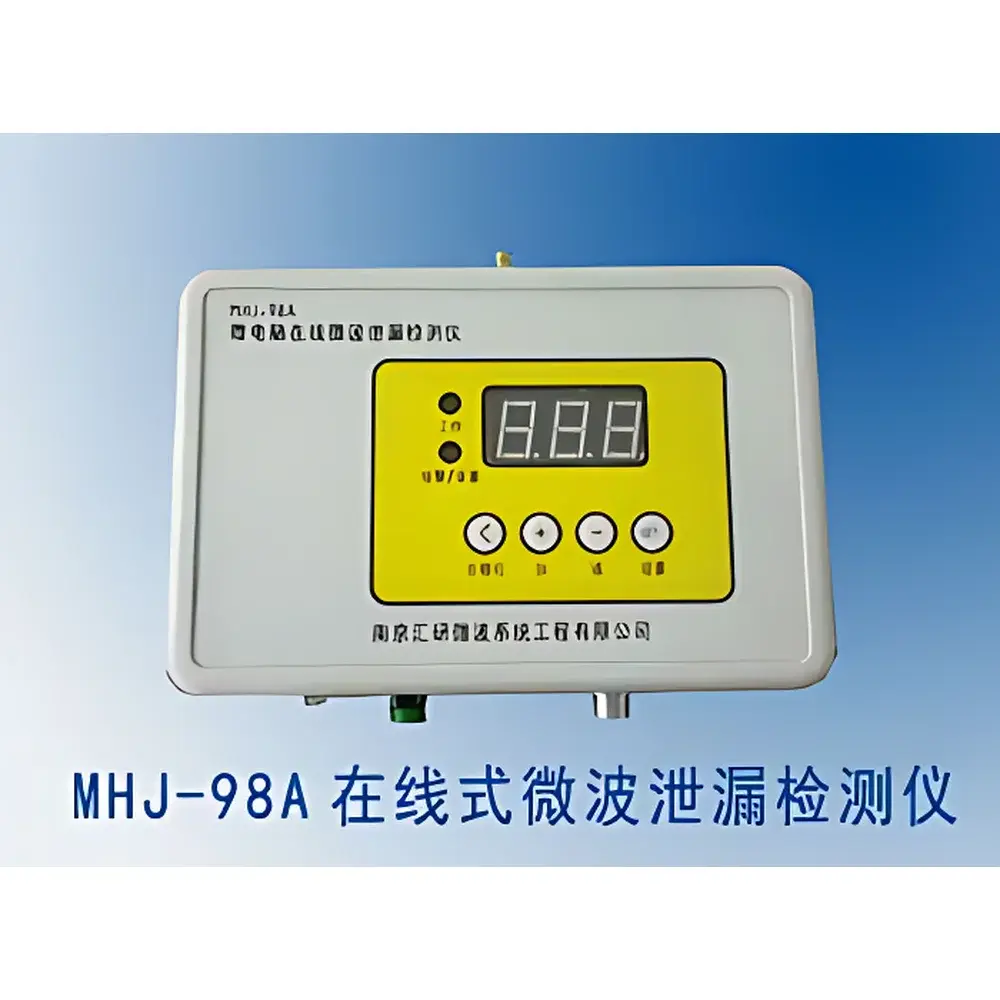
Hyundai MHJ-98A Microcomputer-Based Online Microwave Leakage Detector
| Brand | Hyundai |
|---|---|
| Model | MHJ-98A |
| Instrument Type | Microwave Power Density Meter (Continuous & Pulsed Wave) |
| Measurement Principle | Broadband Diode-Detector-Based RF Field Sensing |
| Frequency Range | 0.9–3 GHz |
| Power Density Range | 0.01–9.99 mW/cm² |
| Operating Temperature | −10 °C to +40 °C |
| Calibration Uncertainty | ±0.75 dB |
| Display | LED Digital, 3-digit |
| Analog Output | 0–5 V DC (proportional to measured power density) |
| Digital Switch Output | SPST, rated ≤24 V DC / 1 A |
| Overload Threshold | 100 mW/cm² (CW, non-destructive) |
| Housing | CNC-Machined Aluminum Alloy (EMC-Optimized) |
| Power Supply | Linear Regulated DC Input |
| Dimensions | 152 × 104 × 42 mm |
| Compliance | IEC 61000-4 Series (EMC Immunity), ISO/IEC 17025 Traceable Calibration Protocol Support |
Overview
The Hyundai MHJ-98A is a microprocessor-controlled, real-time microwave leakage detector engineered for continuous in-situ monitoring of electromagnetic field emissions from industrial and domestic microwave sources. It operates on the principle of broadband RF detection using a calibrated diode-based sensor head, converting incident microwave energy—whether continuous-wave (CW) or pulsed—into a proportional DC voltage signal. This analog output is digitized via a high-resolution ADC and displayed as average power density (mW/cm²) on a three-digit LED screen. Unlike broadband survey meters with limited dynamic range or frequency selectivity, the MHJ-98A integrates a U.S.-sourced microwave sensor chipset optimized for the 0.9–3 GHz band—the primary operating range of domestic microwave ovens (2.45 GHz), industrial heating systems, radar transmitters, and RF drying equipment. Its aluminum enclosure provides Class A EMC shielding performance per IEC 61000-4-3 and IEC 61000-4-6, ensuring stable operation in electrically noisy environments such as food processing lines, semiconductor cleanrooms, or R&D laboratories where adjacent RF sources may induce measurement drift.
Key Features
- Real-time digital readout of average power density (0.01–9.99 mW/cm²) with LED display and automatic zero-tracking algorithm
- Programmable alarm threshold across full scale; default factory setting at 5.00 mW/cm² per ICNIRP occupational exposure guidelines
- Dual-output interface architecture: isolated 0–5 V analog output (linear, ±1% FS accuracy) and galvanically decoupled switch output (SPST, 24 V DC / 1 A max)
- Onboard self-diagnostic routine at power-up, including sensor continuity check and baseline offset verification
- Linear regulated power supply design minimizing ripple-induced noise and thermal drift
- Rugged CNC-machined aluminum housing with EMI gasketing and IP54-rated front panel sealing
- Robust overload tolerance: withstands up to 100 mW/cm² CW exposure without sensor degradation or calibration shift
Sample Compatibility & Compliance
The MHJ-98A is validated for use with common microwave-emitting devices including domestic/commercial microwave ovens, industrial microwave dryers, plasma generators, and magnetron-based heating systems. Its sensor head exhibits flat frequency response across 0.9–3.0 GHz with <±0.75 dB deviation from NIST-traceable reference fields. While not a certified dosimeter per IEC 62209 or IEEE C95.3, it meets functional requirements for routine compliance screening under OSHA 1910.97 (RF Radiation Protection), FCC Part 18 (Industrial, Scientific, and Medical Equipment), and EN 50664 (Microwave Oven Leakage Testing). The instrument supports traceable calibration documentation aligned with ISO/IEC 17025 procedures when serviced by authorized calibration laboratories.
Software & Data Management
The MHJ-98A operates as a standalone hardware meter with no embedded firmware update capability or USB connectivity. However, its analog output (0–5 V) is fully compatible with third-party SCADA systems, PLCs (e.g., Siemens S7, Allen-Bradley CompactLogix), and data acquisition platforms (National Instruments DAQmx, LabVIEW-compatible modules). The switch output enables hardwired interlock integration—for example, triggering emergency shutdown of a microwave generator upon exceedance of user-defined limits. For auditability, all alarm events are logged locally via LED flash pattern coding (e.g., triple blink = sustained over-threshold condition >2 s), supporting GLP-aligned operational records when paired with external time-stamped logging.
Applications
- Preventive maintenance verification of microwave oven door seals and waveguide integrity in food service and manufacturing facilities
- Periodic safety audits of industrial microwave heating systems per corporate EHS protocols
- Commissioning validation of RF-shielded enclosures and anechoic chamber integrity
- In-line process monitoring in pharmaceutical lyophilization or chemical synthesis reactors utilizing microwave-assisted heating
- Field verification of regulatory compliance prior to facility inspections (FDA, EU HACCP, local health departments)
- Research-grade spatial mapping of near-field leakage patterns using manual probe scanning and external data capture
FAQ
What is the recommended calibration interval for the MHJ-98A?
Annual calibration against a NIST-traceable standard is advised for applications requiring regulatory compliance; semi-annual calibration is recommended in high-use industrial settings.
Can the MHJ-98A measure pulsed microwave signals accurately?
Yes—it computes true average power density for both CW and pulsed waveforms with duty cycles ≥1%, adhering to IEEE Std 1528-2013 averaging methodology.
Is the sensor head replaceable or field-calibratable?
The sensor module is sealed and non-user-serviceable; replacement requires return-to-factory recalibration to maintain ±0.75 dB traceability.
Does the instrument comply with FDA 21 CFR Part 11 for electronic records?
No—the MHJ-98A lacks audit trail, electronic signature, or secure data storage functionality; it serves as a measurement endpoint only.
What mounting options are available for permanent installation?
The chassis includes two M3 threaded inserts on the rear panel for DIN-rail adapter brackets or custom bracketing; no wall-mount kit is supplied standard.
Related Products







