
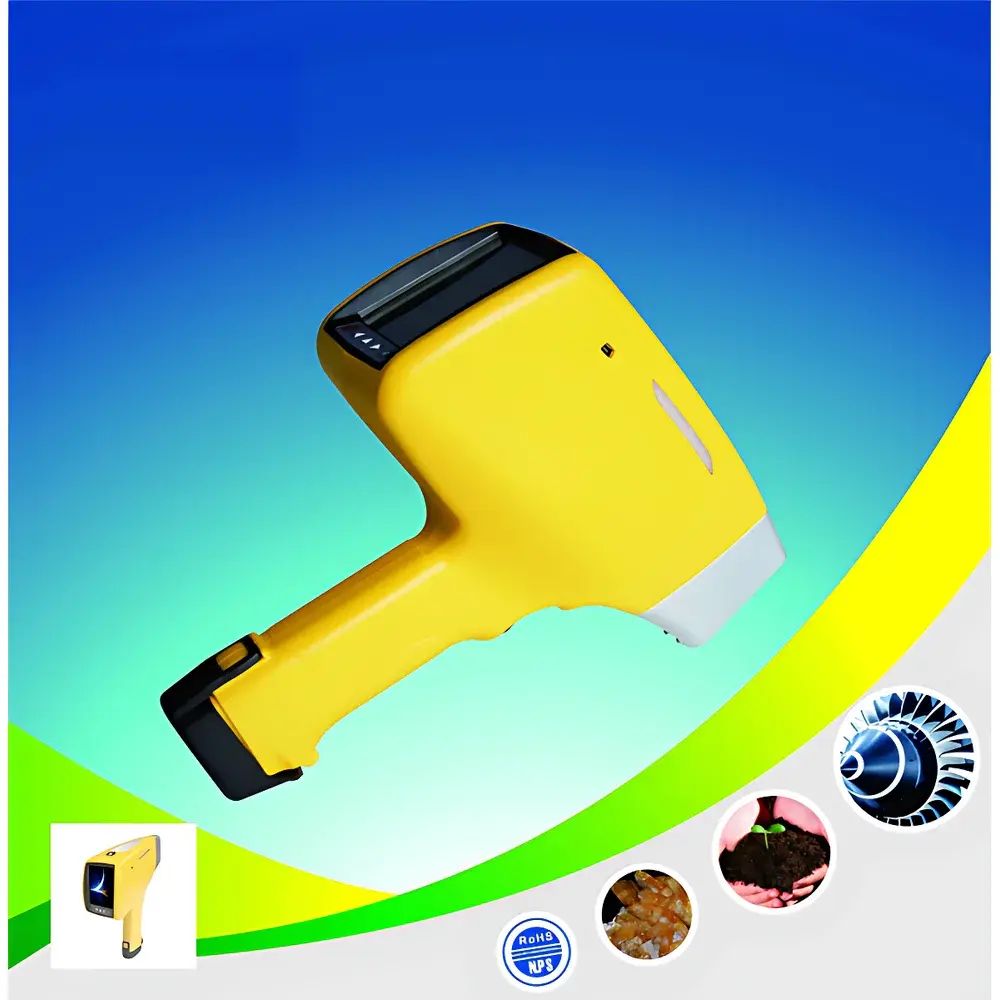

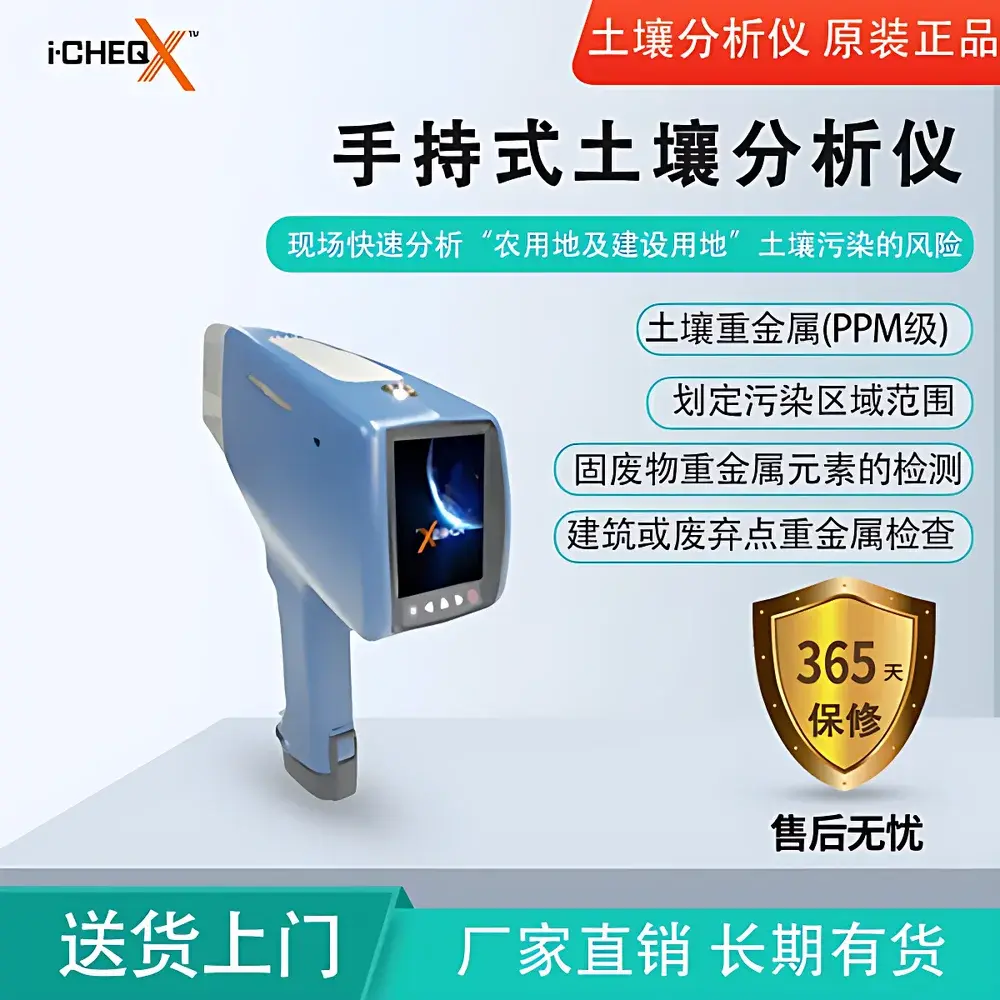
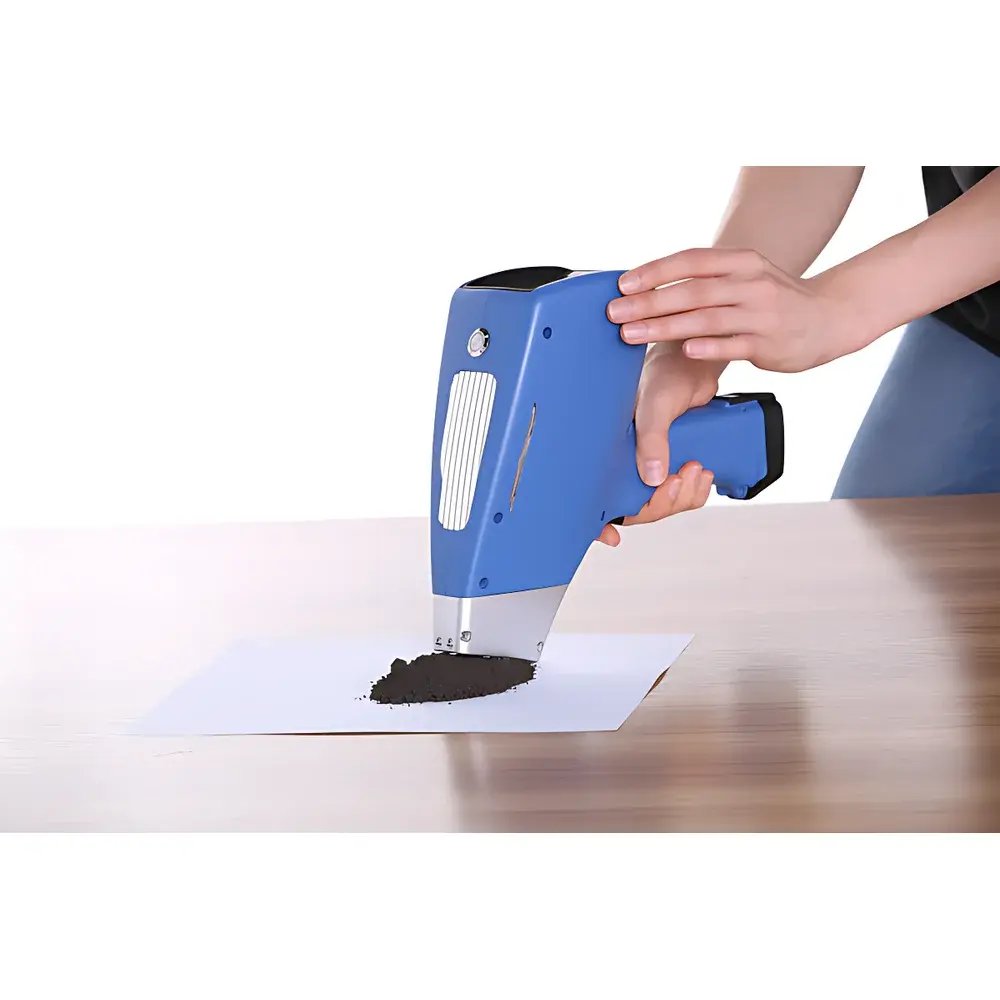
I-CHEQ F2-9000 Handheld Energy Dispersive X-Ray Fluorescence (ED-XRF) Spectrometer for Soil and Environmental Analysis
| Brand | I-CHEQ |
|---|---|
| Origin | USA |
| Model | F2-9000 |
| Application | Handheld/Field-Portable |
| Element Range | Mg–Pu |
| Detection Range | 1 ppm – 99.99% |
| Energy Resolution | 120–140 eV |
| Repeatability | 0.1% |
| Detector | High-Resolution Silicon Drift Detector (SDD) |
| Excitation Source | Variable-Voltage (up to 50 kV) Microfocus X-ray Tube with Selectable Anode Materials (Au, Ag, W, Ta, Pd) |
| Cooling | Peltier Semiconductor |
| Operating System | Windows CE |
| Display | Industrial-Grade TFT Color Touchscreen |
| Dimensions (L×W×H) | 233 × 84 × 261 mm |
| Weight (with battery) | 1.46 kg |
| Compliance | Meets IEC 61000-6-3 (EMC), IEC 61000-6-2, ANSI N43.3, and FDA 21 CFR Part 1020.40 for X-ray safety |
Overview
The I-CHEQ F2-9000 is a field-deployable, handheld energy dispersive X-ray fluorescence (ED-XRF) spectrometer engineered for rapid, non-destructive elemental analysis of soil, sediment, dust, and atmospheric particulates in situ. Based on the fundamental principle of X-ray fluorescence—where primary X-rays eject inner-shell electrons from sample atoms, inducing characteristic secondary (fluorescent) X-ray emission—the F2-9000 quantifies elemental composition by measuring the energy and intensity of emitted photons. Its high-resolution silicon drift detector (SDD), coupled with a variable-kV microfocus X-ray tube and intelligent anode/filter selection, enables precise excitation and detection across the Mg–Pu range (atomic number 12–94). Designed for environmental monitoring, regulatory compliance screening (e.g., EPA Method 6200, ISO 12847), and geochemical field surveys, the instrument delivers laboratory-grade data without sample preparation or transport delays.
Key Features
- Ultra-portable architecture: Weighing only 1.46 kg with integrated battery, featuring ergonomic tapered nose geometry for access to confined sampling locations including soil cores, trench walls, and filter media.
- Advanced excitation control: 50 kV microfocus X-ray tube with five selectable anode materials (Au, Ag, W, Ta, Pd) and programmable multi-stage filters—automatically optimized per measurement to maximize signal-to-background for light elements (Mg–P) and heavy metals (Pb, As, Cd, Hg).
- High-fidelity detection: Cryogen-free Peltier-cooled SDD delivering ≤140 eV Mn Kα resolution at 0°C, ensuring robust peak separation for overlapping transitions (e.g., Pb L-lines vs. As K-lines) in complex matrices.
- Ruggedized industrial design: IP54-rated enclosure with shock-absorbing polymer overmold, reinforced aluminum chassis (1/3 structural mass), and anti-reflective, glove-compatible TFT touchscreen operable under direct sunlight or low-temperature conditions (−10°C to +50°C).
- Intelligent operational safeguards: Real-time beam gating with 2-second auto-shutoff when no sample is detected; hardware-enforced dose limits compliant with IEC 62495; automatic atmospheric pressure compensation for altitude-invariant quantification.
- Extended field endurance: Dual 6800 mAh Li-ion batteries support >8 hours continuous operation; ultra-low-power standby mode disables X-ray tube and detector during idle periods while retaining full system state.
Sample Compatibility & Compliance
The F2-9000 is validated for direct analysis of heterogeneous, unprepared solid matrices—including moist soils, clay-rich sediments, airborne particulate filters (e.g., Teflon® or quartz fiber), and surface-contaminated concrete or asphalt. Its shallow penetration depth (~20–50 µm for mid-Z elements) ensures surface-sensitive measurement critical for contamination mapping and leaching risk assessment. The instrument meets international regulatory requirements for field screening: it supports ASTM D7707 (XRF analysis of soil lead), EPA SW-846 Method 6200 (field portable XRF), and ISO 12847 (soil quality — determination of trace elements by ED-XRF). All firmware and calibration routines are traceable to NIST SRM standards (e.g., 2710a, 2711a), and audit trails comply with GLP/GMP documentation expectations per 21 CFR Part 11 when used with optional secure software modules.
Software & Data Management
Running on a hardened Windows CE platform, the F2-9000 executes Alloy Plus 3.0 analytical software—built upon a mature fundamental parameters (FP) algorithm refined over a decade of environmental applications. Core spectral processing includes adaptive background subtraction, escape peak correction, sum peak deconvolution, and peak overlap factor modeling to resolve interferences common in soil spectra (e.g., Ti Kβ/Sr Kα, Zn Kα/Pb Lα). Data management supports USB 2.0, Bluetooth 4.2, and Wi-Fi hotspot export to networked PCs or cloud platforms. Internal SD card storage accommodates >200,000 spectra with full metadata (GPS, time stamp, operator ID, atmospheric pressure, tube settings). Customizable reporting exports directly to Excel-compatible .csv or PDF formats, including annotated spectra, calibration curves, and statistical summaries (RSD, confidence intervals). Users may define application-specific calibrations using certified reference materials (CRMs) and maintain proprietary grade libraries.
Applications
- Regulatory soil screening: Rapid identification and quantification of priority pollutants (As, Cd, Cr, Cu, Ni, Pb, Zn, Hg) against local action levels (e.g., EU Soil Thematic Strategy, China GB 15618-2018).
- Environmental site assessment: On-site delineation of contamination plumes during Phase II investigations; real-time decision-making for excavation boundaries and composite sampling strategies.
- Agricultural land monitoring: Mapping micronutrient distribution (Fe, Mn, Zn, Cu) and heavy metal accumulation in farmland; supporting precision fertilization and phytoremediation planning.
- Atmospheric deposition studies: Quantitative analysis of PM10/PM2.5 filter samples for crustal (Al, Si, Ca) and anthropogenic (V, Ni, Zn, Pb) tracers.
- Archaeological and geological surveying: In-field characterization of soil stratigraphy, pottery provenance, and mineralogical weathering indices without destructive sampling.
FAQ
What regulatory methods does the F2-9000 support for soil testing?
The instrument is method-validated for EPA Method 6200, ASTM D7707, and ISO 12847, with documented performance metrics for accuracy, precision, and detection limits across target elements.
Can the F2-9000 analyze light elements such as magnesium and aluminum in high-moisture soils?
Yes—its optimized vacuum path (optional), low-noise SDD, and tailored excitation/filtration protocols enable reliable Mg–P quantification even in wet, organic-rich matrices when combined with moisture-correction algorithms.
Is spectral data export compliant with LIMS integration requirements?
All exported .csv and XML files include structured metadata fields (sample ID, coordinates, instrument serial, calibration version), enabling seamless ingestion into laboratory information management systems (LIMS) and GIS platforms.
How is calibration maintained in variable field conditions?
The system performs automatic pressure-based matrix correction and includes built-in verification using alloy check standards; users may also deploy site-specific empirical calibrations traceable to CRMs.
Does the F2-9000 meet radiation safety standards for daily field use?
Yes—it complies with ANSI N43.3 and IEC 62495 for handheld XRF devices, featuring redundant hardware interlocks, real-time dose rate monitoring, and Type A shielding certification verified by third-party dosimetry.
Related Products






