
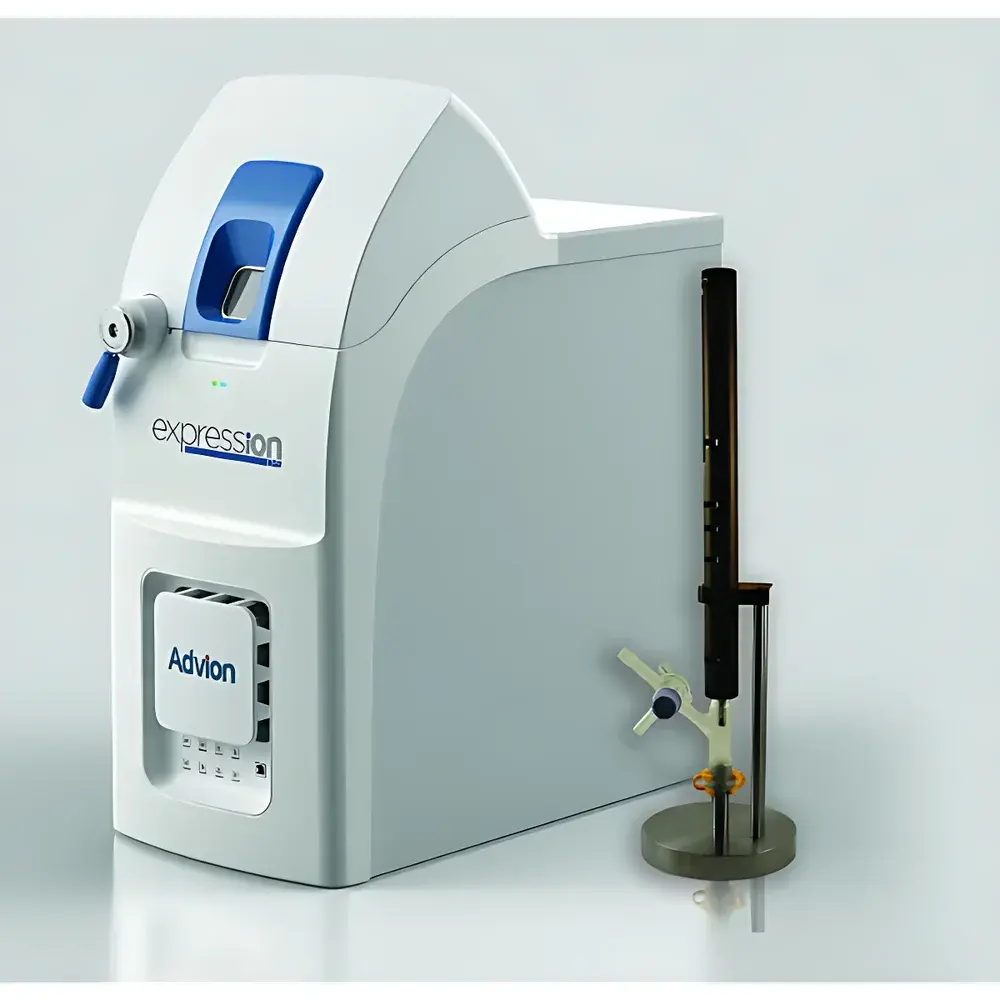
iASAP Inert Gas Atmospheric Pressure Solid Analysis Probe
| Brand | Advion Interchim Scientific |
|---|---|
| Origin | USA |
| Manufacturer Type | Authorized Distributor |
| Product Category | Imported Instrument |
| Model | iASAP Inert Gas Atmospheric Pressure Solid Analysis Probe |
| Instrument Type | APCI Ion Source |
| Application Scope | General-Purpose |
| Mass Range | 10–2000 m/z |
| Sensitivity | S/N ≥ 100:1 (1 pg reserpine) |
| Resolution | 0.5–0.85 m/z (FWHM) |
| Mass Accuracy | ±0.1 Da |
| Compliance | Compatible with Advion expression® CMS and compact CMS platforms |
Overview
The iASAP Inert Gas Atmospheric Pressure Solid Analysis Probe is an advanced ambient ionization source engineered for direct, real-time mass spectrometric analysis of air-sensitive solid and liquid samples under inert atmospheric conditions. Built upon the proven ASAP (Atmospheric Solids Analysis Probe) principle—where thermal desorption couples with atmospheric pressure chemical ionization (APCI)—the iASAP variant integrates a sealed, argon- or nitrogen-purged sample introduction pathway to maintain strict oxygen- and moisture-free environments throughout the entire sampling-to-ionization sequence. This architecture enables reliable characterization of highly reactive species—including transition metal catalysts, organometallic complexes, radical intermediates, and pyrophoric reagents—without exposure to ambient air. Unlike conventional ESI or MALDI sources requiring solvent dissolution or matrix crystallization, the iASAP probe operates without derivatization, extraction, or chromatographic separation, delivering spectral data within seconds of probe insertion.
Key Features
- Inert gas manifold integrated into probe housing, supporting continuous purging with high-purity N₂ or Ar (≤1 ppm O₂/H₂O) during sample loading, heating, and ion transfer
- Modular design compatible with Advion expression® CMS and compact CMS benchtop mass spectrometers via standard APCI interface
- Programmable temperature ramping (ambient to 400 °C) with sub-5 °C thermal stability for controlled desorption of thermally labile compounds
- Direct coupling to reaction vessels: probe tip accommodates vials, Schlenk tubes, and glovebox-integrated sample holders for in-situ monitoring
- Low dead-volume transfer line minimizes analyte dispersion and preserves signal integrity across the full 10–2000 m/z range
- Robust ceramic-heated capillary ensures consistent ion transmission and resistance to corrosion from halogenated or sulfur-containing species
Sample Compatibility & Compliance
The iASAP probe supports solids (crystalline powders, thin films, heterogeneous catalysts), viscous liquids (reaction mixtures, slurries), and semi-solids (gels, polymer melts) without prior dilution or filtration. It is routinely employed in synthetic organic, organometallic, and catalysis laboratories where sample integrity under inert conditions is critical. The system complies with GLP-aligned workflows: all method parameters (temperature profile, gas flow rate, dwell time) are logged with timestamps and user IDs in instrument control software. Data acquisition adheres to FDA 21 CFR Part 11 requirements when deployed with validated Advion CMS software versions supporting electronic signatures and audit trails.
Software & Data Management
Controlled via Advion’s proprietary CMS Software Suite (v3.2+), the iASAP probe supports automated method sequencing, real-time spectral preview, and batch processing of time-resolved datasets. Raw data files (.raw) are stored in vendor-neutral mzML format for third-party processing (e.g., MZmine, XCMS). Quantitative workflows leverage internal standard calibration curves generated from replicate injections under identical inert gas flow and thermal desorption conditions. Spectral libraries (NIST, Wiley, custom organometallic databases) are searchable with mass tolerance settings adjustable down to ±0.05 Da for high-confidence annotation.
Applications
- Real-time monitoring of cross-coupling reactions (Suzuki, Heck, Buchwald–Hartwig) inside gloveboxes
- Rapid screening of catalyst decomposition pathways and ligand dissociation kinetics
- Identification of transient metallacyclic intermediates in C–H activation studies
- Quality assessment of air-sensitive pharmaceutical intermediates (e.g., Grignard-derived APIs)
- Surface analysis of supported metal nanoparticles without solvent-induced leaching
- High-throughput verification of cryo- or low-temperature synthesis outcomes
FAQ
What inert gases are compatible with the iASAP probe?
High-purity nitrogen (99.999%) or argon (99.998%) is recommended; helium is not advised due to its high diffusivity and potential interference with APCI plasma stability.
Can the probe be used with non-Advion mass spectrometers?
No—it is mechanically and electrically optimized exclusively for Advion expression® and compact CMS platforms with native APCI interface specifications.
Is vacuum lockout required during probe insertion?
No. The probe operates at atmospheric pressure; no venting or pump-down cycles are needed before or after sample introduction.
How is calibration performed for mass accuracy?
Calibration uses dual-point tuning with sodium formate cluster ions (m/z 69, 139, 209) under identical inert gas flow and temperature conditions as sample analysis.
What maintenance intervals are recommended?
Capillary cleaning every 50–100 analyses using methanol/acetone sonication; ceramic heater inspection every 6 months or after exposure to corrosive halogenated compounds.





