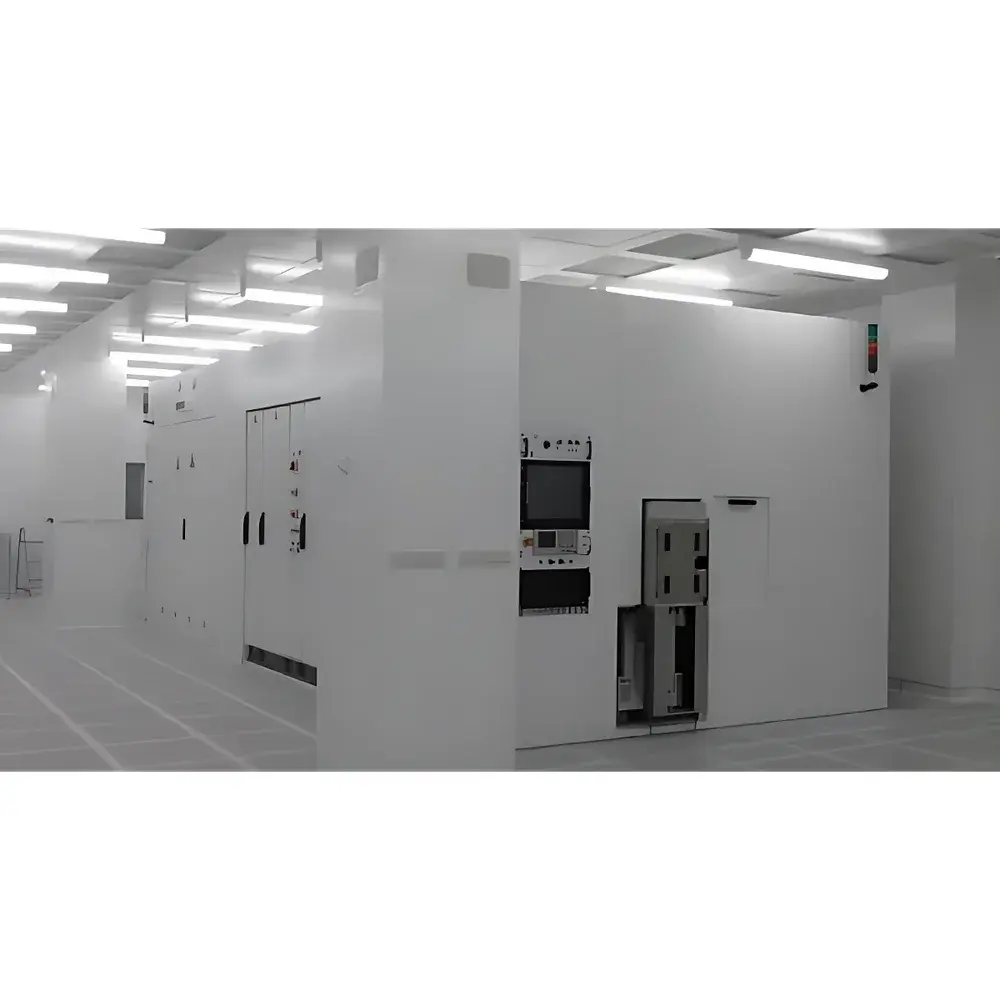
IBS IMC210 Medium-Current Ion Implanter
| Brand | IBS |
|---|---|
| Origin | France |
| Model | IMC210 |
| Product Type | Medium-Current Ion Implanter |
| Application Domain | IC Fabrication & Semiconductor Doping |
| Implant Energy | 50 keV (adjustable 20–200 keV, upgradable to 3 keV or 400/600 keV for multiply charged ions) |
| Wafer Size Compatibility | 8-inch and 12-inch wafers (backward-compatible with 6-inch, 2–5-inch, and irregular substrates down to 1 cm²) |
| Implant Species | p⁺ (e.g., ¹¹B, ³¹P, ⁷⁵As), Al⁺, H⁺, N⁺, He⁺, Ar⁺ |
| Beam Current | >600 µA (¹¹B⁺), >1500 µA (³¹P⁺ or ⁷⁵As⁺) at 120–200 keV |
| Dose Range | 1×10¹¹ – 1×10¹⁸ atoms/cm² |
| Uniformity | <1.0% 1σ (measured on 6″ Si wafers with 100 nm SiO₂, ¹¹B⁺ at 100 keV, 1×10¹⁴ atoms/cm²) |
| Vacuum | Ion source <2×10⁻⁶ mbar |
| Gas Delivery | Integrated 5-channel system (BF₃, PH₃, AsH₃, Ar, N₂) with real-time gas consumption monitoring and cylinder endpoint detection |
Overview
The IBS IMC210 is a medium-current ion implanter engineered for precision dopant introduction in semiconductor manufacturing and advanced materials research. Developed by IBS INFORMATION—a French company founded in 1987 with deep roots in defense-derived plasma and beam physics—the IMC210 employs electrostatic mass separation and magnetic steering to deliver high-fidelity, energy-resolved ion beams onto planar and non-planar substrates. Its core architecture follows the conventional single-ended, serial implantation paradigm optimized for wafer-level processing, distinguishing it from immersion-type pulsed plasma systems (e.g., PULSION series). The instrument operates on the principle of accelerating extracted ions through precisely controlled electrostatic potentials, followed by mass analysis via a 90° magnetic sector and final focusing onto the target using electrostatic lenses. This ensures atomic-species selectivity, repeatable dose delivery, and compatibility with standard cleanroom integration protocols.
Key Features
- Electrostatic-magnetic hybrid mass analyzer delivering high isotopic purity and minimal beam contamination
- Adjustable implant energy range from 20 keV to 200 keV (with optional upgrades supporting 3 keV low-energy operation or 400/600 keV for doubly/triply charged species)
- Dual-angle mechanical stage enabling fixed-angle implantation at 0° and 7°, with manual fixture exchange supporting configurable tilt up to ±45°
- Integrated vacuum architecture: chemical dry pumps for roughing, turbo-molecular pumps for ion source, and cryogenic pumps for beamline and target chamber—ensuring stable ultra-high vacuum (<7×10⁻⁷ mbar) critical for beam transmission and process reproducibility
- Onboard five-gas delivery system (BF₃, PH₃, AsH₃, Ar, N₂) featuring closed-loop flow control, real-time gas usage logging, and automated cylinder endpoint detection to minimize downtime and ensure regulatory traceability
- Modular software framework compliant with industrial automation standards, supporting role-based access control (RBAC), audit-trail-enabled parameter logging, and full recipe versioning
Sample Compatibility & Compliance
The IMC210 supports 8-inch and 12-inch silicon wafers as standard, while retaining backward compatibility with 6-inch, 2–5-inch, and irregular-shaped substrates—including discrete chips and microfabricated test structures as small as 1 cm². Substrate heating and cooling are not integrated, making the system suitable for room-temperature or externally temperature-controlled processes. All vacuum and gas subsystems conform to ISO 27427 (vacuum safety) and SEMI S2/S8 (equipment safety and ergonomics). Software operations comply with FDA 21 CFR Part 11 requirements for electronic records and signatures when configured with audit trail, electronic signature, and user authentication modules. The system meets GLP/GMP documentation expectations for process validation in semiconductor pilot lines and R&D labs.
Software & Data Management
The embedded control software provides three operational modes: Manual (for diagnostics and beam tuning), Engineering (step-by-step process execution with real-time override), and Automatic (fully sequenced recipe-driven runs). Each mode enforces hierarchical user permissions—administrators, engineers, and operators—with session-specific logins and encrypted credential storage. All process parameters—including beam current, energy, dose, angle, gas flows, and vacuum readings—are timestamped and stored in a relational database with configurable retention policies. Alarm events trigger automatic email/SNMP notifications and generate structured CSV reports compatible with MES (Manufacturing Execution Systems) and LIMS (Laboratory Information Management Systems). Firmware and GUI updates are delivered via secure HTTPS channels and validated using SHA-256 checksums.
Applications
The IMC210 serves as a production-capable tool for shallow junction formation, well doping, and channel engineering in CMOS, power devices, and MEMS fabrication. It is routinely deployed for boron, phosphorus, and arsenic implantation into silicon, silicon carbide, and gallium nitride substrates. Beyond mainstream IC applications, it supports specialized research workflows including: ion-induced defect engineering for quantum memory hosts; controlled hydrogen implantation for layer splitting (Smart Cut™); and dopant profiling studies requiring sub-10 nm depth resolution via secondary ion mass spectrometry (SIMS) calibration. Its beam stability and dose repeatability (<±0.5% RSD over 100 wafers) make it suitable for DOE (Design of Experiments) campaigns under ISO/IEC 17025-accredited laboratories.
FAQ
Does the IMC210 support multi-energy or multi-species implantation in a single vacuum cycle?
No—it performs sequential single-species, single-energy implants per chamber pump-down. Multi-step recipes require automated reconfiguration between steps but maintain vacuum integrity across beamline segments.
Is remote diagnostics and predictive maintenance supported?
Yes—via optional OPC UA server integration, enabling real-time telemetry export to SCADA platforms and third-party condition-monitoring tools.
What vacuum certifications accompany the system?
Each unit ships with a full vacuum performance report, including base pressure measurements per chamber segment, leak-check logs (helium mass spec), and pump-down time validation per SEMI E10.
Can the system be integrated into a Class 100 cleanroom environment?
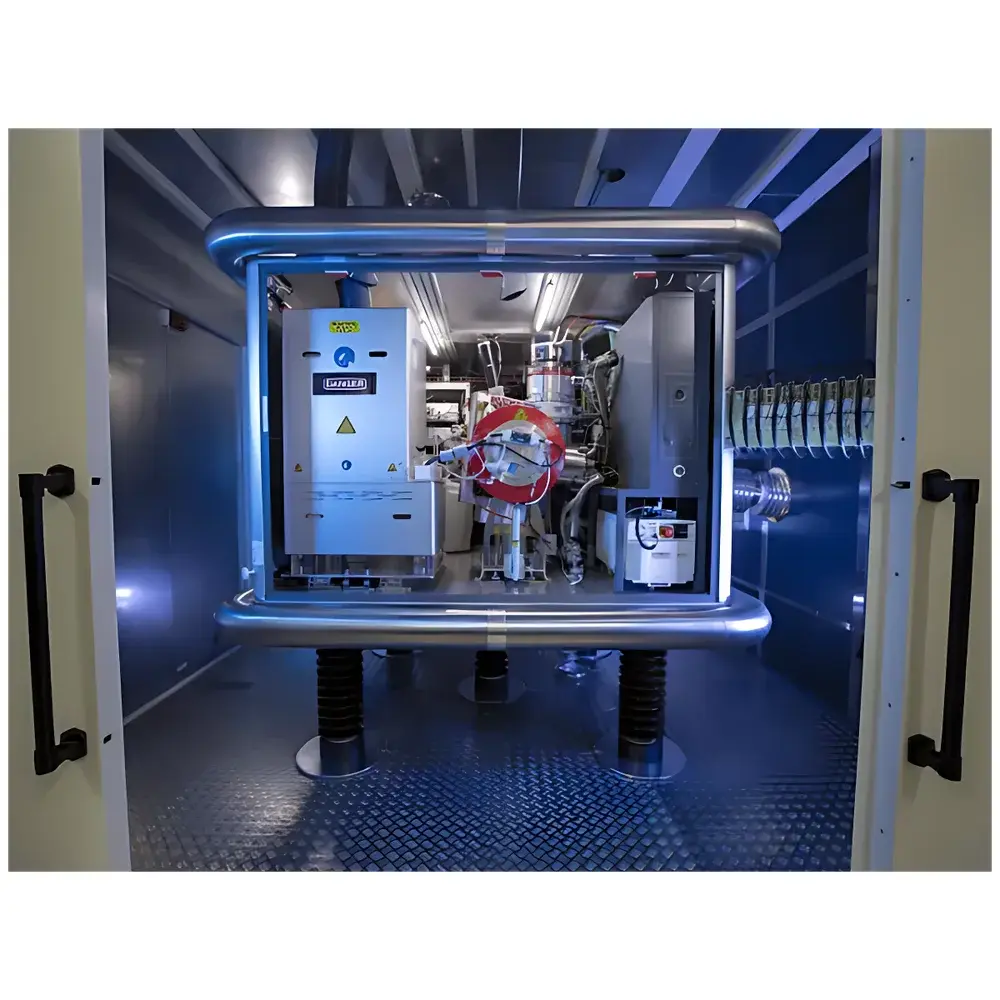
Yes—its footprint (1.6 × 2.15 × 2.3 m) and vibration-isolated mounting design meet ISO 14644-1 Class 5 specifications when installed on appropriate floor foundations.
Are service contracts and spare parts available outside the EU?
IBS maintains authorized service partners in North America, Japan, Korea, and Singapore, with global spares logistics managed through ISO 9001-certified distribution hubs.