
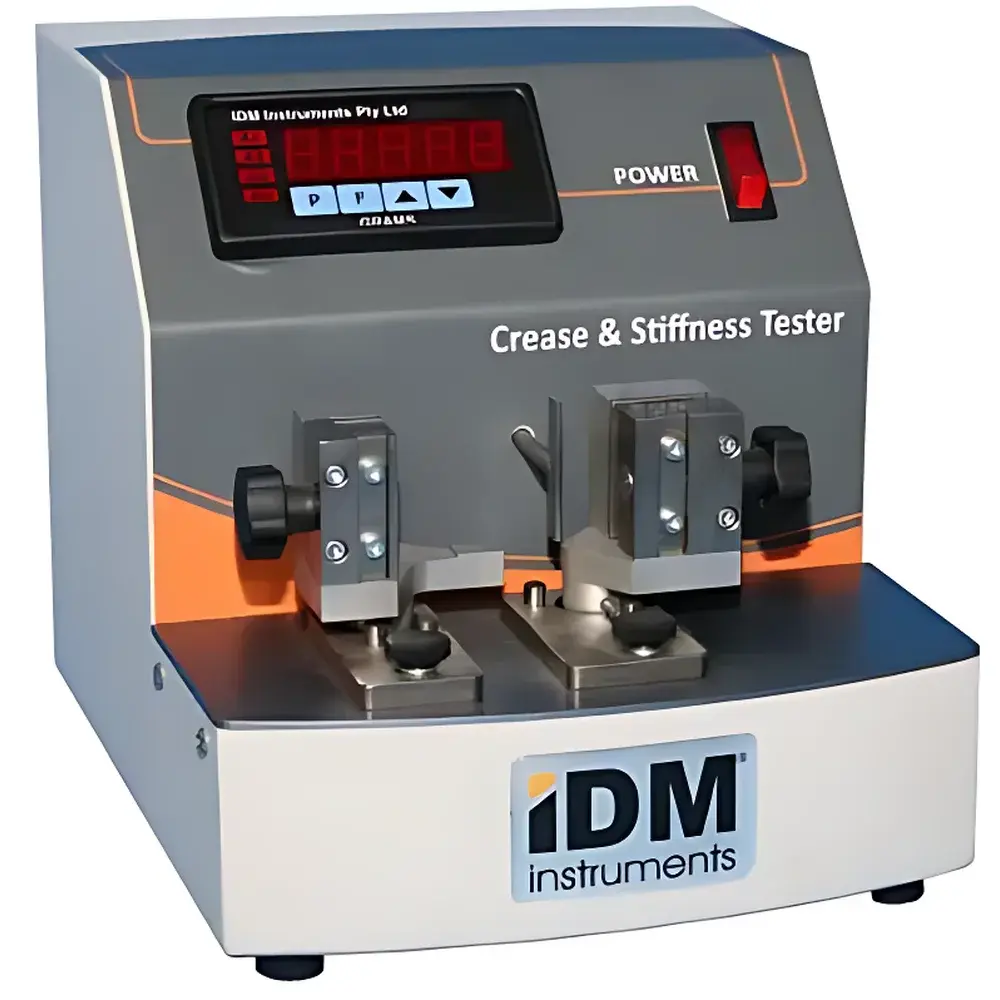
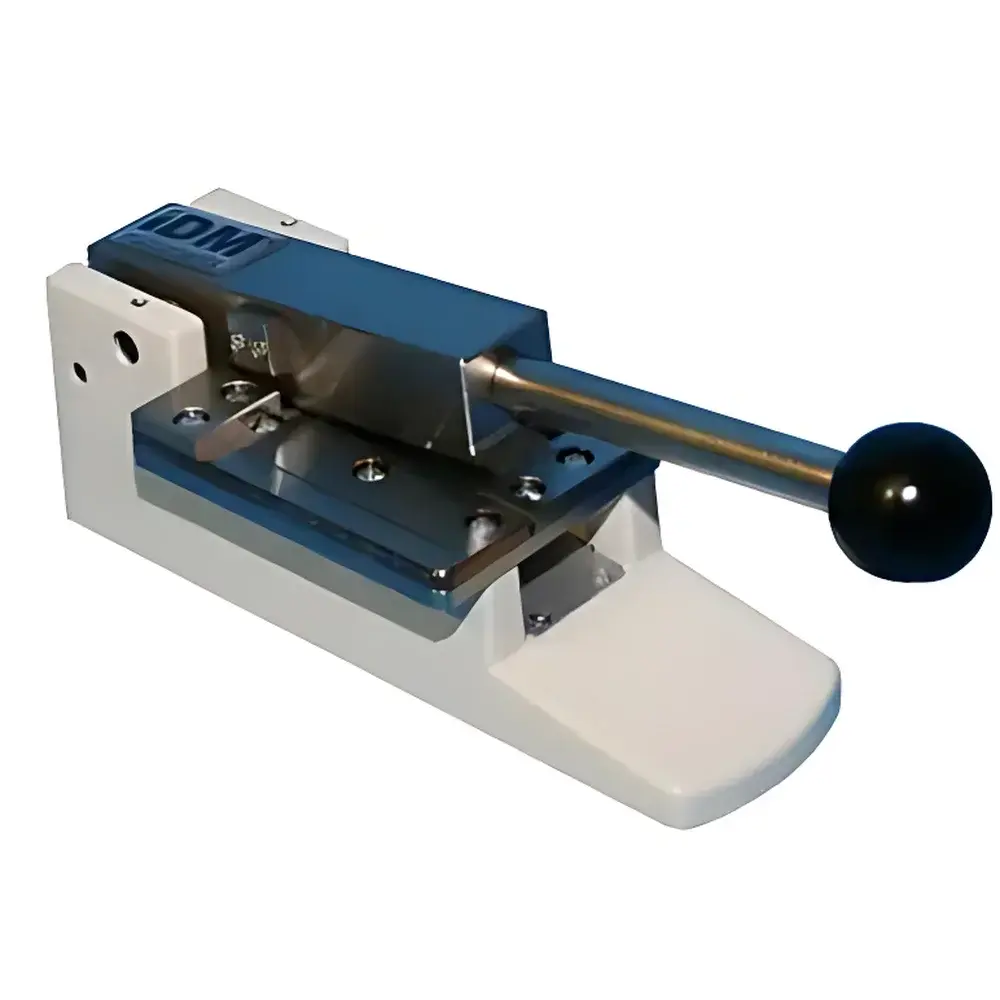
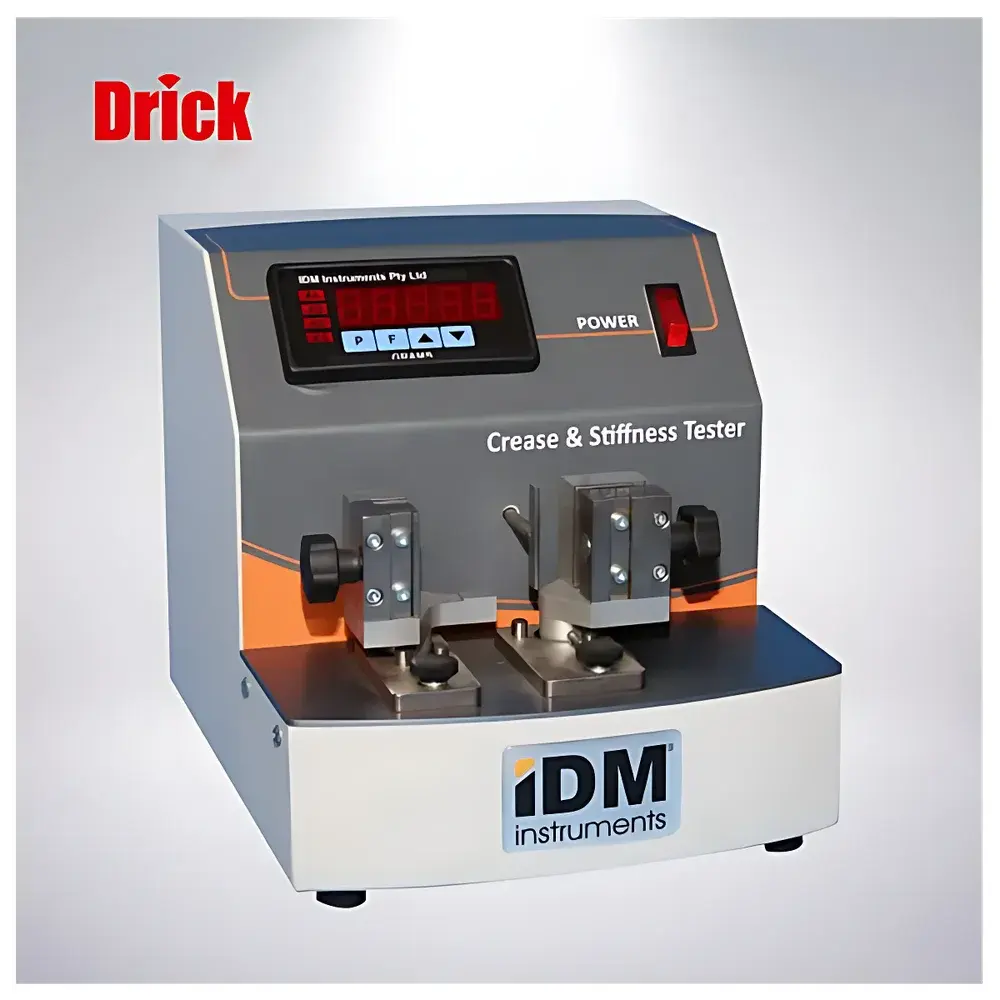
IDM C0038 Crease Stiffness Tester
| Brand | IDM |
|---|---|
| Origin | New Zealand |
| Model | C0038 |
| Measurement Range | 0–1000 gf |
| Resolution | 0.5 g |
| Bending Angle | 90° (crease recovery), 15° (board stiffness) |
| Specimen Dimensions | Crease test: 38 × 36 mm |
| Board stiffness test | 70 × 38 mm |
| Test Duration | 15 s |
| Calibration Weight Included | 200 g |
| Interface | RS232 |
| Compliance Standards | BS 6965, BS 3748, ISO 2493:1992 |
| Power Supply | 220/240 VAC @ 50 Hz or 110 VAC @ 60 Hz |
| Dimensions (H×W×D) | 140 × 275 × 150 mm |
| Weight | 5.5 kg |
Overview
The IDM C0038 Crease Stiffness Tester is a precision-engineered instrument designed for quantitative evaluation of crease recovery and board stiffness in corrugated board, solid fiberboard, folding carton stock, and coated paper substrates. It operates on the principle of controlled angular deflection under static load, measuring the resisting moment generated when a standardized specimen is bent to 90° and allowed to recover over a defined 15-second interval — a parameter directly correlated with fold durability, box erectability, and closure integrity in high-speed packaging lines. Unlike generic bending testers, the C0038 implements dual-mode testing: one mode quantifies crease stiffness (i.e., resistance to permanent deformation at the scored line), while the other measures bulk board stiffness (i.e., flexural rigidity of uncreased material). This bifunctional capability enables correlation analysis between crease-to-board stiffness ratios — a critical metric for predicting dimensional stability during automated case packing, top-load performance, and shelf-life integrity.
Key Features
- Dual-test configuration: Simultaneous support for both crease stiffness (ISO 2493:1992 compliant) and board stiffness measurements using dedicated specimen geometries (38 × 36 mm for crease, 70 × 38 mm for board)
- High-resolution digital force transducer with ±0.5 g repeatability, ensuring traceable consistency across production batches and inter-laboratory comparisons
- Fixed-angle bending mechanism with precision-machined 90° clamping jaws and optional adjustable-radius fold dies for simulating real-world scoring geometries
- Integrated 15-second timed recovery cycle with automatic hold-and-read logic, eliminating operator-dependent timing variability
- Rugged cast-aluminum frame with vibration-damped base, engineered for long-term stability in QC labs and factory-floor environments
- RS232 serial interface standard-equipped for direct connection to LIMS or local data acquisition systems
Sample Compatibility & Compliance
The C0038 accommodates a broad range of packaging substrates including single- and double-wall corrugated board, clay-coated recycled board, bleached kraft linerboard, and laminated folding carton materials. Specimen preparation is standardized per ISO 2493:1992 (determination of crease stiffness), BS 3748 (methods for testing paper and board stiffness), and BS 6965 (specifications for folding boxboard). All mechanical components—including the C0016 precision cutting die—conform to dimensional tolerances specified in these standards to ensure inter-laboratory reproducibility. The instrument supports GLP-aligned operation through documented calibration procedures, traceable weight sets (200 g included), and audit-ready test logs when used with CST software.
Software & Data Management
The optional CST (Crease Stiffness Toolkit) software provides full automation of data capture, calculation, and reporting. Upon RS232 connection, CST acquires raw force values in real time, computes crease stiffness (gf), board stiffness (gf), and their normalized ratio (Crease/Board %), and stores metadata including date/time stamp, operator ID, and specimen ID. Reports comply with internal QA templates and can be exported in PDF or CSV format for integration into enterprise quality management systems. The software supports FDA 21 CFR Part 11–compliant user authentication, electronic signatures, and audit-trail generation — essential for regulated packaging suppliers serving pharmaceutical, food, and medical device markets.
Applications
- Correlation of crease geometry (score depth, width, radius) with measured recovery force to optimize die-cutting parameters
- QC release testing of incoming board lots against supplier specifications and internal Tolerances
- Root-cause analysis of box collapse, misfolding, or lid lift-off in automated packaging lines
- Formulation development for water-based coatings and barrier varnishes affecting fiber mobility and hinge resilience
- Accelerated aging studies assessing humidity- and temperature-induced changes in crease memory behavior
- Validation of sustainable fiber blends (e.g., bamboo, agricultural residue) for structural performance parity with virgin kraft
FAQ
What standards does the IDM C0038 comply with?
The instrument meets the mechanical and procedural requirements of ISO 2493:1992, BS 3748, and BS 6965 for crease and board stiffness determination.
Can the C0038 measure both crease and board stiffness on the same unit?
Yes — it features interchangeable specimen fixtures and pre-configured test modes for both measurement types without hardware modification.
Is the C0016 cutting die required for routine operation?
While manual cutting is possible, the C0016 die ensures strict adherence to nominal specimen dimensions (38 × 36 mm and 70 × 38 mm), minimizing edge-effect variability and improving inter-test reproducibility.
Does the system support calibration traceability to national standards?
Yes — the included 200 g calibration weight is supplied with a manufacturer’s certificate of conformity; users may further validate against NIST-traceable mass standards.
What power configurations are available for global deployment?
The unit ships with configurable input: 220–240 VAC @ 50 Hz or 110 VAC @ 60 Hz — specify voltage/frequency at time of order.




