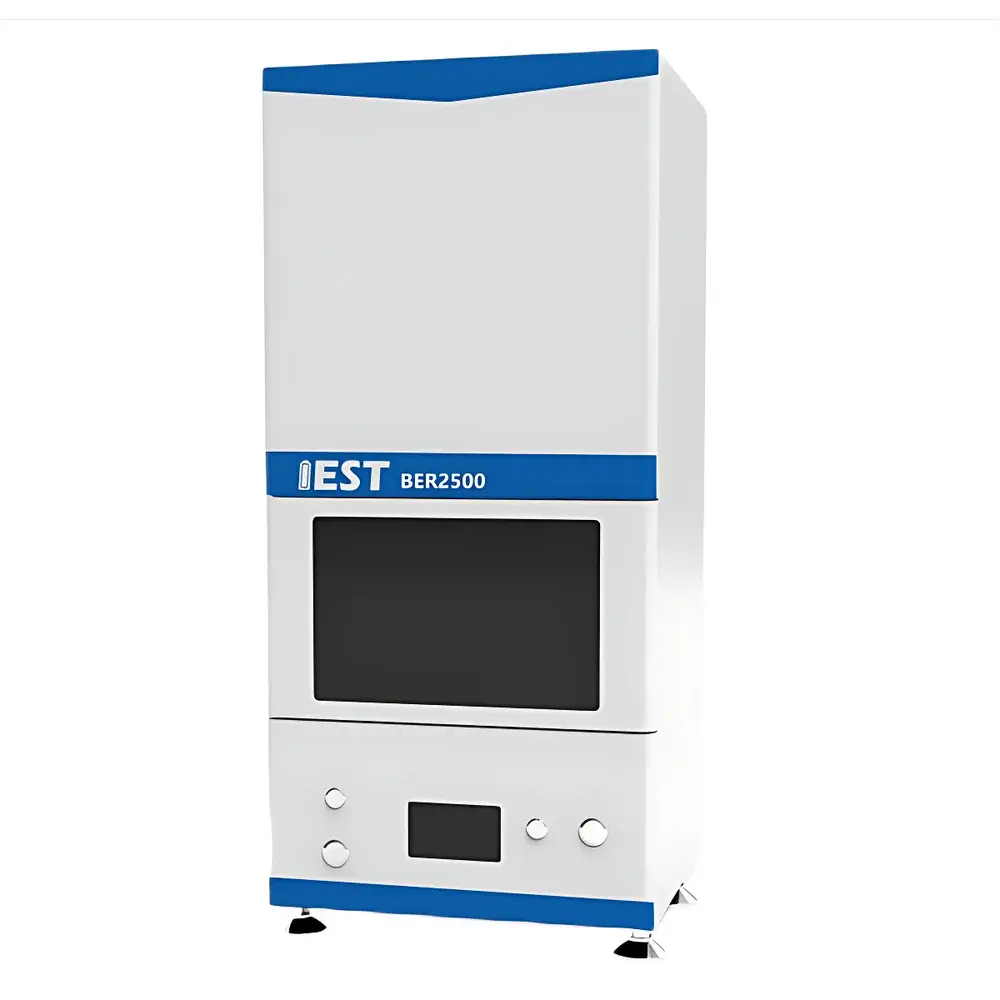
IEST BER2500 Battery Electrode Resistivity Tester
| Brand | IEST |
|---|---|
| Origin | Fujian, China |
| Model | BER2500 |
| Power Supply | 200–240 VAC, 50–60 Hz |
| Power Consumption | 450 W |
| Dimensions (W×D×H) | 355 × 320 × 800 mm |
| Weight | 85 kg |
| Resistance Range | 1 µΩ to 3.1 kΩ |
| Resistance Resolution | 0.1 µΩ |
| Resistance Accuracy | ±0.5% FS |
| Pressure Control Range | 5–60 MPa (with Ø14 mm electrode) |
| Pressure Resolution | 0.05 MPa |
| Pressure Accuracy | ±0.3% FS |
| Thickness Measurement Range | 0–5 mm |
| Thickness Resolution/Accuracy | 0.1 µm / ±1 µm |
| Temperature Range | 0–50 °C |
| Humidity Range | 0–90% RH |
| Temp/Humidity Accuracy | ±2 °C / ±5% RH |
| Compliance | CE-certified, ISO 9001 certified, Chinese High-Tech Enterprise certified |
Overview
The IEST BER2500 Battery Electrode Resistivity Tester is a precision-engineered, integrated metrology system designed specifically for quantitative characterization of electronic resistance, resistivity, and conductivity in lithium-ion battery electrode coatings—both single- and double-sided. It operates on the four-point probe principle under controlled mechanical compression, enabling simultaneous measurement of electrical resistance, applied pressure, real-time thickness, temperature, and relative humidity within a sealed test chamber. Unlike conventional multimeters or generic LCR meters, the BER2500 employs servo-motor-driven force actuation (eliminating dependency on compressed air), ensuring high reproducibility and traceable pressure application across its full 5–60 MPa range. Its architecture conforms to industrial requirements for process development, QC/QA validation, and R&D-level correlation studies between electrode microstructure (e.g., porosity, particle packing density) and bulk electronic transport properties.
Key Features
- Integrated Four-Point Probe + Compression System: Combines calibrated voltage-current sourcing with programmable servo-controlled loading (Ø14 mm electrodes), enabling simultaneous acquisition of resistance, pressure, and thickness at defined mechanical states.
- Real-Time Multivariate Synchronization: On-device LCD displays resistance (µΩ–kΩ), pressure (MPa), thickness (µm), temperature (°C), and humidity (%RH) concurrently—ensuring full parameter traceability during each measurement cycle.
- Three Operational Modes: Supports single-point mapping (spatial uniformity analysis), time-resolved continuity testing (resistance drift monitoring), and variable-pressure profiling (R vs. P, ρ vs. σ, density correlation).
- Traceable Calibration Infrastructure: Includes NIM-certified calibration standards: CAL-BER-R (20 mΩ, 500 mΩ, 10 Ω) and CAL-BER-T (0.05 mm, 0.1 mm), each supplied with official metrological certificates.
- Safety-Engineered Chamber Design: Interlocked safety door prevents electrode descent unless fully closed; built-in LED illumination ensures visual verification of contact area and indentation morphology.
- Modular Electrode & Sample Stage System: Standard and clamping-type electrode holders accommodate diverse foil-based substrates (Cu/Al current collectors) and coating configurations (single/double-sided, slurry-dried or calendered).
Sample Compatibility & Compliance
The BER2500 accepts circular electrode samples ≥ Ø14 mm—including cold-rolled, activated, or calendered anode/cathode laminates on metallic foils. Its sample stage geometry supports both free-standing films and current-collector-mounted layers without edge-support artifacts. All mechanical and electrical subsystems comply with EN 61000-6-2 (EMC immunity) and EN 61000-6-4 (EMC emission) standards. The instrument carries CE marking per Directive 2014/30/EU (EMC) and 2014/35/EU (LVD). IEST holds ISO 9001:2015 certification for design, manufacturing, and service delivery. While not explicitly FDA-regulated, the system’s audit-ready data logging, user access control, and electronic signature support align with GLP/GMP-aligned laboratory practices where raw material qualification and process consistency are documented per internal SOPs.
Software & Data Management
The MRMS2500 software suite runs on Windows-based host computers (Intel Core i5 8th gen+, 8 GB RAM, 256 GB SSD minimum) and provides full instrument control, visualization, and reporting. It records timestamped datasets containing resistance, sheet resistance, volume resistivity, conductivity, pressure, compressive stress, thickness, temperature, and humidity. Data export is supported in CSV, XLSX, and PDF formats—with automated report generation including statistical summaries (mean, SD, CV%), curve fitting (log-log, linear), and pass/fail thresholds. The software enforces role-based user permissions and maintains immutable audit trails compliant with 21 CFR Part 11 principles—including electronic signatures, operator ID logging, and modification history. Raw data files are stored with SHA-256 checksums to ensure integrity verification.
Applications
- Quantitative assessment of coating uniformity via spatial resistance mapping across electrode surfaces.
- Correlation of calendering pressure with inter-particle contact resistance and effective electronic conductivity.
- Stability evaluation of dried electrodes under ambient or controlled humidity exposure (time-resolved resistance drift).
- Validation of binder distribution and conductive additive dispersion efficiency in slurry formulations.
- Process window definition for roll-to-roll coating and drying lines using resistance as a surrogate quality indicator.
- Support for ASTM D257 (DC resistance of insulating materials) and ISO 3915 (electrical resistance of conductive plastics) adapted methodologies—when combined with geometric correction factors.
FAQ
What sample size is required for valid measurements?
Samples must be ≥ Ø14 mm in diameter to ensure full coverage by the electrode array and avoid edge effects. Smaller specimens yield non-representative readings due to current constriction and uncontrolled boundary conditions.
Is the BER2500 suitable for measuring dry powder electrodes prior to calendaring?
Yes—provided the powder layer is mechanically stable enough to withstand controlled compression without lateral extrusion. Use the clamping-stage configuration to minimize displacement during initial loading.
Can thickness be measured independently of pressure application?
No—the thickness sensor is integrated into the moving electrode assembly and only reports values during active compression cycles. Zero-load thickness requires external micrometry.
Does the system support custom scripting or API integration?
MRMS2500 includes a COM-based automation interface compatible with LabVIEW, Python (pywin32), and MATLAB, enabling integration into automated test benches or MES environments.
How often should calibration blocks be re-certified?
NIM recommends annual recalibration of CAL-BER-R and CAL-BER-T standards. A full system verification using these blocks is advised before each daily measurement session.