
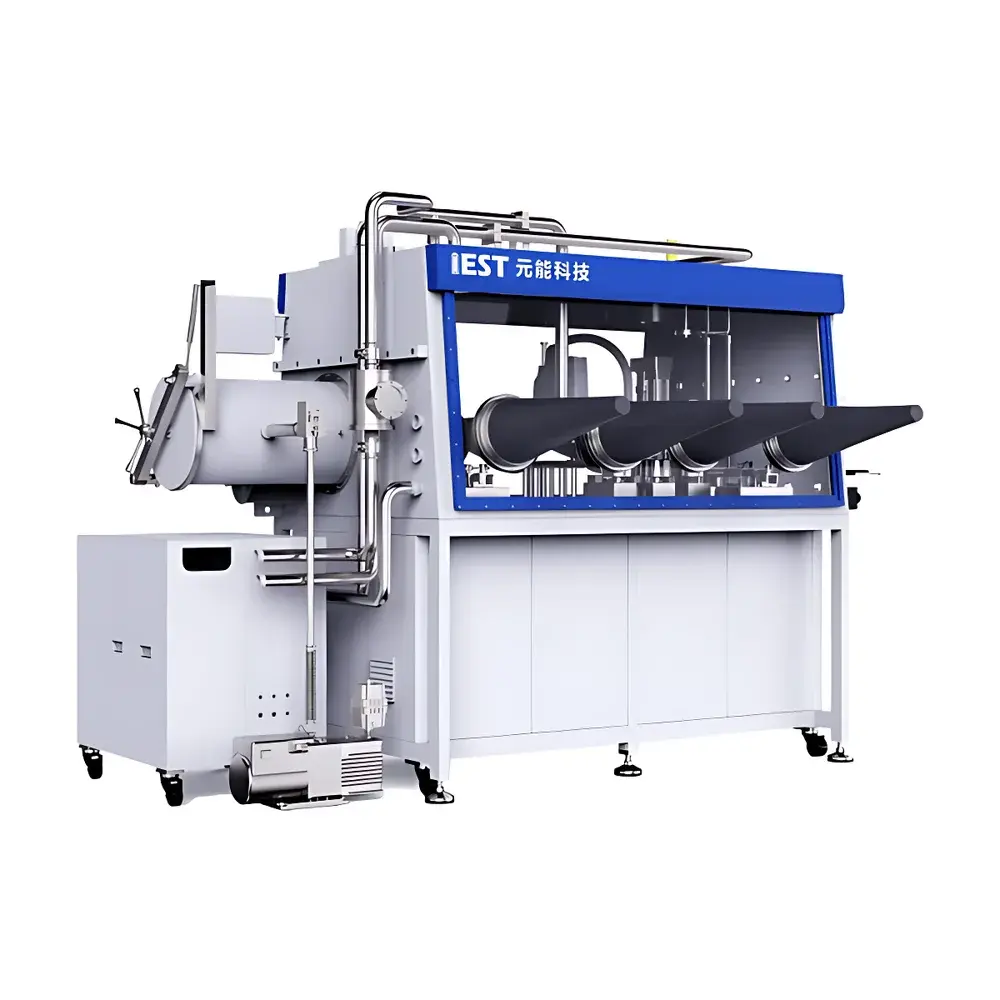
IEST CAAS1200G/M Automated Coin-Cell Assembly System
| Brand | IEST |
|---|---|
| Origin | Fujian, China |
| Manufacturer Type | Original Equipment Manufacturer (OEM) |
| Country of Origin | China |
| Model | CAAS1200G/M |
| Pricing | Upon Request |
Overview
The IEST CAAS1200G/M Automated Coin-Cell Assembly System is an integrated, precision-engineered platform designed specifically for high-reproducibility electrochemical cell fabrication in lithium-ion and sodium-ion battery R&D laboratories. It implements a closed-loop assembly workflow grounded in deterministic mechanical handling, real-time vision-guided positioning, and programmable process control—enabling consistent fabrication of standardized coin cells (e.g., CR2032, CR2430, CR2025, CR2016) under inert atmosphere conditions. Unlike manual or semi-automated approaches, the CAAS1200G/M executes full-cycle assembly—including electrode disc loading, separator placement, electrolyte dispensing, stacking alignment, and crimp sealing—with sub-millimeter positional accuracy and force-controlled sealing parameters. Its architecture supports rigorous materials screening protocols where statistical robustness of electrochemical data (e.g., specific capacity, Coulombic efficiency, voltage hysteresis) depends directly on mechanical consistency across hundreds of identical cells.
Key Features
- High-precision robotic arm with ±5 µm repeatability for electrode disc and separator handling, mitigating misalignment-induced short circuits or uneven current distribution.
- Dual high-resolution CCD imaging system for real-time verification of component geometry, orientation, and surface integrity prior to stacking—detecting curling, edge burrs, or contamination at ≥10 µm resolution.
- Automated electrolyte dispensing module with programmable volume control (range: 10–50 µL), solvent-resistant fluid path, and auto-purge/wash cycles between material batches to eliminate cross-contamination.
- Force- and displacement-controlled crimping station with dual feedback monitoring (load cell + linear encoder), ensuring consistent seal pressure (1.2–2.5 kN adjustable) and final cell thickness (±2 µm tolerance).
- Material traceability framework compliant with GLP principles: each cell receives a unique QR code linking to raw material lot numbers, operator ID (if applicable), timestamp, environmental log (O₂/H₂O < 0.1 ppm), and process parameter setpoints.
- Modular tooling design supporting rapid reconfiguration for multiple coin-cell formats (CR20xx, CR24xx, CR16xx) without hardware modification—validated per ISO 17025 calibration procedures.
Sample Compatibility & Compliance
The CAAS1200G/M accommodates standard coin-cell components manufactured to ASTM F2658-22 dimensional tolerances: stainless steel housings (304/316), polypropylene or cellulose-based separators (25–35 µm), and electrode discs (diameter: 12–24 mm; thickness: 50–200 µm). It supports both slurry-coated and dry-pressed electrodes, including high-expansion anodes (Si/C composites) and low-loading cathodes (NMC, LFP, NCA). All wet-process modules meet IP54 ingress protection standards, and the sealed glovebox-integrated configuration complies with OSHA 1910.1200 and EU REACH requirements for hazardous chemical handling. Process logs are structured for FDA 21 CFR Part 11 compliance when deployed in regulated GMP environments.
Software & Data Management
The system runs on IEST ControlSuite v3.2—a deterministic real-time OS with deterministic scheduling (≤1 ms jitter) and audit-trail-enabled user access controls. All process events (e.g., dispensing trigger, crimp force peak, vision pass/fail decision) are timestamped with nanosecond precision and stored in SQLite3 databases with SHA-256 hash integrity verification. Export formats include CSV (for MATLAB/Python post-processing), PDF batch reports (with embedded QR codes), and direct integration with LabVantage LIMS via RESTful API. Software validation documentation (IQ/OQ/PQ protocols) is provided per ISO/IEC 17025:2017 Annex A.2.
Applications
- High-throughput screening of novel cathode/anode active materials (e.g., Ni-rich layered oxides, silicon-dominant anodes, solid-state electrolyte interphases).
- Quantitative evaluation of binder efficacy, conductive additive dispersion, and calendering effects on interfacial resistance.
- Accelerated aging studies requiring >500 statistically identical cells for Weibull failure analysis or Arrhenius modeling.
- Standardization of internal R&D protocols aligned with USCAR-29, JIS C 8714, or GB/T 36276 test methodologies.
- Training and proficiency testing for QC technicians under ISO/IEC 17025-accredited battery testing laboratories.
FAQ
What coin-cell formats does the CAAS1200G/M support out of the box?
Standard configurations include CR2032, CR2430, CR2025, and CR2016. Custom tooling kits for CR1620 and CR1220 are available upon request and require mechanical recalibration.
Can the system integrate with existing argon-filled gloveboxes?
Yes—the CAAS1200G/M is designed for seamless integration into standard 3-atmosphere gloveboxes (e.g., MBraun, VAC, Plasmax) via ISO-KF40 feedthroughs and includes purge-synchronized startup sequences.
How is electrolyte cross-contamination prevented during multi-material campaigns?
Each electrolyte reservoir uses dedicated, chemically resistant tubing; automated solvent flush (3× volume) and nitrogen blowout precede every new batch, validated by in-line conductivity monitoring.
Is the crimping force calibrated traceably to national standards?
Yes—load cells are factory-calibrated against NIST-traceable deadweight standards (±0.05% FS), with annual recalibration certificates available.
Does the system support remote diagnostics and firmware updates?
Remote SSH access (disabled by default) and encrypted OTA firmware updates are supported under ITAR-compliant network segmentation policies; all connections require dual-factor authentication.







