
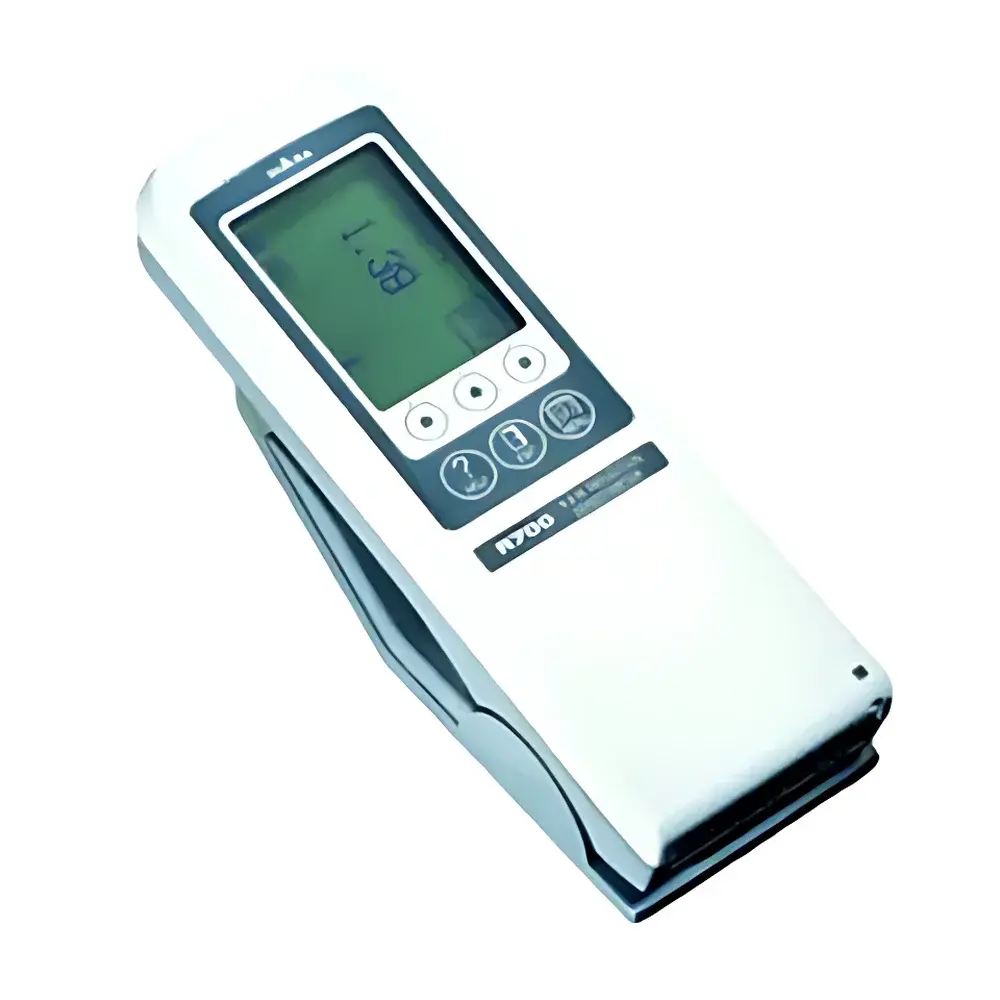
Ihara Electronic R700 White-Black Reflectance Densitometer
| Brand | Ihara Electronic |
|---|---|
| Origin | Japan |
| Manufacturer Type | Authorized Distributor |
| Product Origin | Imported |
| Model | R700 |
| Pricing | Available Upon Request |
Overview
The Ihara Electronic R700 White-Black Reflectance Densitometer is a precision optical measurement instrument engineered for quantitative evaluation of reflectance-based density in graphic arts, printing quality control, and prepress verification workflows. Operating on the principle of diffuse reflectance photometry, the R700 measures the logarithmic ratio of incident light flux to reflected light flux from matte or semi-gloss surfaces—standardized per ISO 5-3:2009 (Graphic technology — Density measurements — Part 3: Spectral conditions) and aligned with ANSI IT8.7/1–2015 spectral response requirements. Unlike transmission densitometers, the R700 employs a fixed-angle 45°/0° geometry (illumination at 45°, detection normal to surface), minimizing directional bias and ensuring high reproducibility across paper, film, coated substrates, and printed halftone patches. Its calibrated tungsten-halogen light source and silicon photodiode detector provide stable, temperature-compensated readings traceable to NIST-traceable reference standards.
Key Features
- Multi-parameter reflectance density analysis: simultaneous calculation of absolute density (D), density difference (ΔD), dot area percentage (% dot gain), tone value (TVI), and contrast ratio (CR) per ISO 12647-2:2013 Annex B.
- Integrated tone curve analysis engine supporting linear, G7 grayscale, and custom TVI mapping; enables direct comparison against target curves defined in GRACoL, SWOP, or Fogra specifications.
- Dual-mode operation: manual single-point measurement and sequential batch mode for up to 99 predefined locations—ideal for press sheet verification and process control charts.
- Onboard memory stores calibration data, user-defined reference whites/blacks, and up to 200 measurement records with timestamp and operator ID tagging.
- Robust industrial housing with anti-static coating and IP52-rated ingress protection for shop-floor durability; ergonomic handheld form factor with tactile feedback buttons and backlit LCD display.
Sample Compatibility & Compliance
The R700 accommodates standard ISO 2846-1 test charts (e.g., ISO 2846-1:2017 cyan/magenta/yellow/black process inks), UGRA/Fogra media wedges, and customer-specific calibration patches. It supports measurement on uncoated offset paper (ISO 536), coated gloss/matte stocks (ISO 8791-4), and flexographic anilox roll test prints. All optical path components comply with IEC 61000-4-3 (EMC immunity) and IEC 61326-1 (electrical safety for laboratory equipment). Calibration adheres to ISO/IEC 17025:2017 requirements when performed using certified reference standards (e.g., NIST SRM 2065 or equivalent traceable white/black tiles). Instrument validation documentation satisfies GLP audit trails for regulated print production environments.
Software & Data Management
The R700 communicates via RS-232 serial interface (included cable optional) to Windows-based desktop software (Ihara Densisoft v3.2+), enabling full data export in CSV, XML, and PDF report formats. Software features include real-time SPC charting (X̄/R, Cpk), automated pass/fail threshold alerts per ISO 12647-2 tolerances, and integration with MIS systems via ODBC-compliant database connectors. Audit trail functionality logs all calibration events, firmware updates, and user modifications—supporting compliance with FDA 21 CFR Part 11 where electronic records are required. Firmware updates preserve backward compatibility with legacy calibration files and maintain consistent algorithmic behavior across device generations.
Applications
- Pressroom process control: monitoring ink film thickness consistency, detecting under/over-inking, and validating dot gain compensation during makeready and run-length verification.
- Prepress proof-to-press correlation: quantifying deviation between digital proofs (e.g., Epson UltraChrome, HP Indigo) and final press output using ΔE₂₀₀₀ and TVI delta metrics.
- Color management system validation: verifying ICC profile accuracy by measuring actual vs. predicted tone reproduction curves across CMYK channels.
- Quality assurance in packaging printing: assessing opacity, substrate uniformity, and varnish gloss interference effects on perceived density.
- Educational use in graphic communications programs: teaching fundamental principles of reflectance photometry, tone reproduction theory, and ISO-based print evaluation protocols.
FAQ
What standards does the R700 comply with for density measurement?
The R700 conforms to ISO 5-3:2009 (spectral conditions), ISO 12647-2:2013 (process control tolerances), and ANSI IT8.7/1–2015 (spectral sensitivity). Calibration is traceable to NIST SRM 2065.
Can the R700 measure metallic or fluorescent inks?
No—the R700 uses a broadband tungsten-halogen source without UV excitation; it is not suitable for fluorescent pigments or metallic flake-based inks requiring specialized spectrodensitometry.
Is firmware upgrade supported in-field?
Yes—firmware updates are delivered via serial interface using Ihara-provided utility software; no hardware modification is required.
Does the R700 support automatic white/black calibration?
Yes—users may perform two-point calibration using included certified white tile and black trap; calibration data persists through power cycles and is protected by non-volatile memory.
What is the typical measurement repeatability under controlled lab conditions?
At 23 °C ±2 °C and 50% RH ±5%, repeatability is ≤±0.015 D for densities between 0.05–2.50 D on ISO-standard matte paper substrates (n=10, same operator, same location).



