
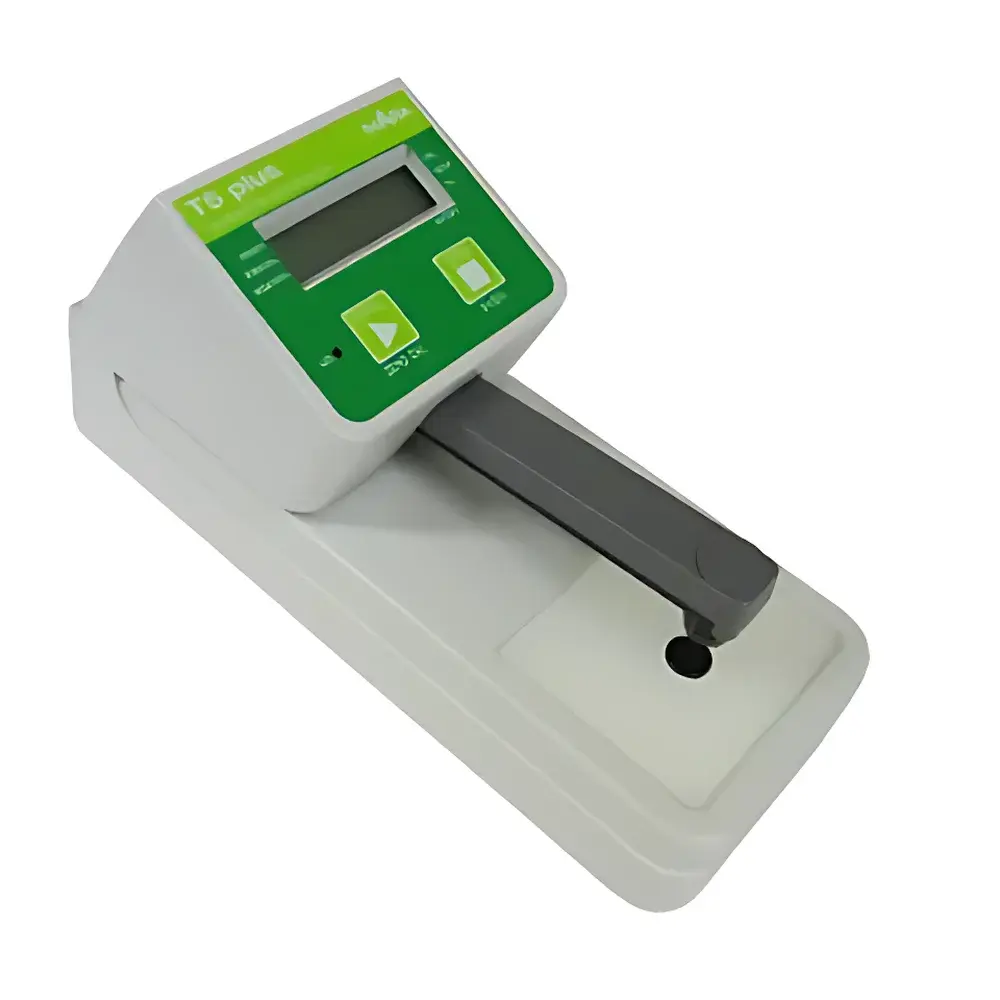
Ihara Electronic T5 Plus Densitometer for Black-and-White Film Transmission Density, Dot Area %, and Transmittance
| Brand | Ihara Electronic |
|---|---|
| Origin | Japan |
| Model | T5 Plus |
| Measurement Range | 0.00–6.00 D (Optical Density) |
| Transmittance | 100.0% to 0.0001% |
| Dot Area | 0.0–100.0% |
| Aperture Sizes | φ1 mm, φ2 mm, φ3 mm |
| Repeatability | ±0.01 D (at <4.0 D, φ3 mm aperture) |
| Accuracy | ±0.02 D (at <4.0 D, φ3 mm aperture) |
| Light Source | Halogen lamp |
| Detector | Filter-integrated photodiode |
| Optical Standard | ANSI PH2.19 (specular reflection geometry) |
| Interface | RS-232C (9600 bps, 8 data bits, no parity, 1 stop bit) |
| Operating Temperature | 5–40 °C |
| Dimensions (unit) | 251 × 103 × 125 mm |
| Light Table Area | 80 × 70 mm |
| Arm Length | 185 mm |
| Weight | ~1.2 kg |
Overview
The Ihara Electronic T5 Plus is a precision benchtop densitometer engineered for quantitative optical characterization of black-and-white photographic films, lithographic films, and halftone master materials. It operates on the principle of transmission densitometry—measuring the logarithmic attenuation of collimated visible light (via calibrated halogen illumination) as it passes through a sample—yielding optical density (D), transmittance (%T), and dot area percentage (% dot gain or dot coverage) in accordance with ANSI PH2.19 standard geometry for specular reflection-corrected transmission measurement. Designed for consistency in prepress quality control, film archive verification, and analog imaging R&D, the T5 Plus delivers traceable, repeatable results across its full 0.00–6.00 D range, supporting critical applications where density linearity, low-noise detection, and aperture-defined spatial resolution are essential.
Key Features
- Triple-aperture optical head (φ1 mm, φ2 mm, φ3 mm) enables localized measurement of fine-grain films, halftone dots, and high-resolution negatives without spatial averaging artifacts
- Integrated light table (80 × 70 mm active area) accommodates A3-format films; adjustable arm (185 mm reach) ensures stable positioning over large substrates
- ANSI PH2.19-compliant optical path with filter-integrated photodiode detector ensures spectral response aligned with standard visual photopic sensitivity (CIE 1931)
- Calibration traceability supported via included NIST-traceable calibration film and verification film—each supplied with certified reference values
- RS-232C serial interface (9600 bps, 8N1) enables automated data logging, integration into QC reporting workflows, and batch measurement scripting under laboratory information management systems (LIMS)
- Rugged aluminum housing and thermal-stable mechanical design maintain measurement integrity across ambient lab conditions (5–40 °C)
Sample Compatibility & Compliance
The T5 Plus is optimized for transparent, non-scattering media including silver-halide-based B&W negative/positive films, diazo and photopolymer litho films, and gravure/halftone test targets. Its fixed-wavelength halogen source (peak ~550 nm) and spectral filtering ensure compatibility with ISO 5–3, ISO 5–4, and ASTM D1720 standards for photographic density measurement. While not FDA 21 CFR Part 11–certified out-of-the-box, audit-ready data export (timestamped, instrument-ID-tagged ASCII streams) supports GLP/GMP-aligned documentation when paired with validated host software. All measurements comply with ANSI PH2.19 requirements for geometric alignment, beam divergence, and stray-light suppression.
Software & Data Management
The T5 Plus communicates via ASCII-based RS-232 protocol, permitting direct integration with custom LabVIEW, Python (pySerial), or MATLAB acquisition scripts. Optional communication cables and terminal emulation utilities enable real-time streaming of density, transmittance, and dot area values—including simultaneous multi-aperture readings when used with external multiplexing hardware. Raw output includes instrument model, firmware version, aperture ID, measurement timestamp (if host-synchronized), and unit-normalized values (e.g., “D=3.427”, “T=0.00382%”, “DOT=72.4”). No proprietary driver or closed software suite is required—facilitating long-term archival compatibility and IT infrastructure independence.
Applications
- Prepress quality assurance: Verification of step tablet density uniformity, gamma curve validation, and dot gain profiling across film exposure systems
- Film archive digitization: Quantitative assessment of aging-induced density drift in historical B&W negatives prior to scanning or restoration
- Analog photography R&D: Characterization of developer chemistry impact on D-log E curves and maximum density (Dmax) saturation
- Lithographic process control: Monitoring of photomask optical density stability across production batches and storage durations
- Educational laboratories: Teaching fundamental principles of photometry, Beer–Lambert law application, and analog image metrology
FAQ
What calibration standards accompany the T5 Plus?
The unit ships with a certified calibration film (with traceable D-values at multiple points) and a separate verification film for daily operational checks. Calibration validity is maintained per ISO/IEC 17025 guidelines when performed annually by an accredited service provider.
Can the T5 Plus measure reflective samples?
No—it is designed exclusively for transmission-mode measurement of transparent substrates. Reflective density requires a separate reflectance densitometer compliant with ISO 5–2.
Is firmware upgrade support available?
Yes—firmware updates are distributed via Ihara Electronic’s global technical support portal and require only a standard RS-232 connection and provided update utility.
How is aperture selection physically implemented?
Apertures are manually swapped using precision-machined, keyed inserts that lock into the optical head—ensuring repeatable alignment and eliminating parallax error between φ1 mm, φ2 mm, and φ3 mm configurations.
Does the T5 Plus meet regulatory requirements for pharmaceutical or medical device film documentation?
While the instrument itself is not 21 CFR Part 11–validated, its deterministic ASCII output, uneditable raw data stream, and optional audit trail logging (via host system) allow integration into validated environments when qualified per organizational SOPs.




