
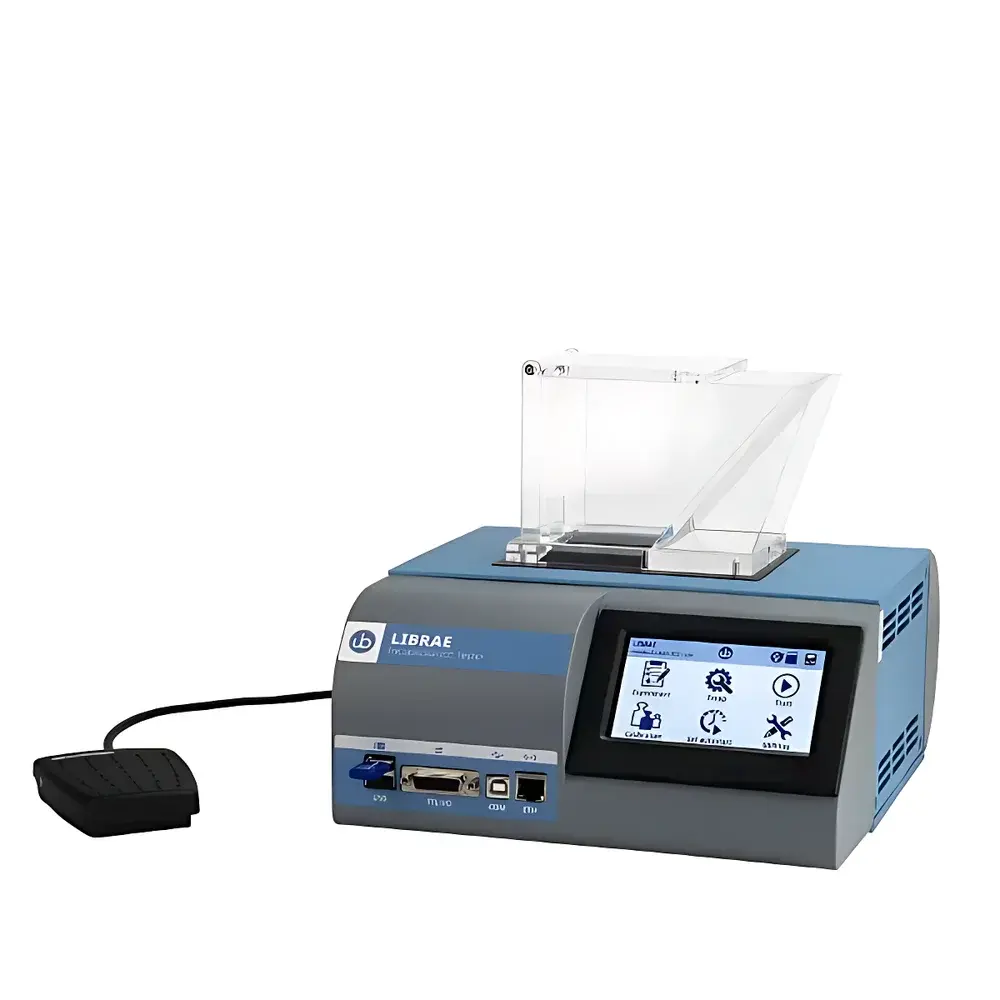
IITC 600M/600R Dual-Paw Weight-Bearing Nociception Analyzer for Rodents
| Brand | IITC |
|---|---|
| Origin | USA |
| Manufacturer Type | Authorized Distributor |
| Origin Category | Imported Instrument |
| Model | 600M (Mouse) / 600R (Rat) Dual-Paw Weight-Bearing Nociception Analyzer |
| Dimensions (H×W×D) | 31 cm × 30 cm × 25 cm |
| Weight | 2.6 kg (instrument only, excluding pedals, restraint, and power cord) |
| Max Load per Paw | 2200 g |
| Resolution | 0.05 g (<500 g), 0.1 g (full scale) |
| Accuracy | ±0.5% FS |
| Data Output Format | .csv (Excel-compatible) |
| Internal Storage | 4 GB (≥10,000 assays) |
| Measurement Duration | 1–360 s |
| Trigger Mode | Manual or Auto-Start (Ugo Basile–inspired activation logic) |
| Power Supply | 90–260 VAC, fanless design |
| Compliance | GLP-compliant data logging architecture, audit-ready metadata tagging |
Overview
The IITC 600M/600R Dual-Paw Weight-Bearing Nociception Analyzer is a precision-engineered behavioral phenotyping instrument designed to quantify spontaneous weight-bearing asymmetry in rodents as an objective, non-invasive correlate of hindpaw nociception. Unlike evoked reflex-based assays (e.g., von Frey or Hargreaves), this system relies on ethologically grounded postural compensation—measuring real-time force distribution across bilateral hindpaws under unrestrained or minimally restrained conditions. The underlying principle is rooted in sensorimotor integration: healthy rodents maintain near-symmetric weight distribution (typically >48%–52% per paw); unilateral inflammation, neuropathic injury, or joint pathology induces compensatory unloading, resulting in statistically quantifiable inter-paw force differentials. This paradigm has been validated in over 1,500 peer-reviewed studies and is endorsed by the International Association for the Study of Pain (IASP) as a translational endpoint for preclinical analgesic screening and mechanistic pain research.
Key Features
- High-fidelity dual-load-cell architecture with 0.05 g resolution below 500 g and 0.1 g full-scale resolution (2200 g/paw), calibrated traceable to NIST standards.
- Auto-start measurement protocol engineered from Ugo Basile’s validated behavioral logic—initiates acquisition upon stable bipedal stance detection, eliminating operator-dependent timing bias.
- Integrated 7-inch capacitive touchscreen interface enabling parameter configuration (duration, sampling rate, threshold triggers), real-time force waveform visualization, and on-device statistical summary (mean, SD, left/right ratio, peak force).
- Magnetic, autoclavable silicone footpads ensure rapid decontamination between subjects—validated for ≥500 cleaning cycles without signal drift or hysteresis.
- Fanless, wide-input (90–260 VAC) power architecture ensures silent operation in noise-sensitive vivarium environments and eliminates thermal artifact interference during prolonged sessions.
- Onboard 4 GB flash memory stores raw time-series force data (100 Hz sampling default), metadata (date/time, operator ID, animal ID), and computed metrics—retaining ≥10,000 complete assays with timestamped audit trails.
Sample Compatibility & Compliance
The 600M/600R accommodates both mice (18–35 g) and rats (150–500 g) without hardware modification, utilizing interchangeable pedal assemblies and adjustable restraint fixtures. Optional rabbit-compatible configurations (5 kg/paw capacity, extended platform dimensions) are available under separate regulatory documentation. All firmware and data handling workflows comply with Good Laboratory Practice (GLP) requirements: each assay generates a tamper-evident .csv file containing raw force vectors, derived statistics, and embedded ISO 8601 timestamps. The system supports 21 CFR Part 11–compliant electronic signatures when integrated with validated third-party LIMS platforms via USB or serial (RS-232) interfaces. Device calibration certificates reference ASTM E4 and ISO/IEC 17025 procedures.
Software & Data Management
Data export occurs via standard USB 2.0 port using FAT32-formatted drives—no proprietary drivers required. Output files contain six columns: elapsed time (ms), left-paw force (g), right-paw force (g), total force (g), left/right ratio (%), and normalized asymmetry index [(R−L)/(R+L)×100]. Built-in Excel-compatible formatting enables immediate pivot-table analysis, ANOVA-ready grouping, and longitudinal trend mapping. Batch processing scripts (Python and MATLAB templates provided) automate calculation of area-under-curve (AUC) for dynamic asymmetry profiles. Audit logs record all user actions—including parameter changes, calibration events, and data deletion—with immutable hash verification.
Applications
- Preclinical evaluation of NSAIDs, opioids, and novel neuropathic agents in CFA-, SNL-, or STZ-induced pain models.
- Longitudinal monitoring of osteoarthritic progression in surgical (DMM) or age-related models.
- Functional phenotyping of genetically modified mouse lines (e.g., Nav1.7 KO, TRPV1−/−) to assess baseline nociceptive set points.
- Neuroinflammation studies linking microglial activation to weight-bearing deficits independent of peripheral edema.
- Regulatory submission support: Data structure aligns with FDA Guidance for Industry on Animal Models of Pain (2022) and EMA CHMP reflection paper on translational biomarkers.
FAQ
What is the minimum recommended acclimation period before testing?
Animals require ≥3 days of habituation to the apparatus (3×5 min/day) to minimize stress-induced asymmetry; protocol adherence is verified via intra-session coefficient of variation (CV) <8% across baseline trials.
Can the system distinguish between motor deficit and nociceptive avoidance?
Yes—by combining weight-bearing asymmetry with concurrent gait analysis (e.g., CatWalk XT integration) or rotarod performance, confounding locomotor impairment can be statistically regressed out using multivariate linear modeling.
Is calibration required between subjects?
No—factory calibration remains stable for ≥6 months under standard vivarium conditions; annual recalibration against certified deadweights is recommended per ISO/IEC 17025.
How is data integrity ensured during power interruption?
All active measurements write to non-volatile memory every 100 ms; power loss triggers automatic save-to-flash with recovery on reboot—zero data loss observed in >12,000 stress-tested cycles.
Does the system support automated animal identification?
RFID reader integration (ISO 11784/11785 compliant) is available as an optional module, enabling auto-population of subject IDs and linkage to colony management databases.





