
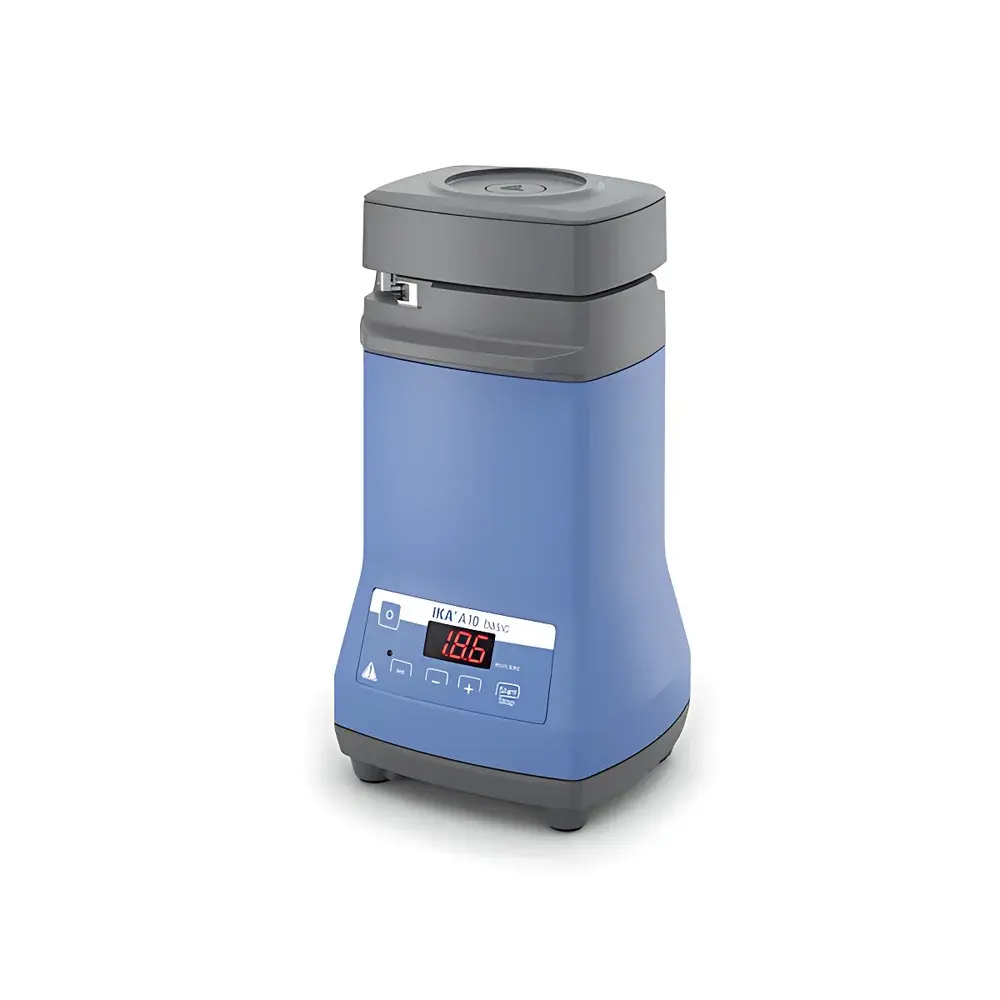
IKA A 10 basic Batch Grinder
| Brand | IKA |
|---|---|
| Origin | Germany |
| Manufacturer | IKA Werke GmbH & Co. KG |
| Product Type | Batch Grinder |
| Model | A 10 basic |
| Sample Type | Hard, brittle, soft, and fibrous materials |
| Feed Particle Size | ≤ 6 mm |
| Output Particle Size | 125–250 µm |
| Maximum Batch Volume | 50 mL |
| Grinding Mechanism | Shear and impact |
| Motor Input Power | 300 W |
| Motor Output Power | 240 W |
| Max. Speed | 25,000 rpm ±500 rpm |
| Peripheral Speed | 73 m/s |
| Max. Feed Hardness | 5 Mohs |
| Grinding Chamber Material | Stainless steel 1.4301 |
| Cutting/Impact Tool Material | Stainless steel 1.4034 |
| Cooling Options | Water-cooled chamber, dry ice cooling, liquid nitrogen cooling |
| Duty Cycle | 5 min ON / 10 min OFF |
| Dimensions (W × H × D) | 130 × 250 × 145 mm |
| Weight | 2.9 kg |
| Ambient Operating Conditions | 5–40 °C, ≤80% RH |
| Protection Rating | IP 41 |
| Electrical Supply | 220–240 V, 50/60 Hz |
| Interface | None |
Overview
The IKA A 10 basic is a compact, CE-compliant batch grinder engineered for reproducible, controlled size reduction of diverse laboratory samples—including hard, brittle, soft, elastic, and fibrous materials. It operates on dual mechanical principles: high-speed shear via rotating blades and impact force generated by centrifugal acceleration against the chamber wall. Designed and manufactured in Staufen, Germany, the instrument adheres to DIN EN 60529 (IP 41) ingress protection standards and integrates intrinsic safety mechanisms aligned with IEC 61000-6-2/6-4 electromagnetic compatibility requirements. Its fixed-speed architecture (25,000 rpm ±500 rpm) delivers consistent peripheral velocity (73 m/s), ensuring uniform energy input across batches—critical for method transferability in QC labs and pre-analytical sample preparation workflows.
Key Features
- Safety-first interlock system: Motor activation only upon full closure and positive latching of the grinding chamber lid; automatic brake engagement ensures complete rotor stop before lid release.
- Durable construction: Grinding chamber fabricated from corrosion-resistant stainless steel 1.4301; impact/shear tools made of hardened stainless steel 1.4034 (X46Cr13), optimized for wear resistance and dimensional stability.
- Thermal management flexibility: Integrated cooling jacket supports external water circulation; additionally compatible with dry ice or liquid nitrogen for cryogenic grinding of thermolabile or polymeric samples.
- Tool modularity: Interchangeable cutting geometries—including standard impact blade (A10.1), reduced-volume blade, and optional shear-specific configurations—enable adaptation to material rheology and target particle distribution.
- Maintenance-optimized design: Tool replacement requires no tools; redesigned snap-lock lid mechanism enables rapid access without alignment calibration or torque-sensitive fasteners.
- Robust drive system: Brushless electronic motor delivers 240 W mechanical output at 300 W electrical input, minimizing thermal drift and acoustic emission (<75 dB(A) at 1 m).
Sample Compatibility & Compliance
The A 10 basic accommodates feed particles up to 6 mm in diameter and processes batches up to 50 mL volume. It reliably reduces materials with Mohs hardness ≤5—including minerals, pharmaceutical tablets, plant tissues, polymers, and food matrices—into a narrow particle size distribution centered between 125–250 µm. While not certified for ISO 13320 laser diffraction validation or ASTM D618 standard compliance out-of-the-box, its mechanical consistency supports method development aligned with USP <429> (Particle Size Distribution) and ISO 17025-accredited laboratories’ internal SOPs. The absence of analog/digital interfaces (no RS232, USB, or analog output) reflects its role as a standalone preparatory tool—not a data-generating analytical instrument—thus exempting it from FDA 21 CFR Part 11 electronic record requirements.
Software & Data Management
The A 10 basic operates without embedded firmware or external software dependency. All operational parameters are manually set via tactile membrane buttons: fixed-speed operation and programmable timer (0–999 s) with visual LED feedback. No data logging, audit trail, or remote control capability is provided. This design prioritizes operational simplicity, regulatory transparency, and long-term serviceability—eliminating firmware obsolescence risks common in connected lab instruments. For GLP/GMP environments requiring traceability, users implement manual logbook entries referencing batch ID, start/stop time, tool configuration, and cooling method—consistent with Annex 11 risk-based validation approaches for non-automated equipment.
Applications
- Pharmaceutical pre-formulation: Homogenization of active pharmaceutical ingredients (APIs) and excipients prior to dissolution testing or XRD analysis.
- Environmental testing: Reduction of soil, sediment, or sludge composites to sub-250 µm fractions for heavy metal extraction (EPA Method 3050B).
- Food safety labs: Preparation of heterogeneous food matrices (e.g., spices, nuts, dairy powders) for mycotoxin or pesticide residue analysis.
- Materials science: Size reduction of polymer pellets or composite fragments prior to FTIR or DSC characterization.
- Agricultural research: Disruption of plant biomass for DNA/RNA extraction or proximate analysis (AOAC 985.29).
FAQ
Can the A 10 basic be used for cryogenic grinding?
Yes—its stainless steel grinding chamber accepts direct application of dry ice or liquid nitrogen for sub-ambient processing of heat-sensitive or elastic materials.
Is the output particle size adjustable?
No—the device delivers a characteristic distribution (125–250 µm) under standardized operating conditions; particle size control is achieved via tool selection, dwell time, and feed geometry—not variable speed.
Does it comply with FDA 21 CFR Part 11?
Not applicable—the instrument lacks electronic records, digital signatures, or audit trail functionality; it functions as a mechanical sample prep tool, not a regulated data acquisition system.
What maintenance intervals are recommended?
Visual inspection of blade sharpness and chamber integrity before each use; lubrication-free operation eliminates scheduled greasing; annual verification of brake response time and interlock reliability is advised per ISO/IEC 17025 Clause 6.4.10.
Can it process oily or aqueous suspensions?
Yes—the sealed chamber design permits wet grinding of slurries or oil-immersed samples, though post-run cleaning must follow IKA’s validated solvent compatibility chart (e.g., avoid chlorinated solvents with stainless steel 1.4034).



