
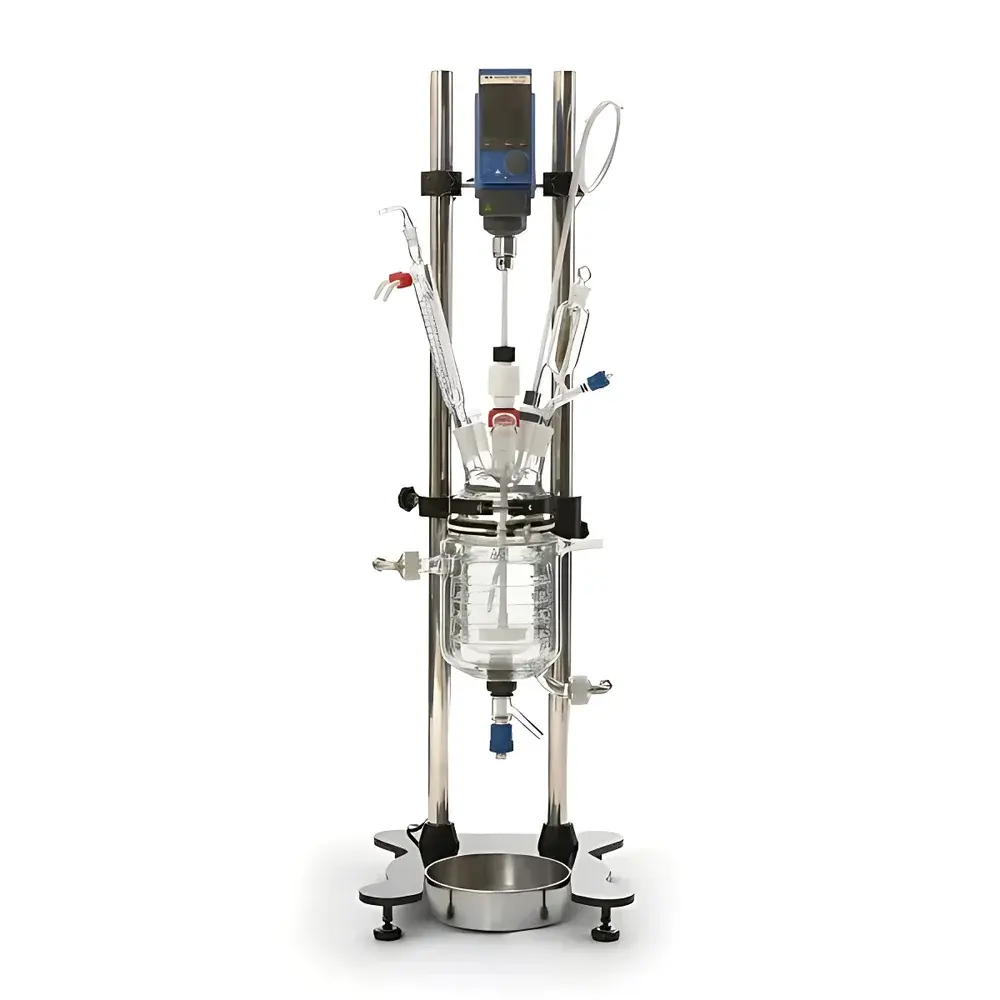
IKA 1L Double-Jacketed Glass Reactor with Baffle Plate
| Brand | IKA |
|---|---|
| Origin | Germany |
| Model | 1L Double-Jacketed Glass Reactor with Baffle Plate |
| Capacity | 1 L |
| Jacket Type | Dual vacuum-insulated jacket |
| Operating Temperature Range | −90 °C to +230 °C |
| Thermal Shock Limit (ΔT) | 60 °C |
| Pressure Range | 666 Pa (vacuum) to ambient pressure |
| Wetted Materials | Borosilicate glass 3.3, PTFE, FFKM, FKM |
| Lid Ports | 6 (SQG 29/42 × 1, TS 29/42 × 1, TS 24/40 × 4) |
| Max Stirring Speed | 800 rpm |
| Dimensions (W×D×H) | 380 mm × 380 mm × 1206 mm |
| Weight | 22 kg |
Overview
The IKA 1L Double-Jacketed Glass Reactor with Baffle Plate is a precision-engineered laboratory-scale reactor system designed for controlled chemical synthesis, kinetic studies, crystallization, polymerization, and multi-step reaction workflows under variable thermal and pressure conditions. Built upon the foundational principles of conductive and convective heat transfer optimization, this reactor employs a dual-layer borosilicate glass 3.3 vessel with an integrated vacuum-insulated outer jacket and internal baffle plate geometry. The vacuum layer minimizes parasitic heat exchange between the process medium and ambient environment—critical for maintaining stable sub-ambient temperatures (down to −90 °C) without excessive cryogen consumption or external condensation. The internal baffle plate disrupts laminar flow patterns in the reaction mass, promoting radial mixing and enhancing heat transfer coefficients across the inner wall surface. This configuration ensures uniform temperature distribution throughout the 1 L working volume and supports reproducible scale-up trajectories from lab to pilot plant.
Key Features
- Double-jacketed borosilicate glass 3.3 vessel with vacuum insulation layer for high thermal efficiency and low thermal inertia
- Internally mounted baffle plate engineered to improve axial dispersion and reduce vortex formation during agitation
- Modular lid assembly with six standardized ports (including SQG 29/42 and TS 24/40 connections) for flexible integration of temperature probes, pH electrodes, dosing needles, gas inlets, and reflux condensers
- Chemically inert wetted components: PTFE-sealed stirrer shaft, FFKM and FKM elastomer gaskets, and glass-to-glass sealing surfaces compliant with USP Class VI requirements
- Tool-free quick-clamp lid fastening mechanism with leak-tight sealing verification via visual alignment indicators
- Bottom-mounted discharge valve with zero-dead-volume design and PTFE-lined seat to prevent cross-contamination and residue accumulation
- High-efficiency overhead stirring drive rated for continuous operation at up to 800 rpm with torque compensation across viscosity ranges up to 50,000 mPa·s
Sample Compatibility & Compliance
This reactor accommodates a broad spectrum of sample types—including corrosive reagents (e.g., concentrated acids, halogenated solvents), moisture-sensitive organometallics, and shear-thinning polymer solutions—without degradation of wetted materials. All glass components conform to DIN ISO 3585 specifications for borosilicate glass 3.3. Elastomeric seals meet ASTM D1418 classification for FFKM and FKM compounds, ensuring compatibility with aggressive oxidizers and high-temperature hydrocarbons. The system supports GLP-compliant operation when paired with validated temperature sensors and audit-trail-capable controllers. It is suitable for use in environments requiring adherence to ISO/IEC 17025 documentation practices and may be configured to satisfy FDA 21 CFR Part 11 data integrity requirements when integrated with compliant software platforms.
Software & Data Management
While the base unit operates via analog/manual controls, it is fully compatible with IKA’s RV 10 digital control interface or third-party PID controllers supporting Modbus RTU or 0–10 V analog inputs. Optional PT100 temperature probes (Class A, ±0.15 °C accuracy) enable closed-loop thermal regulation with ramp/soak profiles. When connected to IKA LabWorld software or LabVIEW-based acquisition systems, real-time logging of stirrer speed, jacket temperature, internal temperature, and pressure (via optional transducer) is achievable. All logged parameters are timestamped and exportable in CSV or Excel format for traceability, batch record generation, and regulatory submission preparation.
Applications
- Low-temperature lithiation and Grignard reactions requiring precise thermal control below −40 °C
- Exothermic nitration or sulfonation processes where rapid heat removal through the double jacket is critical
- Suspension polymerization trials with in-situ particle size monitoring via inline probes
- Hydrogenation studies under controlled H2 pressure using optional pressure-rated lid configurations
- Process analytical technology (PAT) development for QbD-aligned API synthesis
- Green chemistry solvent screening involving high-boiling-point bio-based media
FAQ
Can this reactor be used for pressurized reactions?
Yes—when equipped with a pressure-rated lid (e.g., IKA LR 1000 series accessories) and appropriate safety shielding, it supports operation up to 2 bar(g) with compatible gasket materials.
Is the baffle plate removable for cleaning or alternative configurations?
The baffle plate is permanently fused to the inner wall during glass fabrication and is not user-removable; however, its smooth, crevice-free profile ensures full CIP/SIP compatibility.
What stirring impellers are recommended for high-viscosity applications?
Anchor, helical ribbon, and double-anchor impellers—available in PTFE-coated stainless steel—are optimized for viscosities exceeding 10,000 mPa·s and integrate seamlessly with the standard stirrer coupling.
Does the system include temperature monitoring hardware?
A calibrated PT100 probe with 2 m cable and mini-DIN connector is included as standard equipment for internal temperature feedback.
How is vacuum integrity verified in the jacket space?
The jacket is factory-tested to ≤1 × 10⁻² mbar residual pressure and includes a dedicated vacuum port with built-in Schrader valve for periodic integrity checks using a digital vacuum gauge.



