
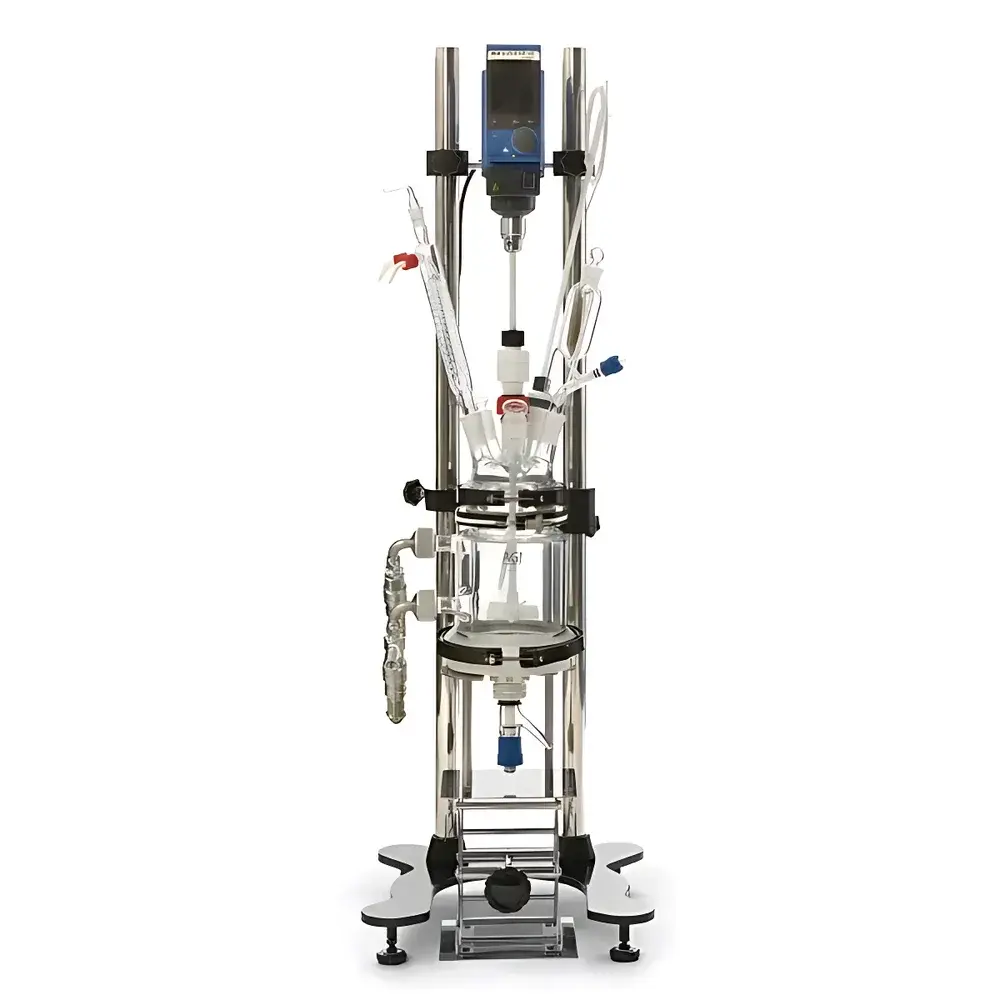
IKA 1L Jacketed Filtration Reactor
| Brand | IKA |
|---|---|
| Origin | Germany |
| Model | 1L Filtration Reactor |
| Vessel Capacity | 1 L |
| Jacketed Design | Yes |
| Operating Temperature Range | −90 °C to +200 °C |
| Thermal Shock Resistance (ΔT) | 110 °C |
| Operating Pressure Range | 666 Pa to ambient pressure |
| Wetted Materials | Borosilicate Glass 3.3, PTFE, FFKM, FKM |
| Lid Ports | 6 (SQG 29/42 × 1, TS 29/42 × 1, TS 24/40 × 4) |
| Maximum Agitator Speed | 800 rpm |
| Dimensions (W×D×H) | 380 mm × 380 mm × 1206 mm |
| Weight | 28 kg |
Overview
The IKA 1L Jacketed Filtration Reactor is a modular, benchtop-scale chemical reactor engineered for precise control and operational flexibility in laboratory-scale synthesis, catalytic screening, crystallization, and solid–liquid separation workflows. Based on Couette-type mixing geometry and jacketed thermal management, the system integrates reaction and inline filtration within a single glass vessel—eliminating intermediate transfer steps that risk cross-contamination, material loss, or exposure to ambient conditions. Its all-glass (DIN ISO 3585 compliant borosilicate 3.3) construction ensures optical clarity for real-time process observation, while the double-walled jacket enables accurate temperature regulation via external circulators. Designed for compatibility with vacuum, inert gas, and mild overpressure environments (up to ambient), the reactor supports thermally demanding protocols—including cryogenic reactions at −90 °C and high-temperature condensations up to +200 °C—with thermal shock resistance of ΔT = 110 °C between internal and jacket media.
Key Features
- Modular architecture with interchangeable agitator shafts, impellers (e.g., anchor, paddle, turbine), and bottom filtration assemblies—enabling rapid reconfiguration for distinct process requirements.
- Removable sintered glass or membrane filtration base (standard pore size options: 10–100 µm; custom options available), sealed via FFKM gasketing to ensure leak-tight operation under vacuum or gentle positive pressure.
- Tool-free assembly: Quick-connect fluid ports (including oil inlet/outlet with integrated pressure relief valve), bayonet-style lid clamping, and snap-fit sealing rings minimize setup time and operator error.
- Zero-dead-volume discharge design: Conical bottom geometry with central outlet valve (PTFE/FFKM diaphragm type) ensures complete, residue-free sample recovery without mechanical scraping or disassembly.
- Integrated Pt100 temperature probe port (DIN EN 60751 Class B) with calibrated insertion depth for accurate in-situ measurement of bulk phase temperature—critical for kinetic studies and exotherm control.
- Robust mechanical drive unit featuring brushless DC motor, digital speed control (0–800 rpm, ±1 rpm resolution), and torque monitoring capability for viscosity-sensitive reactions.
Sample Compatibility & Compliance
The reactor is suitable for handling organic solvents, aqueous media, slurries, viscous polymer solutions, and heterogeneous catalytic mixtures. All wetted surfaces conform to USP Class VI and FDA-compliant materials specifications: borosilicate glass 3.3 (hydrolytic class HGB 1 per DIN ISO 719), virgin PTFE (ASTM D4894), and perfluoroelastomer (FFKM) seals rated for continuous service from −20 °C to +250 °C. The system meets CE marking requirements under the EU Machinery Directive 2006/42/EC and Pressure Equipment Directive 2014/68/EU (PED Category I). It supports GLP-compliant documentation when paired with IKA’s lab software (see Software section) and satisfies key elements of ASTM E2500-13 (verification of laboratory equipment) and ISO/IEC 17025:2017 (testing and calibration laboratories).
Software & Data Management
When interfaced with IKA LabWorld software (v4.0+), the reactor enables automated logging of agitator speed, temperature setpoint/actual, pressure status, and runtime—exportable in CSV or PDF formats with embedded digital signatures. Audit trail functionality complies with FDA 21 CFR Part 11 requirements for electronic records and signatures, including user authentication, event timestamping, and immutable change history. Optional integration with LabArchives ELN or Benchling allows direct metadata synchronization for traceability across R&D workflows.
Applications
- Multi-step batch synthesis requiring in situ filtration (e.g., Grignard reactions followed by catalyst removal).
- Crystallization studies with real-time slurry sampling and mother liquor analysis.
- Heterogeneous hydrogenation under controlled H2 pressure and temperature.
- Solvent exchange and concentration of heat-sensitive APIs using gentle rotary evaporation–compatible configurations.
- Process intensification trials for scale-up modeling—geometry and heat/mass transfer coefficients are directly scalable to pilot-scale jacketed reactors (e.g., IKA RW series).
FAQ
Can this reactor be used under vacuum for solvent removal?
Yes—the vessel is rated for operation down to 666 Pa (5 mbar abs) and includes vacuum-tight sealing via FFKM O-rings and reinforced glass joints (DIN 15880). A dedicated vacuum port is integrated into the lid.
Is the filtration base autoclavable?
No—sintered glass bases are not autoclave-compatible due to thermal stress risks; however, they are chemically resistant and can be cleaned via sonication or solvent rinsing. Membrane filters (e.g., PTFE, PVDF) are single-use or clean-in-place compatible.
What agitator accessories are included by default?
Standard delivery includes an anchor-type impeller with PTFE-coated shaft, adjustable height mounting, and a magnetic coupling assembly rated for full 800 rpm operation in high-viscosity media.
Does the system support pH or conductivity probes?
Yes—two additional standardized ports (TS 24/40) are available for insertion of sterilizable, threaded-sensor probes with IP67-rated feedthroughs.
How is temperature uniformity validated across the reaction volume?
IKA provides optional temperature mapping reports (per ASTM E2251-17) upon request, using calibrated multi-point Pt100 arrays during factory acceptance testing.



