
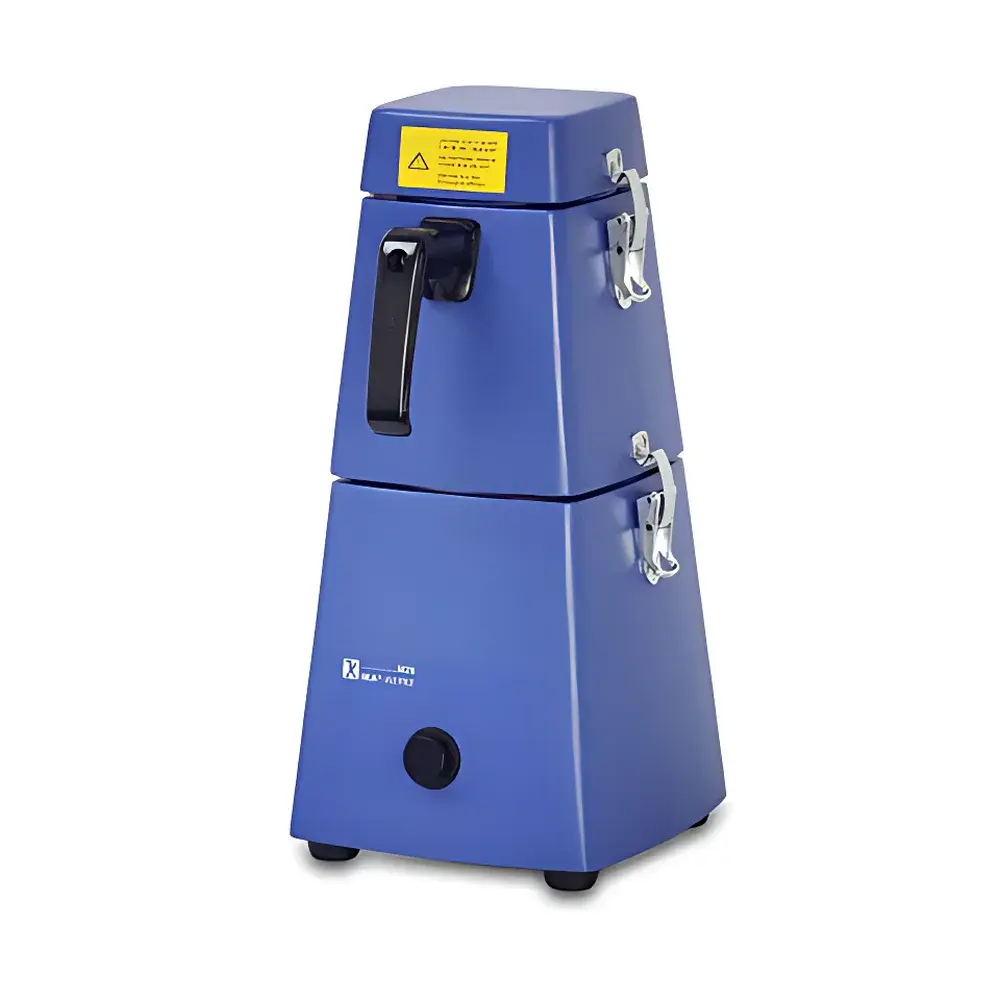
IKA M 20 Universal Mill
| Brand | IKA |
|---|---|
| Origin | Germany |
| Manufacturer Type | Manufacturer |
| Origin Category | Imported |
| Model | M 20 Universal Mill |
| Instrument Type | Grinder |
| Sample Applicability | Hard, brittle materials |
| Feed Particle Size | < 7 mm |
| Output Particle Size | 1–80 µm |
| Batch Grinding Capacity | 250 mL |
| Grinding Media | Stainless steel cutting head (1.4034) and grinding chamber (1.4301) |
| Motor Input Power | 450 W |
| Motor Output Power | 225 W |
| Max. Speed | 20,000 rpm |
| Max. Peripheral Speed | 72 m/s |
| Max. Feed Hardness | 5 Mohs |
| Operating Cycle | 7 min ON / 10 min OFF |
| Cooling | Water-jacketed chamber (external coolant connection) or dry ice cooling |
| Dimensions (W × H × D) | 170 × 350 × 170 mm |
| Weight | 6.6 kg |
| Ambient Temperature Range | 5–40 °C |
| Relative Humidity Limit | ≤ 80 % |
| Protection Class | IP 21 (DIN EN 60529) |
| Voltage | 230 / 115 / 100 V |
| Frequency | 50/60 Hz |
| Total Input Power | 550 W |
Overview
The IKA M 20 Universal Mill is a high-performance, benchtop batch grinder engineered for reproducible, controlled size reduction of hard and brittle solid samples under dry conditions. Based on high-speed rotor-stator shear and impact mechanics, the instrument delivers consistent particle size distribution (PSD) through precise mechanical energy transfer. Its robust stainless-steel construction—featuring a 1.4034 hardened stainless steel cutting head and a 1.4301 austenitic stainless steel grinding chamber—ensures durability against abrasive wear while maintaining material purity. Designed for laboratory environments requiring trace-metal-free processing and routine QC/QA workflows, the M 20 operates within defined thermal limits via integrated cooling options, minimizing heat-induced degradation of thermolabile analytes.
Key Features
- High-speed rotor-stator grinding system operating up to 20,000 rpm with a maximum peripheral velocity of 72 m/s, enabling efficient comminution of materials rated up to 5 Mohs hardness.
- Water-jacketed grinding chamber with standardized hose fittings for external coolant circulation—compatible with tap water, chilled glycol solutions, or dry ice slurry for active temperature control during extended operation.
- Quick-release, tool-free chamber disassembly for rapid cleaning and cross-contamination prevention; compatible with optional dual-chamber configuration (M 21 cutting head pre-installed).
- Thermally managed duty cycle (7 min ON / 10 min OFF) ensures motor longevity and stable performance across repeated batches.
- IP 21-rated enclosure provides protection against vertically falling drips and solid objects ≥12.5 mm, meeting standard laboratory safety requirements per DIN EN 60529.
- Multi-voltage compatibility (230 / 115 / 100 V) and dual-frequency support (50/60 Hz) enable global deployment without hardware modification.
Sample Compatibility & Compliance
The M 20 Universal Mill is validated for dry grinding of inorganic minerals, pharmaceutical excipients, ceramic precursors, polymer granules, and botanical matrices exhibiting low moisture content and brittleness. It is not suitable for fibrous, elastic, or highly viscous materials. The device complies with IEC 61000-6-3 (EMC emission standards) and IEC 61000-6-2 (immunity), and its mechanical design adheres to ISO 13857 (safety distances) and EN 61000-3-2 (harmonic current limits). While not intrinsically certified for ATEX environments, its sealed motor housing and absence of ignition sources make it appropriate for general-purpose analytical labs operating under GLP-compliant documentation protocols.
Software & Data Management
The M 20 operates as a standalone electromechanical instrument without embedded firmware or digital connectivity. All operational parameters—including speed, runtime, and cooling status—are manually set and monitored via front-panel controls. For regulated environments, users may integrate the mill into broader lab data management systems using external time-stamped loggers or programmable logic controllers (PLCs) interfaced via relay outputs (optional accessory). Though lacking native 21 CFR Part 11 compliance features, its mechanical simplicity supports audit-ready recordkeeping when paired with SOP-driven manual logs and batch worksheets aligned with ISO/IEC 17025 and USP guidelines for equipment qualification.
Applications
- Preparation of homogenized reference standards for X-ray fluorescence (XRF) and inductively coupled plasma (ICP) analysis.
- Particle size conditioning prior to sieve analysis (ASTM E11, ISO 3310-1) or laser diffraction measurement (ISO 13320).
- Routine milling of tablet excipients and active pharmaceutical ingredients (APIs) for dissolution testing per USP .
- Fragmentation of geological core samples for geochemical assay preparation (e.g., fusion bead preparation for ICP-OES).
- Size reduction of catalyst supports and battery electrode materials prior to BET surface area analysis (ISO 9277).
FAQ
Can the M 20 be used for cryogenic grinding?
Yes—dry ice slurry can be circulated through the jacketed chamber to maintain sub-ambient grinding temperatures, provided condensation is prevented and sample moisture content remains below 1 %.
Is the grinding chamber autoclavable?
No—the chamber is not designed for steam sterilization; however, it is fully compatible with ethanol wiping, alkaline detergent immersion, and ultrasonic cleaning in non-corrosive solvents.
What maintenance intervals are recommended?
Inspect the cutting head edge and chamber interior for wear every 50 operating hours; replace the cutting head after ~200 h of cumulative use under typical load conditions.
Does IKA provide validation documentation for GMP environments?
IKA supplies Factory Acceptance Test (FAT) reports and mechanical calibration certificates; full IQ/OQ/PQ protocols must be developed by the end user in accordance with their internal quality system.
Can the M 20 process samples containing metallic inclusions?
No—samples with ferromagnetic or hard metallic contaminants risk irreversible damage to the cutting head and chamber; pre-sieving or magnetic separation is mandatory.



