
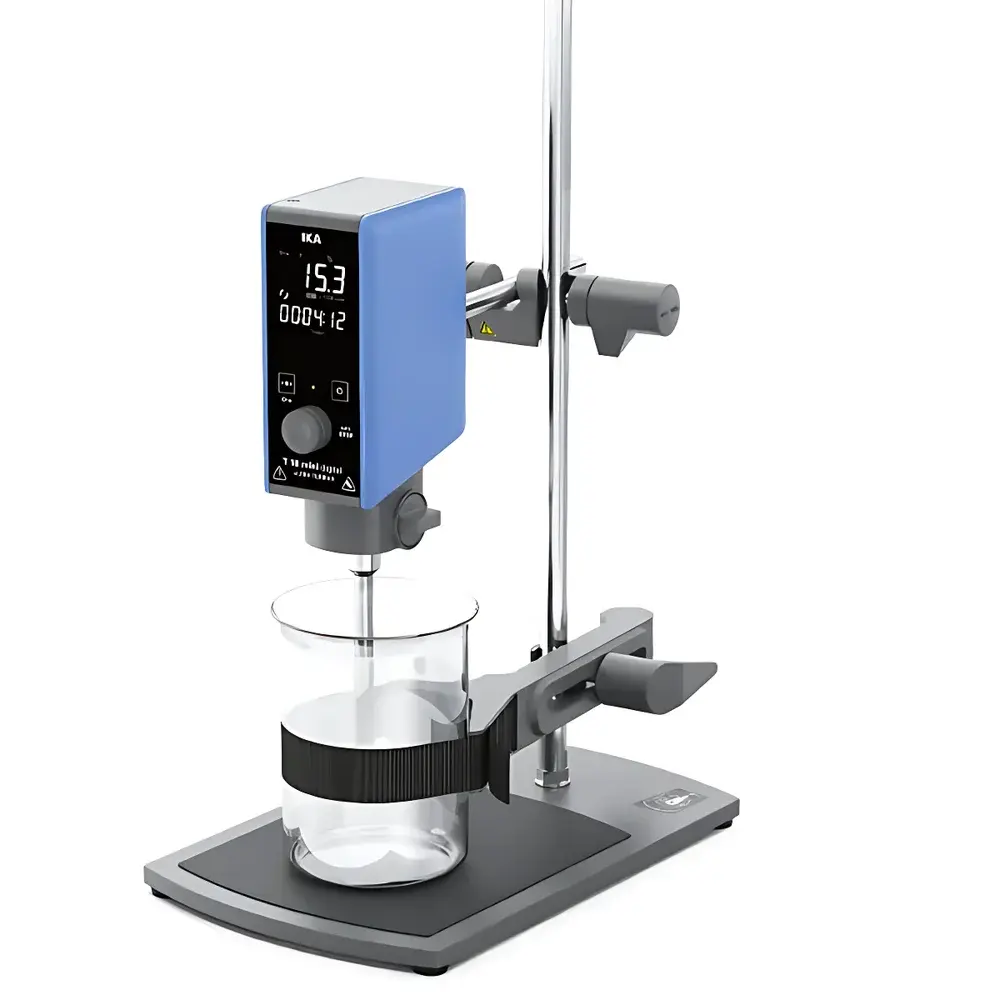
IKA T 25 mini control Solution ULTRA-TURRAX® Disperser System
| Brand | IKA |
|---|---|
| Origin | Germany |
| Manufacturer | IKA Werke GmbH & Co. KG |
| Type | Imported Laboratory Disperser |
| Model | T 25 mini control Solution |
| Motor Input Power | 210 W |
| Motor Output Power | 160 W |
| Volume Range (H₂O) | 0.001–1.5 L |
| Max. Viscosity | 2000 mPa·s |
| Speed Range | 600–25,000 rpm |
| Speed Accuracy | ±3% (n > 3000 rpm), ≤±100 rpm (n < 3000 rpm) |
| Speed Control | Continuously Variable |
| Display | TFT Touchscreen with LED Backlight |
| Temperature Measurement Range | 0–125 °C |
| Temp. Resolution | 0.1 K |
| Temp. Accuracy | ±1 K |
| Timer Function | Yes |
| Continuous Duty Cycle | 100% |
| Dimensions (W×H×D) | 66 × 186 × 100 mm |
| Weight | 1.8 kg |
| Ambient Operating Conditions | 5–40 °C, ≤80% RH |
| Ingress Protection | IP30 (DIN EN 60529) |
| Interfaces | RS232, USB-C, WiFi, Ethernet, PAN |
| Voltage | 100–240 V AC, 50/60 Hz |
| Standby Power Consumption | 3 W |
| DC Supply | 48 V =, 4500 mA |
| Noise Level (no dispersing tool) | 75 dB(A) |
| Drive Principle | Brushless DC Motor |
| Extension Arm Diameter | 13 mm |
| Extension Arm Length | 160 mm |
| Process Type | Batch Processing |
Overview
The IKA T 25 mini control Solution is a compact, high-precision ULTRA-TURRAX® disperser system engineered for reproducible batch processing of low-to-medium viscosity samples in research, quality control, and production laboratories. Based on the principle of high-shear rotor-stator dispersion, it generates intense hydrodynamic forces—via controlled rotational speed and optimized geometry of interchangeable dispersing tools—to achieve efficient homogenization, emulsification, suspension stabilization, and particle size reduction down to the micrometer range. Its brushless DC motor ensures stable torque delivery across the full speed range (600–25,000 rpm), eliminating carbon dust contamination and enabling silent, maintenance-reduced operation. The integrated temperature sensor (0–125 °C, ±1 K accuracy) and real-time digital monitoring allow precise thermal process tracking—critical for heat-sensitive formulations such as pharmaceutical suspensions or polymer dispersions.
Key Features
- Compact footprint (66 × 186 × 100 mm) designed for benchtop integration in space-constrained environments including biosafety cabinets and fume hoods.
- TFT touchscreen interface with high-contrast LED backlight enables clear parameter visualization from distances up to 2 meters—ideal for shared lab workspaces.
- Brushless DC motor architecture delivers extended service life, consistent speed regulation, and acoustic performance rated at ≤75 dB(A) under no-load conditions.
- Continuous-duty rating (100% duty cycle) supports unattended operation during extended protocols; integrated timer function enables programmable run durations with automatic shutdown.
- Multi-interface connectivity (USB-C, RS232, WiFi, Ethernet, PAN) ensures seamless integration into networked lab infrastructures and compliance-ready data workflows.
- Ergonomic, tool-free dispersing tool mounting system (e.g., R 1826 stainless steel rotor/stator assembly) allows rapid exchange and thorough cleaning—supporting GMP-aligned hygiene practices.
Sample Compatibility & Compliance
The T 25 mini control Solution accommodates sample volumes from 1 mL to 1.5 L (water-equivalent), with validated performance up to 2000 mPa·s viscosity. It is compatible with IKA’s full portfolio of ULTRA-TURRAX® dispersing tools—including S 25 EC-T-C-18 G (optimized for emulsification), R 1826 (for fine dispersion), and disposable plastic heads for single-use applications. The system meets DIN EN 60529 (IP30) for protection against solid objects ≥2.5 mm and complies with IEC 61000-6-3 (EMC emissions) and IEC 61000-6-2 (immunity). When used with IKAlabworldsoft® software and enabled audit trail logging, the instrument supports GLP/GMP documentation requirements per FDA 21 CFR Part 11 for electronic records and signatures.
Software & Data Management
IKAlabworldsoft® software provides remote configuration, real-time parameter logging (speed, temperature, time, torque), and export of timestamped CSV datasets. USB-C and Ethernet interfaces support direct connection to local networks or laboratory information management systems (LIMS). WiFi and PAN enable wireless synchronization with mobile devices for status monitoring. All parameter changes are recorded with user ID, timestamp, and value delta—establishing traceability essential for method validation and regulatory submissions. Data encryption and role-based access control align with ISO/IEC 27001-informed IT security policies in regulated environments.
Applications
- Pharmaceutical development: Preparation of nanoemulsions, microsuspensions, and lipid-based drug delivery systems.
- Materials science: Exfoliation of 2D materials (e.g., graphene oxide), dispersion of nanoparticles in polymer matrices, and slurry homogenization for battery electrode manufacturing.
- Food & beverage R&D: Stabilization of oil-in-water emulsions (mayonnaise, dressings), cell disruption for enzyme extraction, and viscosity-modified functional ingredient blends.
- Chemical synthesis: Catalyst dispersion in heterogeneous reactions, pigment grinding in coatings, and surfactant-mediated phase inversion processes.
- Academic research: Reproducible scale-down models for industrial dispersion processes, rheological pre-conditioning prior to DLS or SEM analysis.
FAQ
What is the maximum recommended operating temperature for the dispersing tool shaft?
The extension arm (13 mm diameter, 160 mm length) is rated for continuous use up to 125 °C when paired with temperature-compatible dispersing tools such as the S 25 EC-T-C-18 G.
Can the T 25 mini control Solution be integrated into automated liquid handling platforms?
Yes—via RS232 or Ethernet commands, the device accepts ASCII-based remote control instructions (e.g., speed setpoint, start/stop, timer activation), enabling synchronization with robotic arms or PLC-controlled workflows.
Is calibration certification available for speed and temperature sensors?
IKA offers factory calibration certificates (traceable to DKD/DAkkS standards) upon request; users may also perform internal verification using NIST-traceable tachometers and PT100 reference probes.
How does the system handle high-viscosity samples near the 2000 mPa·s limit?
Optimal performance requires selecting a rotor-stator geometry with larger clearance (e.g., S 25 N) and reducing speed incrementally while monitoring motor load—avoiding sustained operation above 85% nominal torque.
Does the USB-C port support power delivery to connected peripherals?
No—the USB-C interface is data-only; external peripherals must be self-powered or connected via separate USB hubs with independent power supplies.
Related Products



