
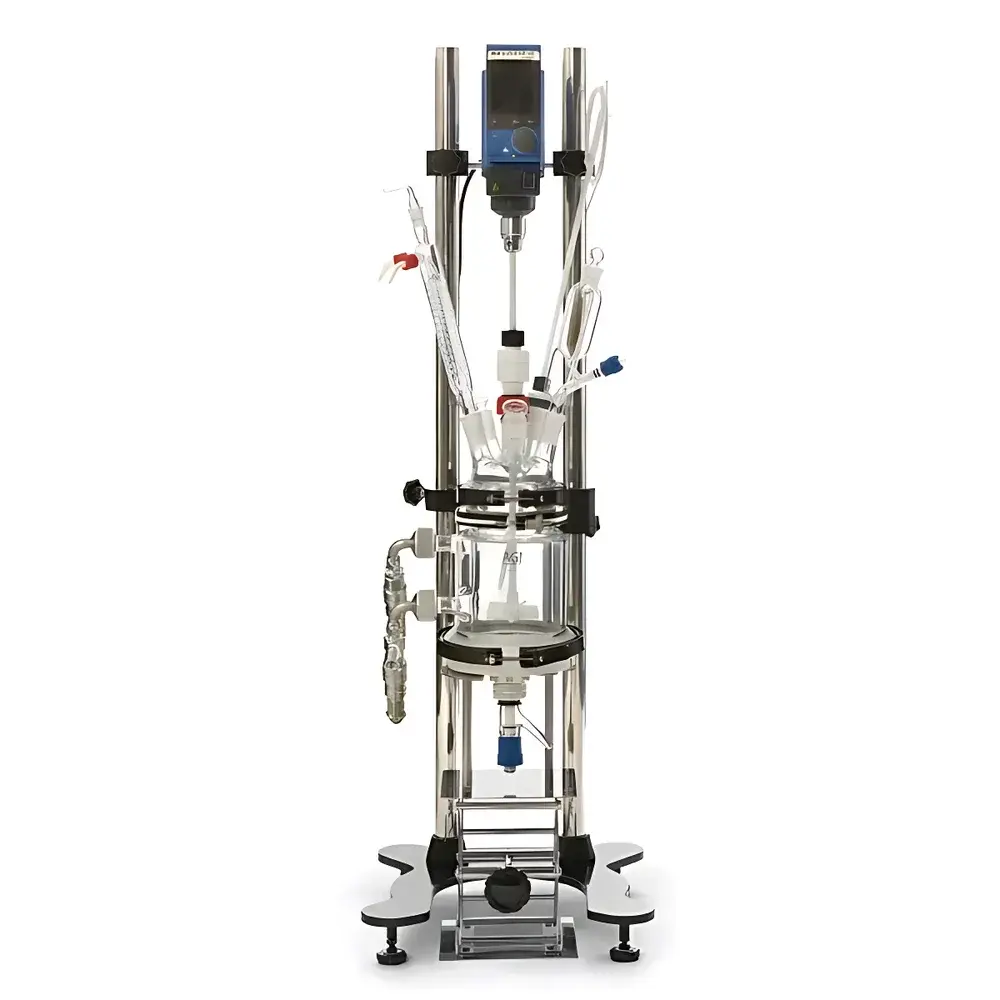
IKA 5L Jacketed Filter Reactor
| Brand | IKA |
|---|---|
| Origin | Germany |
| Model | 5L Filter Reactor |
| Vessel Capacity | 5 L |
| Jacketed Design | Yes |
| Operating Temperature Range | −90 °C to +200 °C |
| Thermal Shock Resistance (ΔT) | 110 °C |
| Operating Pressure Range | 666 Pa to atmospheric |
| Wetted Materials | Borosilicate Glass 3.3, PTFE, FFKM, FKM |
| Lid Ports | 6 (SQG 29/42 × 1, TS 29/42 × 1, TS 24/40 × 4) |
| Maximum Agitator Speed | 800 rpm |
| Dimensions (W×D×H) | 380 mm × 380 mm × 1206 mm |
| Weight | 33 kg |
Overview
The IKA 5L Jacketed Filter Reactor is a modular, benchtop-scale chemical reactor engineered for precise control and operational flexibility in small-batch synthesis, catalytic screening, crystallization, and solid–liquid separation workflows. It integrates jacketed temperature control, high-integrity mechanical agitation, and in-situ filtration into a single, compact platform—eliminating intermediate transfer steps and minimizing cross-contamination risk. Based on Couette-type shear principles and gravity-assisted or vacuum-assisted filtration, the system enables real-time process monitoring and reproducible phase separation under controlled thermal and pressure conditions. Its design adheres to fundamental principles of chemical process intensification, supporting both stoichiometric and kinetic studies where thermal stability, material compatibility, and phase integrity are critical.
Key Features
- Modular jacketed glass vessel (5 L capacity) constructed from DIN ISO 3585-certified borosilicate glass 3.3, ensuring high thermal shock resistance (ΔT ≤ 110 °C) and chemical inertness across pH 0–14 and common organic solvents.
- Integrated filtration base with quick-release mechanism; compatible with standard sintered glass frits (porosity grades G3–G4), polymeric membranes, or custom filter cartridges.
- Leak-tight sealing architecture: dual O-ring compression at the filtration base interface, reinforced with FFKM and FKM elastomers rated for continuous use from −90 °C to +200 °C.
- Top-mounted agitator drive with magnetic coupling, delivering up to 800 rpm with torque feedback and adjustable speed ramping—optimized for viscous media (up to 50,000 mPa·s) without shaft seal leakage.
- Six standardized lid ports (including SQG 29/42 and TS 24/40 interfaces) support simultaneous integration of temperature probes, pH electrodes, reflux condensers, dosing needles, and gas inlets.
- Tool-free assembly/disassembly of filtration components; bottom discharge valve with PTFE-lined seat ensures zero dead volume and complete sample recovery.
- Efficient thermal management via double-wall jacket with optimized flow path geometry—enabling rapid heating/cooling rates and <±0.5 °C temperature uniformity across the reaction volume.
Sample Compatibility & Compliance
The reactor accommodates heterogeneous reaction mixtures including slurries, precipitates, catalyst suspensions, and thermally sensitive intermediates. All wetted surfaces comply with USP Class VI and FDA 21 CFR 177.1550 for fluoropolymer components. The glass body meets ASTM E438 Type I, Class A specifications. System architecture supports GLP/GMP-aligned documentation practices: temperature probe outputs are calibrated traceable to NIST standards; pressure and agitation logs can be exported for audit trails. Optional validation packages include IQ/OQ protocols aligned with ISO 9001 and ISO/IEC 17025 laboratory accreditation requirements.
Software & Data Management
While the base configuration operates via analog controls and manual setpoints, optional digital integration enables connection to IKA Labworld software or third-party SCADA systems via RS485/Modbus RTU. Temperature, agitation speed, and pressure data streams may be logged at 1 Hz resolution with timestamped CSV export. Audit-trail functionality—including user login tracking, parameter change history, and electronic signature support—is available when paired with compliant HMI modules satisfying FDA 21 CFR Part 11 requirements.
Applications
- Catalyst recovery and reuse studies in hydrogenation, oxidation, and cross-coupling reactions.
- Crystallization kinetics and polymorph screening under controlled supersaturation and cooling profiles.
- Heterogeneous acid/base neutralizations with in-line solid removal to prevent side reactions.
- API purification workflows requiring sterile-grade filtration and minimal hold time.
- Process development for continuous manufacturing—providing scalable hydrodynamic and thermal boundary data relevant to pilot-plant reactor design.
- Green chemistry applications involving solvent-free or low-solvent reactions where residue minimization is essential.
FAQ
Can this reactor be used under vacuum or mild positive pressure?
Yes—it is rated for operation from 666 Pa (0.5 Torr) to ambient pressure, with all seals validated per ISO 2852 for leak integrity at 1.5× maximum working pressure.
Is the filtration base compatible with membrane filters?
Yes; the base accepts standard 47 mm or 90 mm diameter flat-sheet membranes with appropriate support plates and gasket kits (sold separately).
What agitator geometries are supported?
Standard configurations include anchor, paddle, and turbine impellers in PTFE-coated stainless steel or fully PTFE construction; custom geometries can be mounted via ISO 20811-compliant flange adapters.
How is temperature measured and controlled?
A Pt100 Class B probe is embedded in the jacket inlet/outlet manifold; external PID controllers (e.g., IKA RV 10 digital) regulate circulating fluid temperature with ±0.3 °C setpoint accuracy.
Does the system meet electrical safety standards for EU laboratories?
Yes—certified to EN 61010-1:2019 and carries CE marking with conformity to RoHS 2011/65/EU and EMC Directive 2014/30/EU.



