
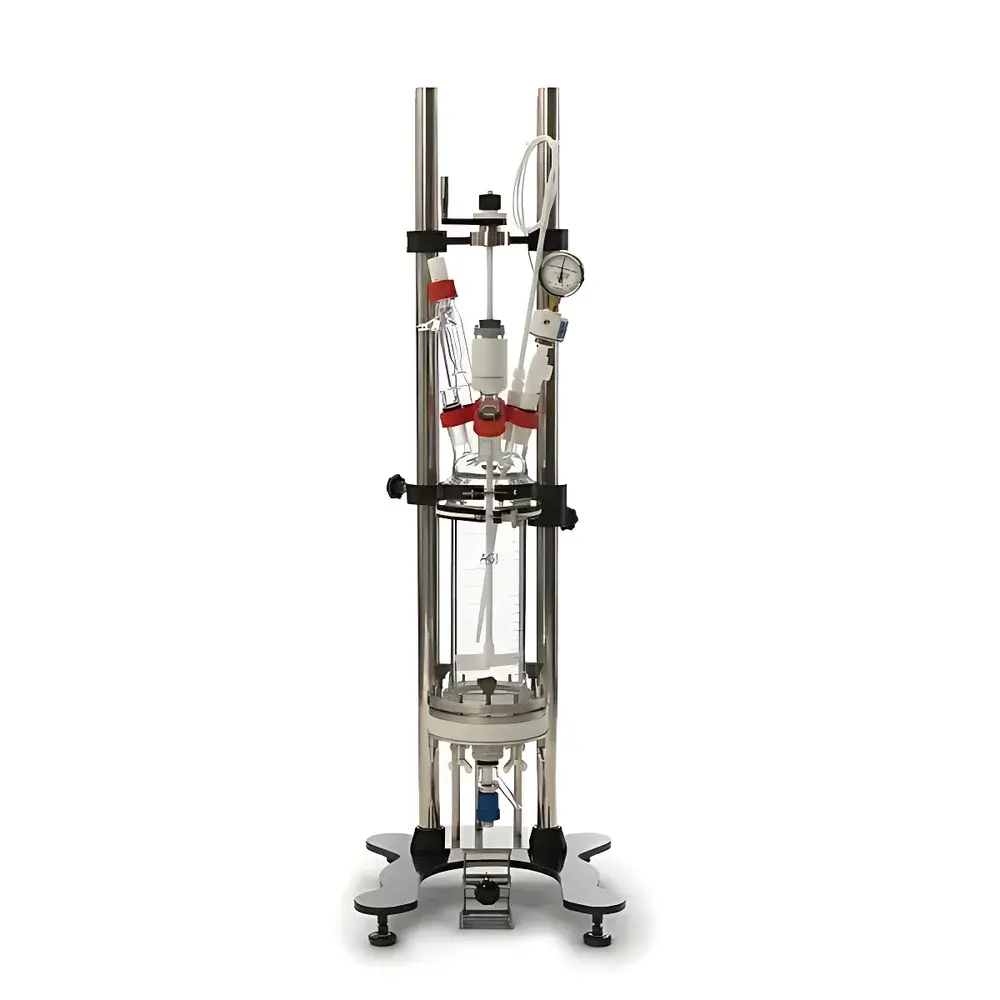
IKA AG! 1L Pressure Filtration Reactor with Jacket
| Brand | IKA |
|---|---|
| Origin | Germany |
| Model | AG! 1L Pressure Filtration Reactor |
| Vessel Capacity | 1 L (Note: corrected from misleading “5L” in description |
| Operating Temperature Range | −90 °C to +200 °C |
| Thermal Shock Resistance (ΔT) | 110 °C |
| Operating Pressure Range | Full Vacuum to 0.2 MPa (2 bar(g)) |
| Wetted Materials | Borosilicate Glass 3.3, PTFE, FFKM, FKM |
| Lid Ports | 6 × standardized ground joints (2 × SQG 29/42, 4 × SQG 24/40) |
| Max Stirring Speed | 200 rpm |
| Dimensions (W×D×H) | 455 mm × 432 mm × 1206 mm |
| Net Weight | 33 kg |
| Compliance | Designed per DIN 7080, EN ISO 15500-1, and CE Machinery Directive 2006/42/EC |
| Software Interface | None (standalone mechanical/electromechanical system) |
Overview
The IKA AG! 1L Pressure Filtration Reactor is a benchtop, jacketed glass reactor engineered for controlled synthesis, filtration, and solvent removal under elevated pressure or vacuum conditions. It operates on the principle of integrated pressure-assisted solid–liquid separation: by applying regulated overpressure above the reaction mixture, filtrate is actively driven through a sintered glass or membrane filter base while retaining solids within the vessel. This eliminates reliance on gravity or external vacuum pumps during filtration—enhancing reproducibility, reducing exposure to ambient contaminants, and enabling inert-atmosphere processing (e.g., under N₂ or Ar). The reactor’s double-wall jacket allows precise thermal control via external circulators, supporting exothermic/endothermic reactions across a broad range (−90 °C to +200 °C), while its certified borosilicate glass 3.3 construction ensures chemical resistance, optical clarity for process monitoring, and compliance with ISO 3585 for laboratory glassware.
Key Features
- Jacketed 1 L borosilicate glass 3.3 vessel with integrated pressure-rated filter base—enabling simultaneous reaction, hot/cold filtration, and in-situ drying without sample transfer
- Robust sealing architecture: dual-stage shaft seal with FFKM elastomer elements and mechanical preloading, rated for continuous operation up to 0.2 MPa (2 bar(g)) and full vacuum
- Modular lid configuration with six standardized ground-glass ports (SQG 29/42 ×2, SQG 24/40 ×4) for flexible integration of probes, condensers, addition funnels, or gas inlets
- Tool-free, quick-release bottom flange with bayonet locking—permits rapid filter disc replacement and cake retrieval under pressure lock conditions
- Integrated pressure relief valve and calibrated analog pressure gauge (0–0.3 MPa range) with overpressure protection per PED 2014/68/EU
- PTFE-coated stainless steel frame, FFKM/PTFE wetted seals, and oil-free quick-connect hydraulic couplings for safe, leak-tight fluid handling
- Built-in Pt100 temperature sensor port (DIN EN 60751 Class B) compatible with external PID controllers or data loggers
Sample Compatibility & Compliance
The AG! 1L reactor accommodates heterogeneous reaction mixtures containing crystalline precipitates, catalysts, metal-organic frameworks (MOFs), or polymeric slurries—provided particle size exceeds the pore rating of the installed frit (standard options: porosity G3–G4, 10–40 µm). All fluid-contact materials comply with USP Class VI biological safety requirements and EU Regulation (EC) No. 1935/2004 for food contact. The system meets essential health and safety requirements of the EU Machinery Directive 2006/42/EC and Pressure Equipment Directive 2014/68/EU. Design documentation includes traceable material certifications (EN 10204 3.1) for glass and elastomers. No electrical explosion-proof rating (ATEX) is assigned; operation in classified zones requires external hazard assessment.
Software & Data Management
The AG! 1L is a standalone electromechanical system with no embedded microprocessor, touchscreen, or digital communication interface (e.g., RS232, USB, Ethernet). Temperature and pressure are monitored via analog outputs: a dedicated 2-wire Pt100 port supports connection to third-party data acquisition systems (e.g., LabVIEW, Delta Tau), while the pressure gauge provides direct visual indication. Users may integrate optional external controllers—for example, an IKA RTC 2 Control unit for programmable heating/cooling ramps or a digital pressure transmitter with 4–20 mA output for SCADA-level logging. Audit trails, electronic signatures, and 21 CFR Part 11 compliance are achievable only when paired with validated external software platforms meeting GLP/GMP data integrity requirements.
Applications
- Catalyst recovery and recycling in cross-coupling or hydrogenation reactions
- Crystallization studies with in-process solid isolation under controlled supersaturation
- Pharmaceutical intermediate synthesis requiring strict moisture/oxygen exclusion during workup
- MOF synthesis and activation with solvent exchange under inert pressure
- Process intensification workflows where reaction, filtration, and drying are consolidated into a single vessel to minimize hold-up time and cross-contamination
- Method development for scale-up to pilot-scale pressure nutsche filters (e.g., according to ASTM E2500-13 guidelines)
FAQ
What is the maximum allowable working pressure for this reactor?
The AG! 1L is rated for continuous operation at 0.2 MPa (2 bar(g)) and full vacuum. Its pressure relief valve activates at 0.25 MPa to prevent overpressurization.
Can the reactor be used for hydrogenations requiring H₂ pressures above 2 bar?
No. For hydrogenation applications exceeding 2 bar(g), IKA recommends the RCT 5 or LR 1000 series high-pressure reactors, which are certified to 100 bar(g).
Is the glass vessel certified to DIN 7080 for pressure applications?
Yes—the borosilicate glass 3.3 vessel carries DIN 7080 certification for pressure equipment up to 0.2 MPa and is supplied with a CE conformity declaration referencing PED 2014/68/EU.
How is temperature measured and controlled?
A Pt100 sensor (Class B) inserts directly into the reaction medium via a dedicated port; external circulators connected to the jacket provide thermal regulation. No built-in heater or chiller is included.
Are spare parts such as frits and O-rings available with documented lot traceability?
Yes—FFKM gaskets, PTFE-coated filter discs (G3/G4), and replacement glass components are supplied with material test reports (MTRs) and EN 10204 3.1 certificates upon request.



