
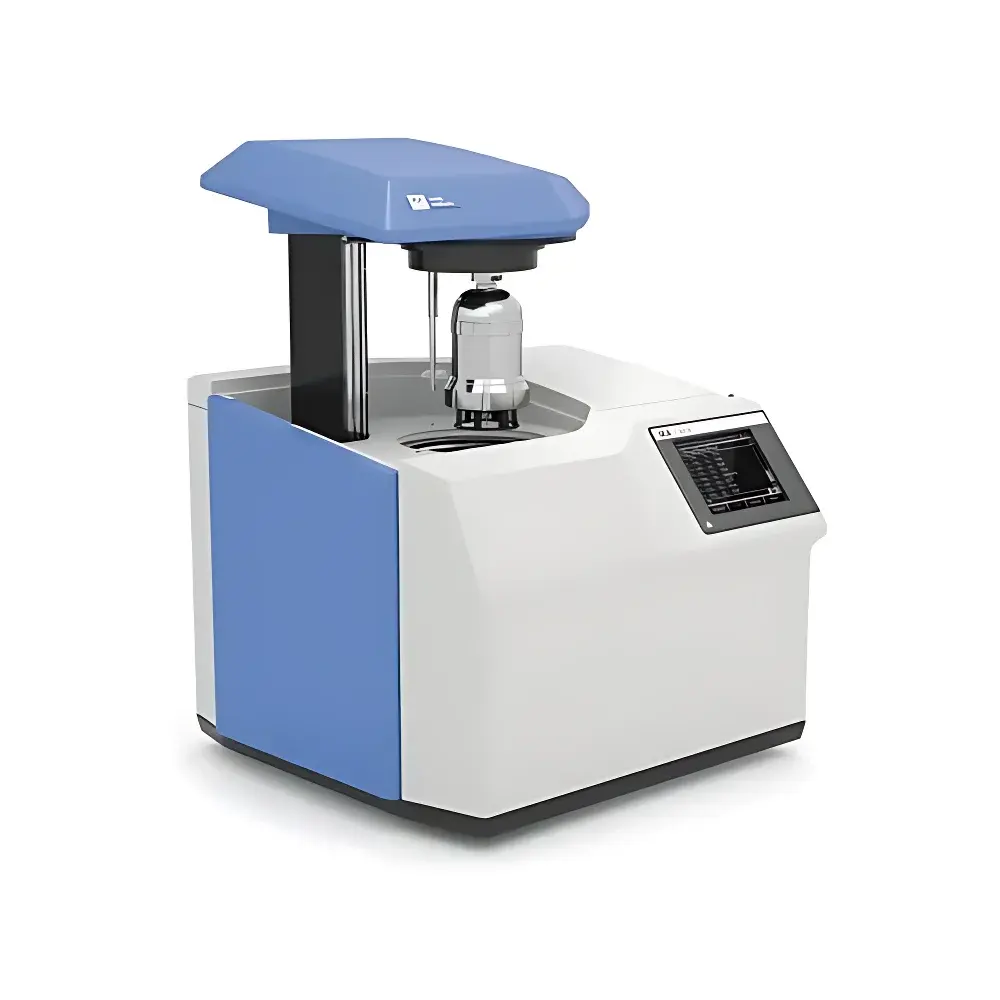
IKA C6000 Global Standards Package 1/10 Adiabatic/Oxygen Bomb Calorimeter
| Brand | IKA |
|---|---|
| Origin | Germany |
| Manufacturer | IKA Works GmbH & Co. KG |
| Instrument Type | Oxygen Bomb Calorimeter |
| Measurement Modes | Adiabatic, Isoperibol (Isothermal), Dynamic |
| Temperature Range | 22–30 °C |
| Temperature Resolution | 0.0001 K |
| Precision | 0.05% RSD (Adiabatic & Isothermal, 1 g benzoic acid NBS 39i) |
| Single-Sample Test Time | 15 min |
| Heat Capacity Calibration Range | 40,000 J |
| Cooling Circulator | RC 2 Basic |
| External Water Jacket Capacity | Not specified |
| Internal Water Jacket Capacity | Not specified |
| Max Oxygen Pressure | 40 bar |
| Cooling Medium | Tap water |
| Min Flow Rate | 60 L/h |
| Max Flow Rate | 70 L/h |
| Ambient Operating Temp | 20–25 °C |
| Relative Humidity Limit | ≤80% RH |
| Protection Class | IP20 |
| Power Supply | 220–240 V / 100–120 V, 50/60 Hz |
| Input Power | 2000 W |
| Dimensions (W×D×H) | 500 × 425 × 450 mm |
| Weight | 29 kg |
Overview
The IKA C6000 Global Standards Package 1/10 is a high-precision oxygen bomb calorimeter engineered for rigorous thermodynamic quantification of gross calorific value (GCV) in solid and liquid fuels, biomass, waste-derived fuels, and certified reference materials. It operates on the fundamental principle of combustion calorimetry: complete oxidation of a precisely weighed sample within a sealed, high-pressure oxygen environment (up to 40 bar), with heat release captured by a thermally isolated water jacket system. The instrument supports three standardized measurement modes—adiabatic, isoperibol (isothermal), and dynamic—each compliant with internationally recognized test protocols including DIN 51900, ISO 1928, ASTM D240/D4809/D5865, EN 15170, and GB/T 213. Its adiabatic mode maintains near-zero thermal exchange between the inner and outer water jackets via active temperature control, enabling direct determination of energy release without correction for heat loss. The dynamic mode accelerates throughput by optimizing ignition timing and thermal equilibration algorithms while preserving metrological integrity.
Key Features
- Triple-mode operation: Adiabatic (22 °C, 25 °C, 30 °C), isoperibol (22 °C, 25 °C, 30 °C), and dynamic (22 °C, 25 °C, 30 °C) — configurable per test requirement
- High-resolution temperature sensing with ±0.0001 K resolution and traceable calibration against NIST-traceable standards
- Automated workflow integration: motorized oxygen filling, venting, and O2 purge; auto-fill/drain of inner and outer water jackets; spark ignition with simultaneous ignition energy compensation
- RFID-enabled C6010 standard bomb recognition ensuring unambiguous sample-bomb association and audit-ready metadata capture
- 10.1-inch capacitive touchscreen interface with intuitive navigation, real-time thermal curve visualization, and embedded control chart functionality for SPC-compliant process monitoring
- Dual cooling architecture: integrated RC 2 basic chiller with regulated flow (60–70 L/h at 18 °C) and tap-water-compatible operation; cooling medium inlet range: 12–27 °C, max pressure 1.5 bar
- Comprehensive connectivity suite: RS232 (balance, PC, printer), USB 2.0 (data export, firmware updates, peripheral attachment), Ethernet (network printing, remote diagnostics)
Sample Compatibility & Compliance
The C6000 accommodates a broad spectrum of heterogeneous samples—from coal, coke, and lignite to municipal solid waste (MSW), refuse-derived fuel (RDF), sewage sludge, and biofuels—within its robust C6010 stainless-steel oxygen bomb (DIN-compliant design). Sample mass ranges from 0.5 g to 1.5 g depending on expected energy density, with optional micro-bomb configurations available for low-energy matrices. All measurement outputs are fully traceable to SI units and validated against certified reference materials such as NBS Standard Reference Material 39i (benzoic acid). The system satisfies regulatory requirements for quality assurance in accredited laboratories under ISO/IEC 17025, supports GLP-compliant documentation workflows, and provides full audit trails when paired with C6040 CalWin software—including user action logging, electronic signatures, and 21 CFR Part 11–ready configuration options.
Software & Data Management
C6040 CalWin (optional software package) serves as the central hub for method configuration, result validation, statistical reporting, and LIMS interoperability. It enables automated calculation of net calorific value (NCV) using standardized moisture, hydrogen, and ash corrections per ISO 1928 Annex B or ASTM D3176. Raw thermal data (temperature vs. time) is stored in vendor-neutral CSV format with embedded metadata (operator ID, timestamp, bomb ID, ambient conditions). The software supports customizable report templates aligned with ISO, ASTM, or internal QA formats, and includes built-in uncertainty estimation per GUM (Guide to the Expression of Uncertainty in Measurement). Export functions comply with laboratory informatics standards, allowing seamless integration into enterprise-wide data ecosystems via HL7 or ASTM E1384 interfaces.
Applications
- Fuel certification and trade settlement testing in power generation, cement, and steel industries
- Research and development of alternative and synthetic fuels (e.g., HVO, Fischer–Tropsch liquids, pyrolysis oils)
- Environmental compliance testing for waste-to-energy facilities under EU Waste Framework Directive and national emission trading schemes
- Academic and governmental metrology labs performing interlaboratory comparisons and reference material certification
- Quality control in petrochemical refineries for distillate fuels, heavy fuel oils, and lubricants
- Validation of thermochemical conversion efficiencies in biomass gasification and anaerobic digestion studies
FAQ
What standards does the C6000 support out-of-the-box?
The instrument natively implements calculation routines for DIN 51900, ISO 1928, ASTM D240, D4809, D5865, EN 15170, and GB/T 213 — all selectable via the touchscreen interface without software modification.
Is the C6000 suitable for routine high-throughput testing?
Yes. In dynamic mode, it achieves up to six determinations per hour; in adiabatic mode, five per hour; and in isoperibol mode, four per hour — with full reproducibility maintained across all modes.
Can the system be integrated into an existing LIMS environment?
Absolutely. Via C6040 CalWin and its configurable ASCII/CSV export protocols, the C6000 supports bidirectional LIMS communication, including sample ID push, result pull, and status synchronization.
Does the instrument require external calibration services?
No. Built-in electrical calibration (Joule effect) and certified benzoic acid verification enable in-house daily performance checks per ISO/IEC 17025 clause 7.7. Full recalibration of the temperature sensor and heat capacity factor is performed annually using traceable standards.
What safety certifications apply to the C6000 oxygen handling system?
The C6010 bomb and associated pneumatic circuitry comply with PED 2014/68/EU (Pressure Equipment Directive), EN 13445 (Unfired Pressure Vessels), and DIN EN ISO 13849-1 for functional safety of control systems.
Related Products



