
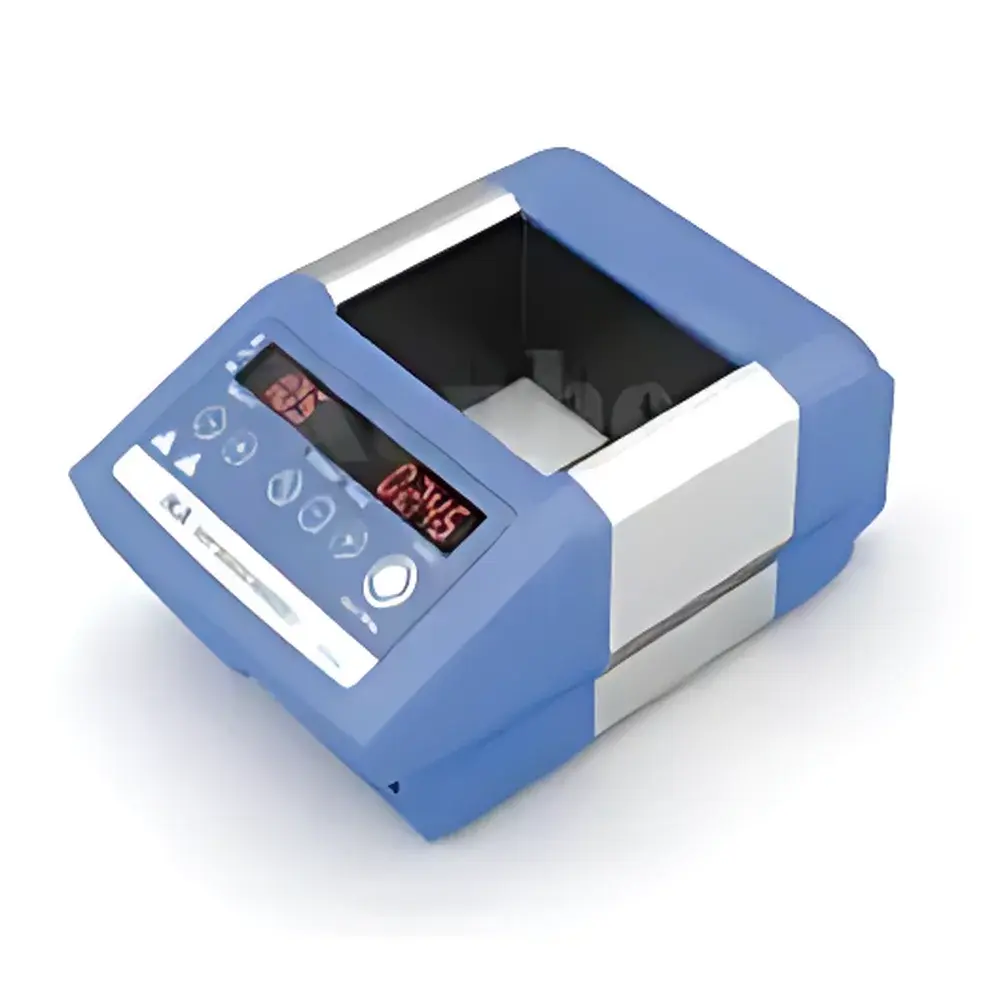
IKA Dry Block Heater 1 Digital Single-Block Metal Bath
| Brand | IKA |
|---|---|
| Origin | Germany |
| Model | Dry Block Heater 1 |
| Temperature Range | Ambient +5 °C to 120 °C |
| Temperature Accuracy | ±0.2 °C at 37 °C, ±0.4 °C at 60 °C |
| Temperature Uniformity | ±0.2 K at 37 °C, ±0.4 K at 60 °C |
| Heating Rate | ~5 K/min (with external PT1000 sensor) |
| Block Dimensions | 96 × 76 mm |
| External Sensor Interface | DIN 12878 compliant PT1000 input |
| Safety Cut-off | 150 °C fixed limit |
| Timer Range | 1 s – 99 h 59 min |
| Power Input | 165 W |
| Voltage | 220–240 V / 115 V / 100 V, 50/60 Hz |
| Housing Dimensions (W×D×H) | 151 × 73 × 228 mm |
| Net Weight | 1.342 kg |
| IP Rating | IP21 |
| Operating Environment | 5–40 °C, ≤80 % RH |
| Compliance | DIN EN 60529, DIN EN 60751 (Class A), DIN 12878 |
Overview
The IKA Dry Block Heater 1 is a precision-engineered digital single-block metal bath designed for reliable, uniform thermal control of small-volume samples in life science, clinical diagnostics, and analytical laboratories. Utilizing solid-state aluminum heating blocks with integrated temperature sensing and active PID regulation, it delivers stable thermal environments essential for time- and temperature-sensitive biochemical protocols. Unlike water baths, this dry block system eliminates contamination risks, condensation, evaporation, and maintenance overhead—making it ideal for routine incubation, enzymatic assays, nucleic acid denaturation, immunoassays, and quality control testing where reproducibility and traceability are critical. Its DIN 12878-compliant PT1000 sensor interface enables direct sample-in-tube temperature monitoring, ensuring that setpoint accuracy reflects actual sample thermal conditions—not just block surface temperature.
Key Features
- DIN 12878-compatible PT1000 sensor input: Enables real-time, sample-proximal temperature feedback for closed-loop control—critical for applications requiring strict adherence to thermal protocols (e.g., ISO 15197, CLSI EP10).
- High thermal stability and uniformity: ±0.2 K uniformity across the 96 × 76 mm aluminum block at 37 °C; ±0.4 K at 60 °C—validated per DIN EN 60751 Class A specifications.
- Precision digital timer with dual modes: Supports both countdown (1 s – 99 h 59 min) and elapsed-time display, with audible end-of-cycle alert for unattended operation.
- Fixed safety cut-off at 150 °C: Independent hardware-based thermal limiter prevents overheating under fault conditions—compliant with IEC 61010-1 safety requirements for laboratory equipment.
- Modular block compatibility: Designed for future expansion with interchangeable heating blocks (sold separately), supporting tubes (0.2–50 mL), microplates, cuvettes, and Greiner-format vessels.
- Rugged industrial construction: Aluminum housing with IP21 ingress protection ensures durability in shared lab environments; compact footprint (151 × 73 × 228 mm) optimizes benchtop space.
Sample Compatibility & Compliance
The Dry Block Heater 1 accommodates standard consumables including 0.2 mL PCR tubes, 0.5 mL and 1.5 mL microcentrifuge tubes, 96-well PCR plates, Greiner Bio-One polypropylene tubes, quartz and glass cuvettes, and standard spectrophotometric cells. Its thermal performance meets key regulatory benchmarks: temperature accuracy conforms to DIN EN 60751 (Class A PT1000 tolerance), block uniformity aligns with ISO/IEC 17025 calibration traceability requirements, and electrical safety complies with IEC 61010-1:2010. While the unit does not include RS232 or USB connectivity, its analog sensor interface supports integration into GLP/GMP workflows when paired with external data loggers compliant with FDA 21 CFR Part 11 audit trail standards.
Software & Data Management
This model operates as a standalone instrument without embedded software or network connectivity. All parameter setting and monitoring occur via its front-panel LED display and tactile keypad. For regulated environments, users may integrate the PT1000 output signal (via standard DIN 12878 connector) with third-party validated data acquisition systems—enabling automated logging, electronic signatures, and long-term trending in accordance with ALCOA+ principles. No proprietary firmware or cloud dependency is introduced, minimizing validation burden during IQ/OQ/PQ qualification.
Applications
- Thermal activation of restriction enzymes and polymerases in molecular biology workflows
- Controlled denaturation and annealing steps in PCR setup and post-amplification handling
- Incubation of cell cultures, bacterial transformations, and antibody-antigen binding reactions
- Standardized melting point and boiling point determinations per ASTM E324 and USP <741>
- Clinical assay preparation: urea nitrogen quantification, coagulation testing, and ELISA plate pre-warming
- Quality control of culture media sterility and gelatin liquefaction (ISO 7218)
- In situ hybridization (ISH) probe denaturation and hybridization incubation steps
FAQ
Does the Dry Block Heater 1 support external data logging?
Yes—via its DIN 12878-standard PT1000 input port, which provides a calibrated analog signal compatible with most validated laboratory data loggers.
Can the unit be used for GMP-regulated production processes?
It is suitable for GMP environments when qualified per Annex 15 and operated with documented procedures, calibrated sensors, and appropriate change control—though full 21 CFR Part 11 compliance requires integration with a compliant data system.
What is the maximum recommended continuous operating temperature?
The operational limit is 120 °C; prolonged use above 100 °C may accelerate thermal aging of silicone-sealed tube racks and reduce long-term block emissivity consistency.
Is the heating block removable for cleaning or replacement?
Yes—the aluminum block is mechanically secured and field-replaceable using standard lab tools; spare blocks are available with custom well configurations.
How is temperature uniformity verified during factory calibration?
Using a 9-point grid measurement with NIST-traceable PT100 probes per DIN EN 60751, recorded at steady-state conditions after 30 minutes of stabilization at 37 °C and 60 °C.



