
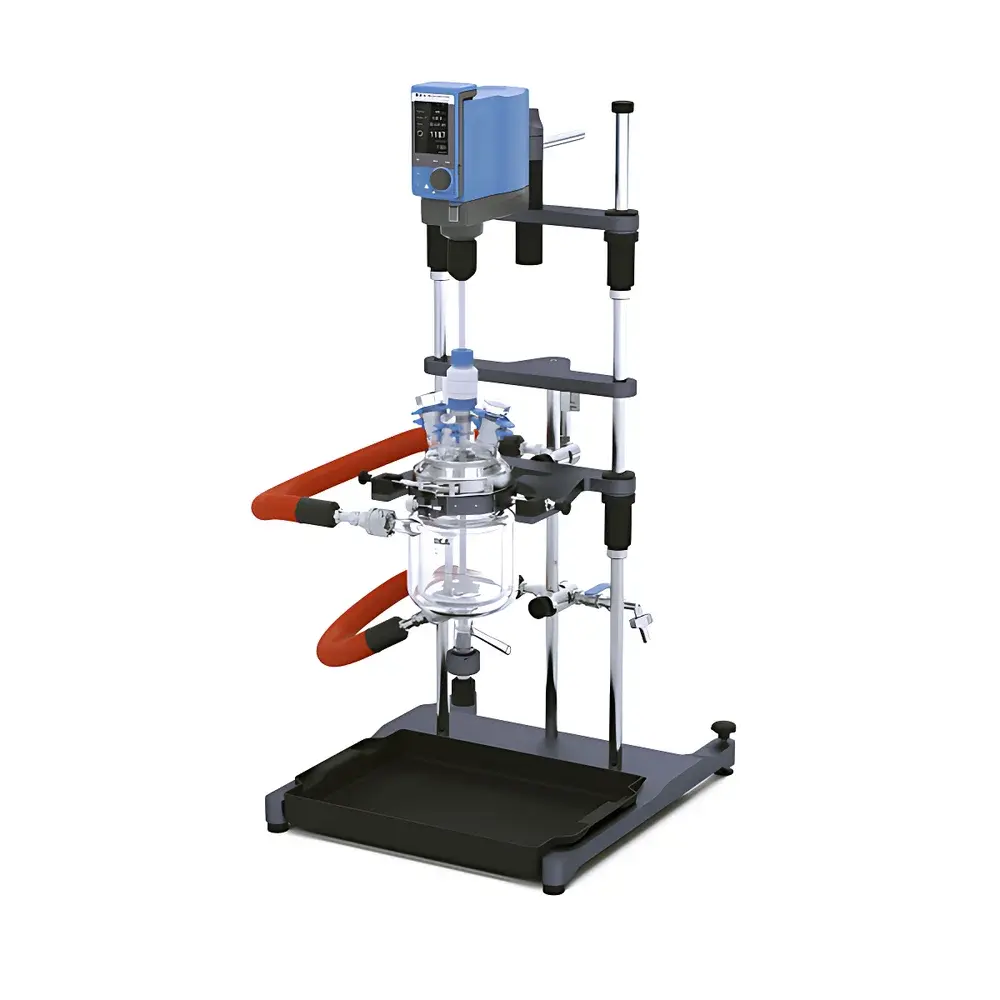
IKA EasySyn 1000 Advanced Professional Synthesis Reactor System
| Brand | IKA |
|---|---|
| Origin | Germany |
| Manufacturer Type | Original Equipment Manufacturer (OEM) |
| Product Category | Imported |
| Model | EasySyn 1000 Advanced |
| Reactor Type | Jacketed Glass Reactor |
| Usable Volume | 1 L |
| Operating Pressure Range | Low-pressure / Vacuum-compatible |
| Vacuum Level | 3 mbar |
| Construction Material | Borosilicate Glass 3.3 |
| Temperature Range | –50 °C to +200 °C |
| Stirrer Motor | EUROSTAR 100 control (Max. Torque: 100 N·cm) |
| Stirring Shaft Seal | High-integrity vacuum-rated mechanical seal |
| Vessel Fixation | DN 100 flange with FEP-coated O-ring |
| Lid Ports | 1 × NS 29/32 central, 2 × NS 29/32 lateral, 1 × NS 14/23 auxiliary |
| Drain System | LT 5.40 quick-drain module with valved thermal bath fluid lines |
| Control Interface | RS232 and USB |
| Software Integration | labworldsoft® 6 (optional external automation) |
Overview
The IKA EasySyn 1000 Advanced Professional Synthesis Reactor System is a fully integrated, jacketed glass reactor platform engineered for precision-controlled organic synthesis, aqueous-phase reactions, and process development in academic, pharmaceutical, and fine chemical laboratories. Based on Couette-type stirring mechanics and thermally regulated double-wall vessel architecture, the system enables reproducible reaction execution under controlled temperature, pressure, and mixing conditions. Its design adheres to fundamental principles of chemical engineering scale-up—maintaining consistent power input per unit volume, heat transfer coefficients, and mass transfer rates from lab-scale to pilot-scale workflows. The reactor operates safely within a validated thermal envelope of –50 °C to +200 °C using compatible circulating baths, and achieves stable vacuum conditions down to 3 mbar via a chemically inert, dual-lip mechanical shaft seal. All wetted components—including the 1 L vessel, lid, bottom discharge valve, and O-rings—are constructed from DIN ISO 3585-compliant borosilicate glass 3.3 and fluoropolymer derivatives (PTFE, FEP), ensuring long-term resistance to aggressive reagents including strong acids, alkalis, halogenated solvents, and anhydrous organometallics.
Key Features
- DN 100 standardized flanged vessel mounting system with FEP-coated elastomeric sealing for leak-tight operation under vacuum and elevated temperature
- EUROSTAR 100 control overhead stirrer featuring digital torque monitoring (0–100 N·cm), programmable ramp profiles, overload protection, and real-time relative torque feedback for viscosity trend analysis
- Ergonomic height-adjustable support frame (500 × 950 × 580 mm) with tool-free vessel exchange mechanism—optimized for operator safety and workflow efficiency
- LT 5.40 rapid drain module with integrated valves and insulated thermal-fluid lines, enabling complete jacket evacuation in <30 seconds without disassembly
- Multi-port reactor lid (NS 29/32 × 3, NS 14/23 × 1) accommodating standard ground-glass joints for condensers, addition funnels, gas inlets, temperature probes, and pH electrodes
- Spring-loaded PTFE-bottom discharge valve designed to absorb thermal expansion stresses and prevent glass fracture during cryogenic or high-temperature cycling
- labworldsoft® 6 software compatibility via RS232/USB for protocol-based automation, time-stamped data logging, and audit-trail generation compliant with GLP and FDA 21 CFR Part 11 requirements
Sample Compatibility & Compliance
The EasySyn 1000 Advanced supports heterogeneous, homogeneous, and catalytic reactions involving solids, liquids, and gases—including hydrogenations, Grignard couplings, lithiations, esterifications, and polymerizations. Its borosilicate glass 3.3 construction meets ASTM E438 Type I, Class A specifications for laboratory glassware, while all fluoropolymer components conform to USP Class VI biocompatibility standards. The system’s vacuum integrity (≤3 mbar) satisfies ISO 27427 requirements for low-pressure distillation and solvent removal. When operated with calibrated PT100 sensors and traceable circulators, it fulfills temperature uniformity criteria outlined in ISO 17025-accredited calibration protocols. Optional accessories—including explosion-proof controllers, inert gas purging kits, and PAT-ready probe interfaces—enable compliance with ATEX Directive 2014/34/EU and ICH Q5C stability testing guidelines.
Software & Data Management
labworldsoft® 6 serves as the central control and documentation hub for the EasySyn platform. It provides role-based user access, electronic signature capability, and immutable event logs—including setpoint changes, alarm triggers, torque deviations, and temperature excursions. All sensor data (stirring speed, torque, bath temperature, internal temperature if equipped) are timestamped and exported in CSV or XML format for integration into LIMS or ELN systems. The software supports method templates aligned with SOP-driven workflows and generates PDF reports containing metadata, raw curves, and pass/fail annotations against predefined acceptance criteria. Audit trails comply with ALCOA+ principles (Attributable, Legible, Contemporaneous, Original, Accurate, Complete, Consistent, Enduring, Available) required for GxP-regulated environments.
Applications
- Process optimization studies for API synthesis under varying stoichiometry, residence time, and cooling/heating rates
- Development of continuous-flow hybrid batch processes using modular add-on units (e.g., inline FTIR, automated sampling)
- Kinetic profiling of exothermic reactions via real-time torque and temperature correlation
- Crystallization screening under controlled supersaturation and seeding protocols
- Green chemistry applications involving solvent-free or low-solvent reactions under vacuum-assisted dehydration
- Education and training in unit operations—heat transfer, mass transfer, reaction kinetics, and safety-critical parameter management
FAQ
What is the maximum allowable working pressure for the EasySyn 1000 Advanced?
The system is rated for low-pressure operation only; its design basis is vacuum-to-atmospheric pressure (0–1.2 bar abs). Positive pressure operation beyond ambient requires third-party pressure-rated accessories and is not supported by default.
Can the reactor be used for reactions requiring inert atmosphere?
Yes—via optional gas inlet ports and purge cycles. The NS 29/32 joints support standard Schlenk line adapters; residual oxygen levels <10 ppm can be achieved with triple-vacuum/purge sequences.
Is the EUROSTAR 100 stirrer compatible with non-IKA impellers?
Only impellers with ISO 867/ISO 22930-compliant collet geometry and ≤15 mm shank diameter are mechanically and thermally validated for use.
Does the system meet FDA 21 CFR Part 11 requirements out-of-the-box?
Full compliance requires labworldsoft® 6 deployment with enabled electronic signatures, audit trail archiving, and system validation documentation—available upon request for qualified customers.
What maintenance intervals are recommended for the mechanical shaft seal?
Under normal usage (≤8 hrs/day, non-abrasive media), inspection is advised every 12 months; replacement is recommended every 24 months or after exposure to particulates or crystallizing solutions.



