
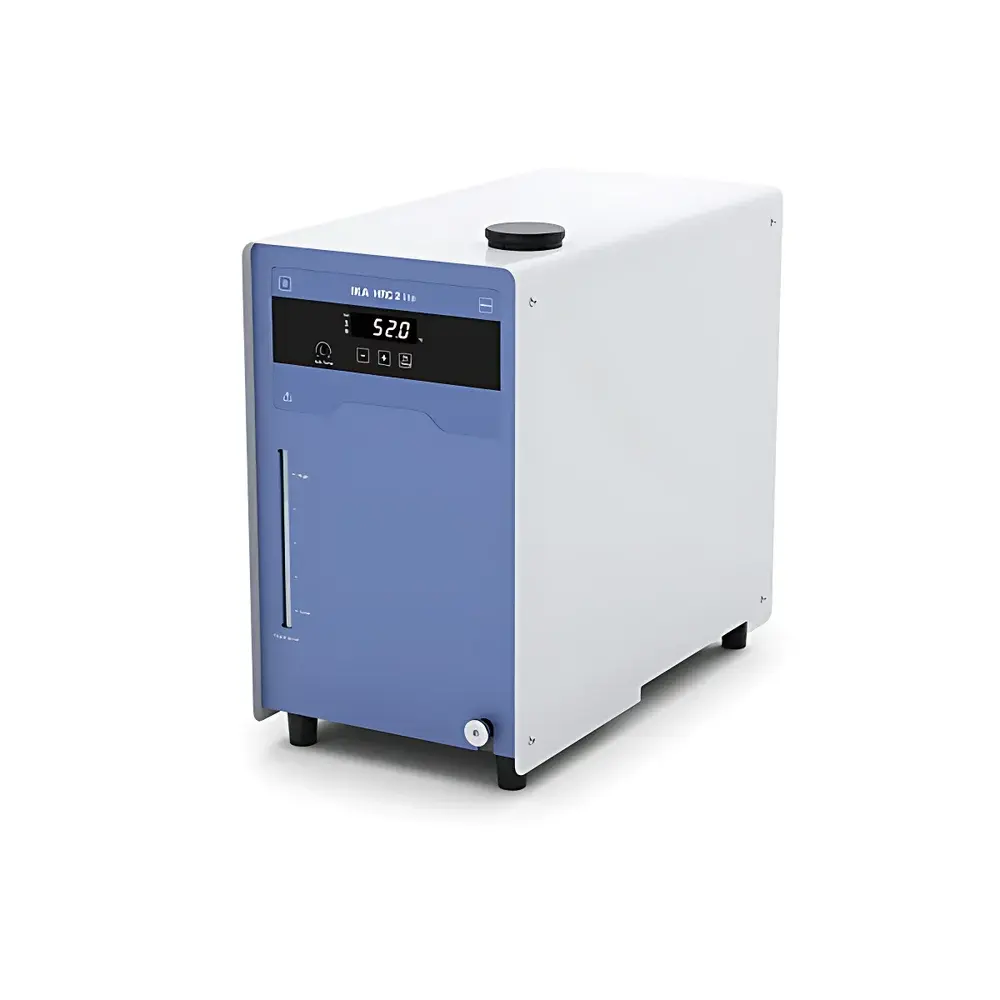
IKA HRC 2 lite Heating and Cooling Circulating Bath
| Brand | IKA |
|---|---|
| Origin | Germany |
| Manufacturer | IKA Werke GmbH & Co. KG |
| Type | Heating and Cooling Circulating Bath |
| Model | HRC 2 lite |
| Bath Volume | 3.5 L |
| Temperature Range | –10 to 100 °C |
| Temperature Stability | ±0.1 K (per DIN 12876, at +70 °C and –10 °C) |
| Pump Type | Pressure/Suction Circulation Pump |
| Max. Pump Pressure | 0.35 bar |
| Max. Flow Rate | 18 L/min (at 0 bar backpressure) |
| Heating Power | 1000 W |
| Cooling Capacity | 400 W (@ 20 °C), 350 W (@ 10 °C), 250 W (@ 0 °C), 100 W (@ –10 °C) |
| Refrigerant | R290 (propane, natural hydrocarbon) |
| Refrigerant Charge | 72 g |
| Max. Refrigerant Pressure | 21 bar |
| Control Sensor | PT1000 (dual: operational + safety) |
| Temperature Display | LED, resolution 0.1 K |
| Safety Features | Adjustable overtemperature/undertemperature cutoff (0–110 °C), visual & audible alarms |
| Compliant with | DIN 12876 Class II, DIN EN 60529 IP21, CE, RoHS |
| Power Supply | 230 V, 50/60 Hz |
| Input Power | 1250 W |
| Noise Level | 51 dB(A) |
| Dimensions (W×D×H) | 225 × 385 × 430 mm |
| Weight | 24.9 kg |
| Ambient Operating Conditions | 5–32 °C, ≤80 % RH |
Overview
The IKA® HRC 2 lite is a compact, high-precision heating and cooling circulating bath engineered for reliable temperature control in laboratory applications requiring dynamic thermal management across a broad operational range. Based on Couette-flow circulation principles and integrated PID-controlled thermoregulation, the unit delivers stable thermal output via a closed-loop fluid circuit—enabling precise external temperature conditioning of bioreactors, jacketed reactors, viscometers, spectrophotometers, and open-bath systems. Its dual-mode operation supports both heating and refrigeration using a single, sealed refrigeration circuit charged with R290—a natural, low-GWP hydrocarbon refrigerant compliant with EU F-Gas Regulation (EU) No 517/2014 and aligned with global sustainability mandates. Designed and manufactured in Staufen, Germany, the HRC 2 lite adheres strictly to DIN 12876 Class II safety requirements for laboratory thermostats, ensuring robust performance under continuous 24/7 operation.
Key Features
- Wide operational temperature range from –10 °C to +100 °C with ±0.1 K stability (verified per DIN 12876 at both extremes), enabled by dual PT1000 sensors—one for process control and one for independent safety cutoff.
- High-efficiency circulation pump delivering up to 18 L/min flow rate at zero backpressure and 0.35 bar maximum pressure—optimized for compatibility with external equipment featuring moderate hydraulic resistance.
- Intuitive LED display with 0.1 K resolution, real-time temperature readout, and configurable alarm thresholds for overtemperature, undertemperature, and sensor fault conditions.
- Front-mounted transparent level indicator tube for immediate visual verification of bath fluid volume—critical for maintaining thermal homogeneity and preventing dry-run damage.
- Tool-free removable stainless-steel air filter with washable mesh design, minimizing maintenance downtime and supporting GLP-aligned preventive servicing protocols.
- Standard RS232 and USB interfaces support bidirectional communication for remote parameter setting, data logging, and integration into centralized lab automation platforms compliant with IEEE 11073 or LabVIEW environments.
Sample Compatibility & Compliance
The HRC 2 lite is validated for use with water, water-glycol mixtures (up to 30 % v/v), silicone oils (up to 100 cSt), and other non-corrosive heat-transfer fluids compatible with stainless-steel wetted parts (AISI 304) and EPDM seals. It meets DIN 12876 Class II classification for laboratory thermostats intended for general-purpose external circulation, including applications involving flammable media (designated FL marking). The unit conforms to essential health and safety requirements under the EU Machinery Directive 2006/42/EC and Low Voltage Directive 2014/35/EU. Electrical safety certification includes EN 61010-1:2019; electromagnetic compatibility complies with EN 61326-1:2013. All firmware implements audit-trail-capable event logging (power-on/off, alarm triggers, setpoint changes) to support FDA 21 CFR Part 11 readiness when paired with validated third-party software.
Software & Data Management
Native IKA Labworld software (v3.2+) provides full instrument configuration—including ramp/soak profiles, pump speed modulation, alarm hysteresis tuning, and calibration offset adjustment—via USB or RS232. Logged temperature and status data export in CSV format supports traceability requirements in ISO/IEC 17025-accredited laboratories. Optional OPC UA server modules enable seamless integration into MES or LIMS ecosystems. Firmware updates are delivered through digitally signed packages verified via SHA-256 hash, ensuring integrity during field deployment. All stored parameters retain non-volatile memory retention for ≥10 years without power.
Applications
- Temperature control of stirred-tank bioreactors (5–20 L scale) during microbial fermentation or mammalian cell culture.
- Thermal conditioning of analytical instrumentation such as UV-Vis spectrophotometers, DSC sample stages, and capillary electrophoresis systems.
- Calibration baths for probe validation per ISO/IEC 17025 Clause 6.5.2, supporting accredited metrology workflows.
- Process simulation in chemical engineering labs: exothermic reaction quenching, crystallization kinetics studies, and polymerization temperature profiling.
- Environmental stress testing of electronic components or packaging materials under controlled thermal cycling (–10 → +100 °C).
FAQ
What heat-transfer fluids are approved for use with the HRC 2 lite?
Water, aqueous glycol solutions (≤30 % v/v), and silicone oils up to 100 cSt are fully compatible. Avoid halogenated solvents, strong acids/bases, or fluids with flash points below 60 °C.
Does the unit support external temperature feedback control?
Yes—the RS232 interface enables external PID setpoint modulation using a user-supplied reference sensor signal, allowing cascade control architectures.
Is the refrigerant R290 serviceable in standard laboratory environments?
R290 requires no special handling beyond standard ventilation practices; its low charge (72 g) and sealed system design meet DIN EN 378-1 requirements for unattended operation in non-explosion-proof rooms.
Can the pump direction be reversed for suction-only configurations?
No—the pump is unidirectional but supports both internal recirculation and external loop configurations via M16x1 threaded ports; suction head capability is rated to 0.15 bar at zero flow.
How often does the air filter require cleaning under typical lab usage?
Under ambient lab conditions (ISO 8 / Class 100,000), inspection every 3 months and cleaning every 6 months is recommended; frequency increases proportionally with airborne particulate load.
Related Products



