
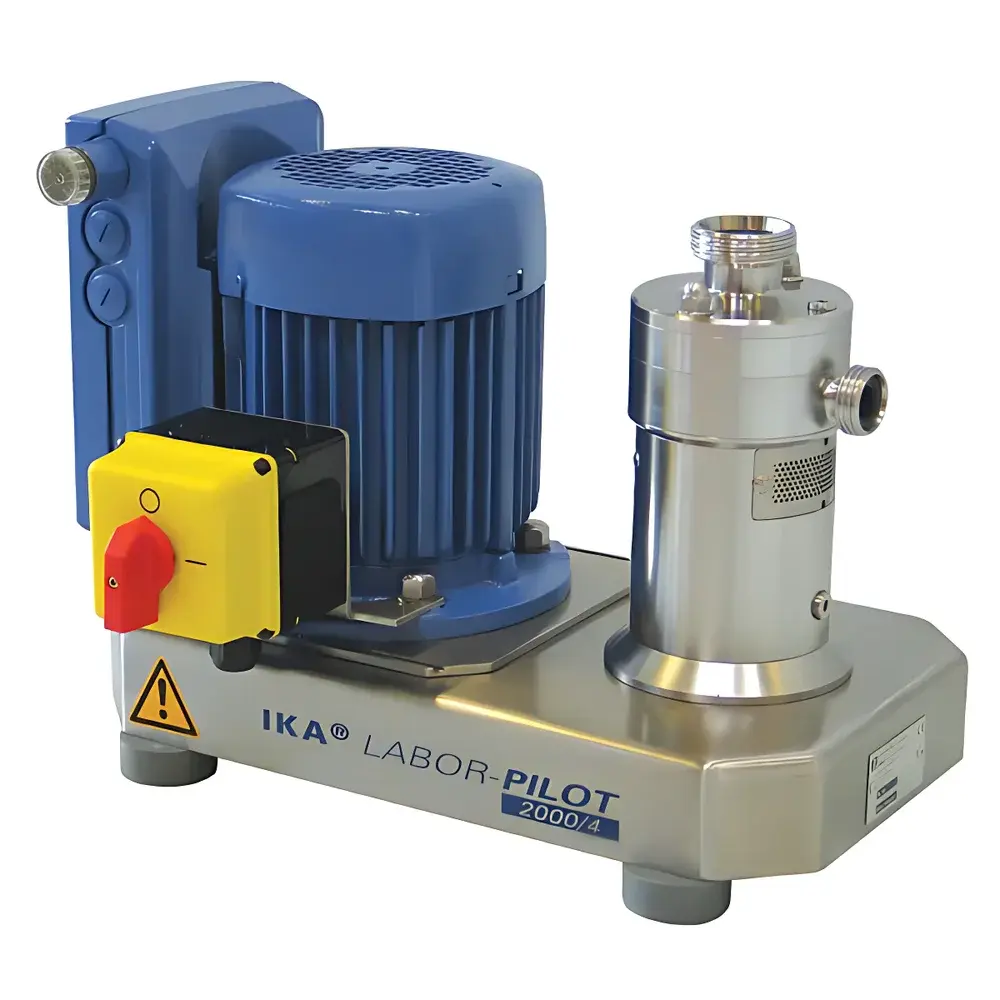
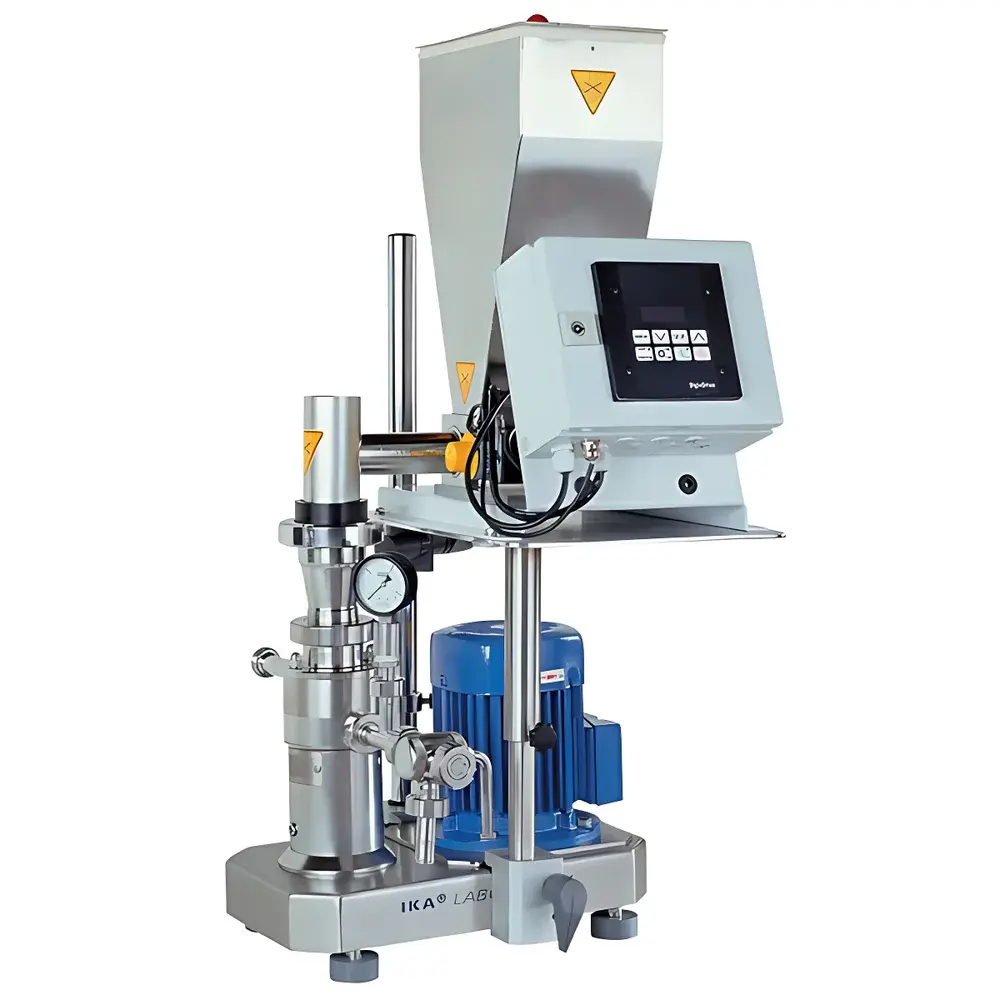
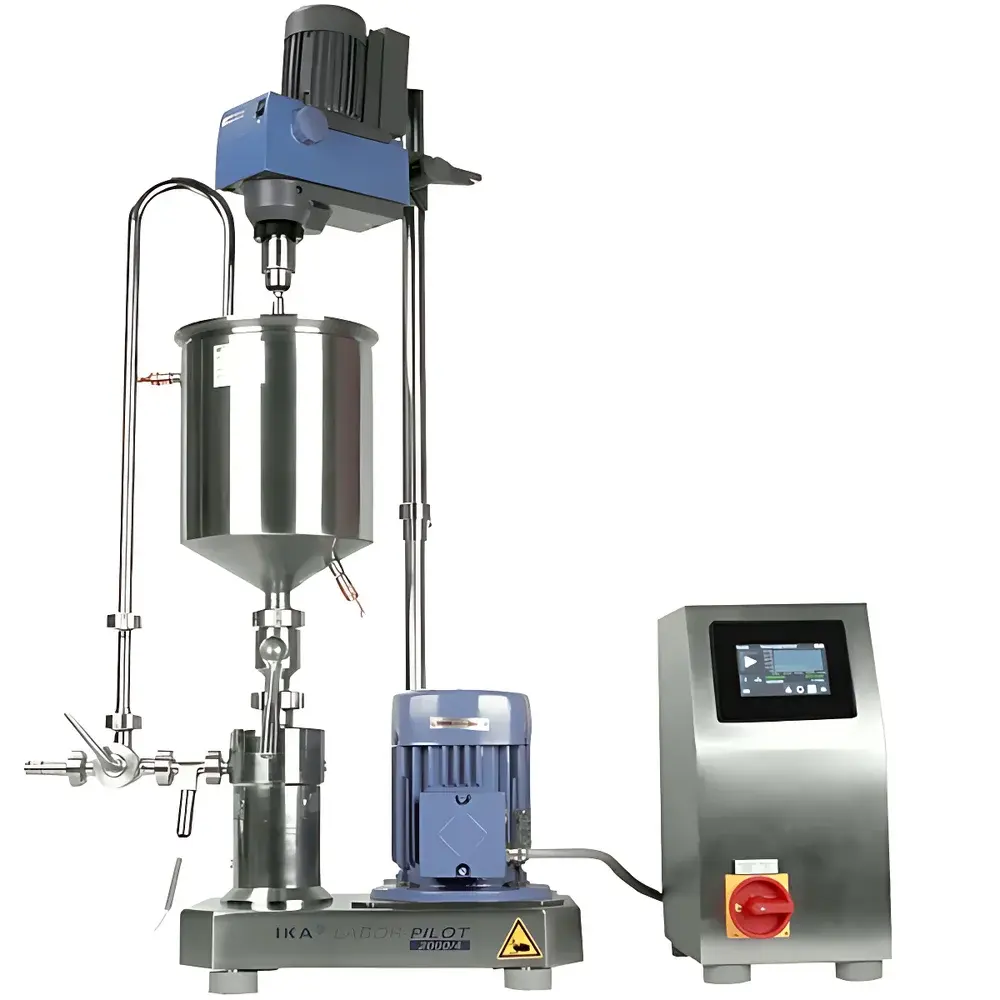
IKA Labor Pilot 2000/4 Inline Dispersing and Emulsifying System
| Brand | IKA |
|---|---|
| Origin | Germany |
| Manufacturer Type | Original Equipment Manufacturer (OEM) |
| Product Origin | Imported |
| Model | Labor Pilot 2000/4 |
| Pricing | Upon Request |
Overview
The IKA Labor Pilot 2000/4 is a high-precision, benchtop-scale inline dispersing and emulsifying system engineered for laboratory and pilot-plant environments. Based on rotor-stator hydrodynamic shear principle, it delivers controlled, reproducible energy input to achieve particle size reduction, homogenization, suspension stabilization, emulsion formation, and wet milling of viscous or abrasive formulations. Its modular architecture enables direct process simulation of industrial-scale production lines—making it an essential tool for scalable formulation development in regulated industries. Unlike batch homogenizers, the Labor Pilot 2000/4 operates continuously under defined flow conditions, allowing real-time monitoring of shear rate, temperature, and pressure profiles critical for establishing robust process parameters.
Key Features
- Modular design with six interchangeable functional modules—including high-shear dispersing heads, fine emulsifying rotors, coarse grinding inserts, and CIP/SIP-compatible sanitary configurations—enabling rapid reconfiguration for diverse unit operations.
- Inline operation compatible with recirculation loops or continuous feed systems; supports volumetric flow rates up to 200 L/h depending on viscosity and module selection.
- Integrated shaft sealing options: standard mechanical seal configuration (Labor Pilot) or fully hygienic double mechanical seal with barrier fluid monitoring (Process Pilot variant), suitable for vacuum, pressure (up to 6 bar), and elevated temperature applications (up to 120 °C).
- Motor-driven precision speed control from 1,000 to 12,000 rpm, delivering consistent tip speeds across operating ranges for reliable shear intensity calibration.
- Optional Labor Pilot-Controller integration provides programmable multi-stage protocols, real-time torque and temperature logging, audit-trail-capable data export (CSV), and compliance-ready electronic signatures per FDA 21 CFR Part 11 requirements.
- Stainless steel 316L wetted parts, IP54-rated housing, and EHEDG-compliant surface finish (Ra ≤ 0.8 µm) ensure suitability for GMP, GLP, and ISO 22000-certified facilities.
Sample Compatibility & Compliance
The Labor Pilot 2000/4 accommodates a broad spectrum of sample types—including suspensions containing micronized pigments, polymer latices, API nanosuspensions, oil-in-water cosmetic emulsions, and food-grade colloidal dispersions. It handles viscosities from 50,000 mPa·s (filled pastes) when paired with appropriate modules. All configurations comply with DIN EN ISO 14159 (safety of machinery for food processing), meet EC Machinery Directive 2006/42/EC, and support validation protocols aligned with ASTM D2777 (precision and bias of particle size analysis methods) and USP (light scattering measurements for lipid injectables). Optional documentation packages include IQ/OQ templates and material traceability dossiers.
Software & Data Management
When equipped with the Labor Pilot-Controller, the system runs IKA LabWorld software—a validated platform supporting method storage, parameter locking, user access levels (admin/operator), and automatic generation of electronic batch records. All operational events—including start/stop timestamps, speed ramps, temperature excursions, and alarm triggers—are time-stamped and stored locally with SHA-256 hash integrity verification. Data export conforms to ALCOA+ principles (Attributable, Legible, Contemporaneous, Original, Accurate, Complete, Consistent, Enduring, Available) and integrates seamlessly with LIMS or MES via OPC UA or Modbus TCP protocols.
Applications
- Pharmaceutical: Development of nanoemulsions for oral delivery, nanoparticle suspensions for injectables, and sterile ointment bases under aseptic transfer conditions.
- Personal Care: Optimization of surfactant-free microemulsions, pigment dispersion stability in sunscreens, and rheology-controlled hair conditioning polymers.
- Coatings & Inks: Pigment deagglomeration studies for waterborne acrylics, carbon black dispersion in conductive inks, and long-term storage stability prediction.
- Food Science: Homogenization of plant-based dairy alternatives, encapsulation matrix preparation for probiotics, and viscosity-modified sauce formulations.
- Chemical Intermediates: Catalyst slurry activation, nanocellulose dispersion for functional composites, and reactive monomer emulsification prior to polymerization.
FAQ
Can the Labor Pilot 2000/4 be used for sterile processing?
Yes—when configured with SIP-capable modules, steam-jacketed housing, and a validated sterilization protocol, it meets ASME BPE-2023 standards for biopharmaceutical applications.
What is the minimum batch volume required for representative results?
For statistically valid scale-up correlation, a minimum recirculation loop volume of 5 L is recommended; however, method development can begin with as little as 1.5 L using optimized flow dynamics.
Is third-party calibration support available?
IKA-certified service centers provide NIST-traceable torque and rotational speed calibration, with optional ISO/IEC 17025-accredited reports.
How does the system handle abrasive materials like titanium dioxide or silica?
Hardened tungsten carbide rotor/stator sets and ceramic-coated shafts are available as factory options for extended service life in high-wear applications.
Can existing 2000-series inline units be retrofitted with Labor Pilot modules?
Yes—mechanical and electrical interfaces are standardized across the IKA 2000 platform, enabling cross-compatibility with prior-generation inline dispersers.



