
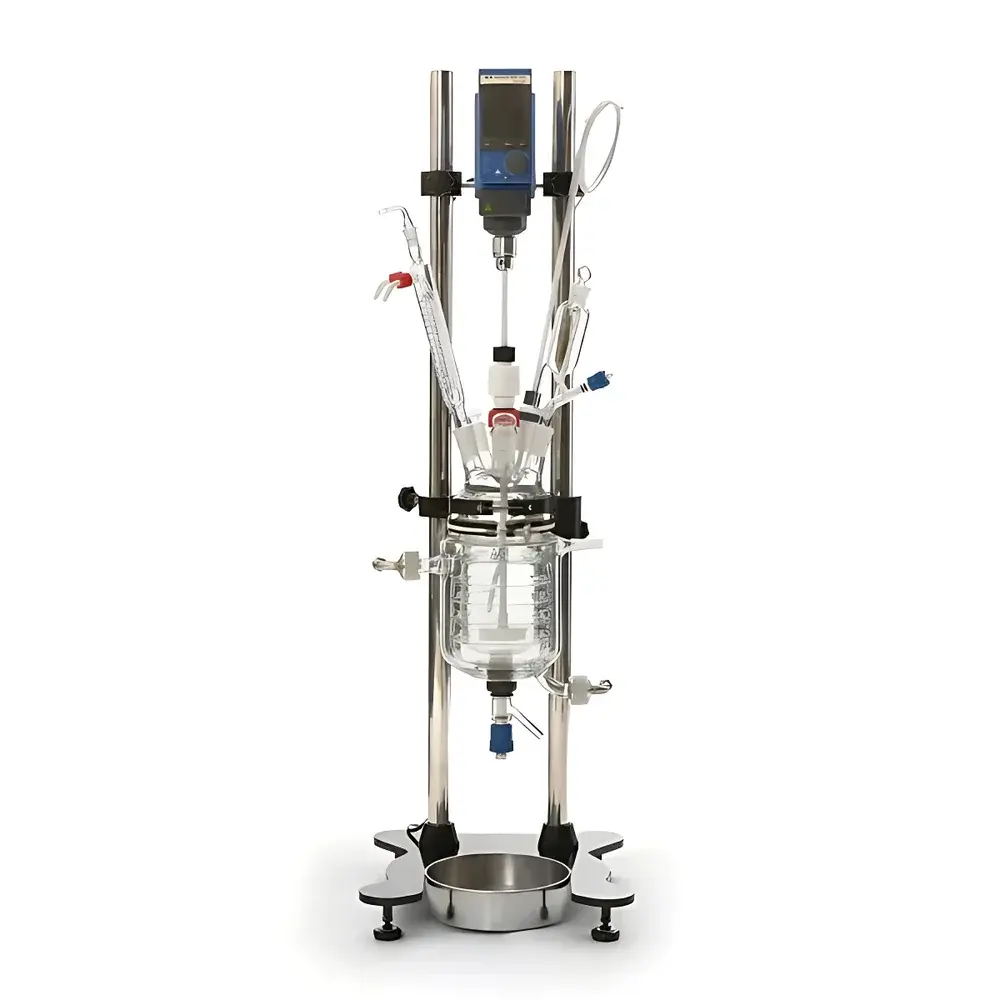
IKA LabTech 5L Jacketed Glass Reactor System
| Brand | IKA |
|---|---|
| Origin | Germany |
| Model | 5L Jacketed Reactor |
| Capacity | 5 L |
| Construction | Single-jacketed borosilicate glass 3.3 vessel with PTFE/FFKM wetted parts |
| Operating Temperature Range | −90 °C to +230 °C |
| Thermal Shock Resistance (ΔT) | 110 °C |
| Pressure Range | 666 Pa (vacuum) to ambient pressure |
| Sealing Speed Limit | up to 800 rpm |
| Dimensions (W×D×H) | 380 mm × 380 mm × 1206 mm |
| Weight | 24 kg |
| Port Configuration | 6 ports (SQG 29/42 ×1, TS 29/42 ×1, TS 24/40 ×4) |
Overview
The IKA LabTech 5L Jacketed Glass Reactor System is a precision-engineered, modular laboratory-scale reactor platform designed for controlled chemical synthesis, kinetic studies, crystallization, hydrogenation, and process optimization under variable thermal and pressure conditions. Built around a high-purity borosilicate glass 3.3 vessel (DIN ISO 3585), the system employs jacketed heat transfer architecture to enable bidirectional temperature control—supporting cryogenic operation down to −90 °C via external circulator coupling and stable heating up to +230 °C. The single-jacket design facilitates uniform thermal distribution across the reaction mass while minimizing thermal inertia and energy loss. Its vacuum-rated construction (down to 666 Pa) accommodates solvent removal, low-boiling-point reactions, and moisture-sensitive chemistry. The reactor operates as a closed, sealed system with full compatibility for inert gas purging (N₂, Ar) and optional pressure monitoring—making it suitable for GLP-compliant development workflows in pharmaceutical, fine chemical, and academic research laboratories.
Key Features
- Chemically inert wetted surfaces: Borosilicate glass 3.3 vessel body, PTFE-stemmed overhead stirrer shaft, FFKM/FFKM sealing elements, and fluoropolymer-coated valves ensure compatibility with aggressive reagents (e.g., strong acids, organometallics, halogenated solvents).
- Optimized mechanical agitation: Integrated overhead drive supports speeds up to 800 rpm with torque-sensing feedback; includes quick-release coupling for rapid interchange of impeller types (e.g., anchor, paddle, turbine, helical ribbon) without tools.
- Leak-tight modular porting: Six standardized ground-glass and threaded ports (SQG 29/42, TS 29/42, TS 24/40) allow simultaneous integration of condensers, addition funnels, gas inlets, pH probes, sampling lines, and reflux accessories.
- Tool-free assembly & maintenance: All critical joints—including lid clamping, drain valve actuation, and probe insertion—utilize ergonomic bayonet or cam-lock mechanisms to reduce setup time and operator exposure.
- Zero-dead-volume discharge: Bottom-mounted PTFE-lined ball valve with flush-seating geometry eliminates holdup volume and enables quantitative product recovery—critical for high-value intermediates and analytical sample withdrawal.
- Thermal efficiency architecture: Internal baffle-guided jacket flow path ensures laminar, high-velocity coolant circulation; combined with low-thermal-mass glass walls, this yields <±0.5 °C temperature stability during exothermic/endothermic events.
Sample Compatibility & Compliance
The reactor is validated for use with organic, aqueous, and biphasic reaction mixtures—including suspensions, slurries, and viscous polymer solutions up to 50,000 mPa·s (measured with compatible IKA RV-visc adapters). Its materials of construction conform to USP Class VI and FDA 21 CFR 177.1550 (PTFE) and 177.2600 (FFKM) standards. The system supports audit-ready documentation workflows when paired with IKA’s lab software (e.g., LabWorldSoft), enabling electronic signature capture, change tracking, and 21 CFR Part 11–compliant data archiving. It meets key requirements of ISO 17025 (testing laboratories), ASTM E2500 (verification of laboratory equipment), and EU GMP Annex 15 (qualification of process equipment).
Software & Data Management
When integrated with IKA LabWorldSoft or third-party SCADA systems (via RS232/USB/Ethernet), the reactor enables synchronized logging of temperature (jacket + internal probe), stirring speed, torque, and elapsed time. Real-time trend visualization supports deviation detection during scale-up trials. All datasets are exportable in CSV or XML format for statistical analysis (e.g., JMP, MATLAB) or inclusion in regulatory submissions. Optional PID auto-tuning and ramp-soak profiles facilitate reproducible thermal programming across batches—essential for DoE (Design of Experiments) and QbD (Quality by Design) initiatives.
Applications
- Process safety screening: Calorimetric assessment of reaction enthalpy under controlled heating/cooling ramps.
- Heterogeneous catalysis: Slurry-phase hydrogenations, Suzuki couplings, and asymmetric epoxidations requiring strict O₂ exclusion.
- API intermediate synthesis: Multi-step batch reactions with in-process sampling and pH-controlled additions.
- Polymerization kinetics: Free-radical, condensation, and ring-opening polymerizations monitored via viscosity and temperature profiling.
- Crystallization development: Seeding, supersaturation control, and polymorph screening under precise thermal gradients.
- Green chemistry optimization: Solvent-free melt reactions, mechanochemical-assisted transformations, and continuous-flow hybrid setups using inline feed modules.
FAQ
What external circulators are compatible with the jacket interface?
Standardized 1/2″ BSP or G1/2″ male threads support all major brands (Huber, Julabo, Lauda, Fisher Scientific) with silicone oil, glycol/water, or liquid nitrogen-based fluids.
Can the system be upgraded for pressure operation beyond ambient?
Yes—optional reinforced lid assemblies with DIN 28120–rated glass pressure windows and pneumatic clamps enable operation up to 6 bar(g); requires separate pressure sensor and relief valve integration.
Is torque measurement available as a factory option?
Torque sensing is built-in on all IKA RW 20/40 overhead drives used with this platform; real-time values are accessible via LabWorldSoft or analog output (0–10 V).
How is cleaning validation supported?
The absence of crevices, fully drainable geometry, and autoclavable PTFE components meet ASME BPE surface finish (Ra ≤ 0.8 µm) and residue testing protocols per ICH Q5C.



