
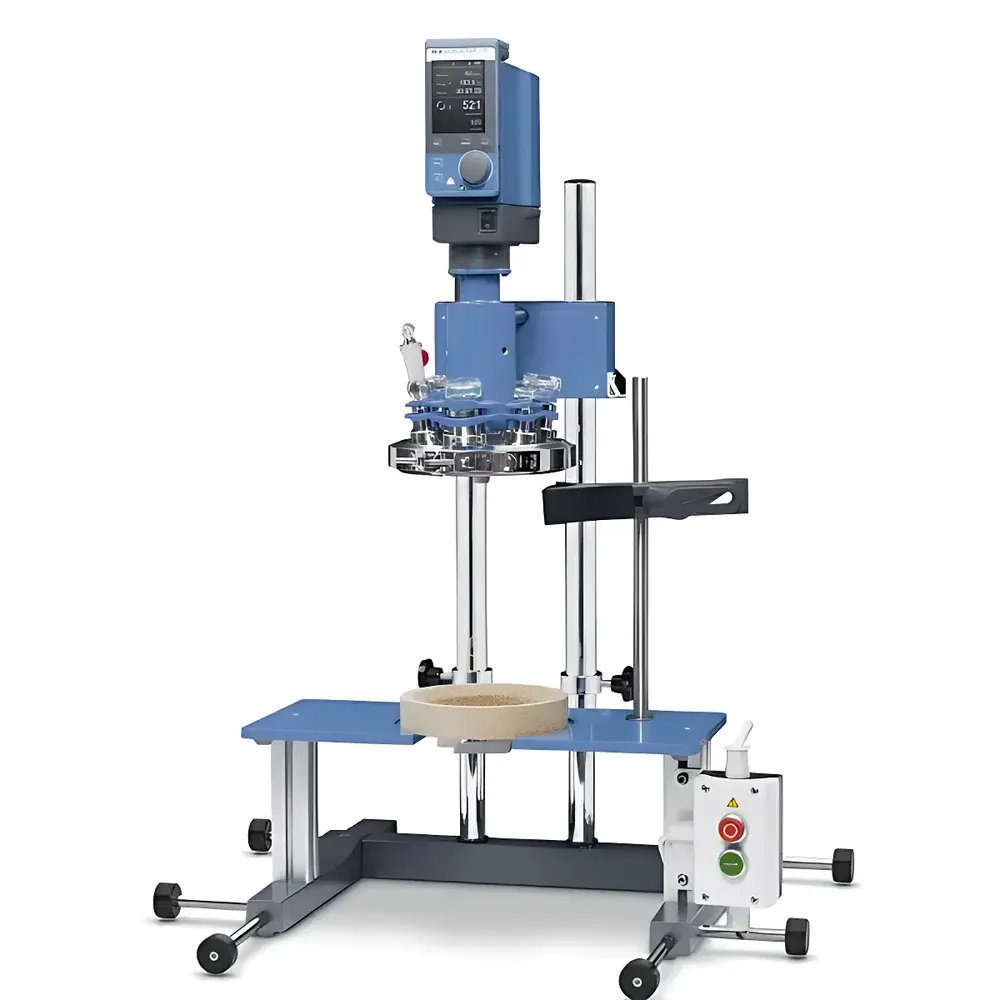
IKA LR-2.ST the Versatile High-Viscosity Laboratory Reactor System
| Brand | IKA |
|---|---|
| Origin | Germany |
| Model | LR-2.ST the Versatile |
| Usable Volume | 500–2000 mL |
| Temperature Range | Ambient to 230 °C |
| Vacuum Capability | Down to 25 mbar |
| Max. Viscosity Handling | 70,000 mPa·s |
| Speed Range | 8–290 rpm |
| Lifting Column Travel | 390 mm |
| Wetted Materials | Borosilicate Glass (DIN ISO 3585), FFPM, PTFE, Stainless Steel 1.4571 |
| Reactor Opening Configuration | 3× NS 29/32 + 2× NS 14/23 |
| Max. Stirring Torque | 100 N·cm |
| Dimensions (W×H×D) | 460 × 1240 × 430 mm |
| Weight | 34 kg |
| Ambient Operating Conditions | 5–40 °C, ≤80 % RH |
| Control | Microprocessor-based speed regulation with load-compensated stability |
Overview
The IKA LR-2.ST the Versatile is a modular, high-integrity laboratory reactor system engineered for reproducible synthesis, reaction monitoring, and high-viscosity mixing under controlled thermal and vacuum conditions. Based on Couette-type shear principles and torque-driven rheological feedback, it integrates a robust vertical lifting column, chemically inert wetted-path construction, and microprocessor-regulated motor control to maintain precise rotational speed across variable load profiles — critical for polymerization, catalytic hydrogenation, emulsion formation, and solvent-free condensation reactions. Its design conforms to core requirements of GLP-compliant process development, supporting traceable parameter logging when paired with optional data acquisition modules.
Key Features
- Modular reactor platform with interchangeable glass vessels (500–2000 mL) and standardized NS-ground-glass joints (3× NS 29/32, 2× NS 14/23) for flexible accessory integration including reflux condensers, addition funnels, and gas inlets.
- High-torque EUROSTAR 100 control stirrer (100 N·cm max.) with bidirectional rotation, real-time torque trend display, and automatic speed compensation under increasing viscosity — enabling continuous monitoring of reaction progress via mechanical resistance changes.
- Chemically resistant sealing system using perfluoroelastomer (FFPM) gaskets rated for sustained exposure to aggressive solvents (e.g., chlorinated hydrocarbons, strong acids/bases) and temperatures up to 230 °C.
- Integrated lifting column with 390 mm vertical travel, precision-machined guide rails, and mechanical safety lock — ensuring stable alignment during vacuum operation and preventing seal extrusion under differential pressure.
- WiCo wireless controller (optional) enables full parameter adjustment and status monitoring from outside fume hoods, eliminating cable clutter and enhancing operator safety during exothermic or toxic reagent handling.
- Microprocessor-based speed regulation maintains setpoint accuracy ±1 % across full load range, independent of ambient temperature fluctuations or voltage variance — essential for kinetic studies requiring strict shear history control.
Sample Compatibility & Compliance
The LR-2.ST accommodates heterogeneous, viscous, and gas-evolving reaction mixtures while maintaining material compatibility across broad chemical classes. All fluid-contact surfaces consist of borosilicate glass 3.3 (DIN ISO 3585), electropolished stainless steel 1.4571 (AISI 904L equivalent), PTFE-coated components, and FFPM elastomers — collectively meeting USP Class VI biocompatibility criteria and resisting stress cracking in halogenated media. The system supports vacuum operations down to 25 mbar, enabling low-temperature distillations and moisture-sensitive anhydrous reactions. While not certified as intrinsically safe, its electrical architecture complies with EN 61010-1 for laboratory equipment, and mechanical design adheres to DIN 28120 for jacketed glass reactors.
Software & Data Management
The LR-2.ST operates as a standalone instrument with embedded firmware for speed, torque, and temperature (when external Pt100 sensor is connected) logging at user-defined intervals. Raw data export is supported via RS232 or USB-to-serial interface to third-party SCADA or LIMS platforms. When integrated with IKA’s labworldsoft® suite (v4.0+), the system enables audit-trail-enabled parameter recording compliant with FDA 21 CFR Part 11 requirements — including electronic signatures, version-controlled method storage, and immutable timestamped event logs. All firmware updates are delivered via signed binary packages validated against SHA-256 checksums.
Applications
- Development-scale batch synthesis of pharmaceutical intermediates under nitrogen or argon blanket, with real-time torque profiling to detect induction periods and endpoint determination.
- Rheologically complex formulations including polyurethane prepolymers, silicone elastomer precursors, and high-solids pigment dispersions requiring extended shear history control.
- Acid-catalyzed esterification and transesterification under reduced pressure to shift equilibrium and minimize thermal degradation.
- Multi-step reactions involving sequential reagent addition through NS 14/23 ports, with simultaneous temperature ramping and agitation speed modulation.
- Process analytical technology (PAT) pilot studies where torque-derived viscosity trends serve as surrogate indicators for molecular weight build-up in step-growth polymerizations.
FAQ
What is the maximum allowable working pressure differential for vacuum operation?
The system is rated for continuous operation at ≤25 mbar absolute pressure; mechanical integrity has been verified per DIN 28120 Annex B for glass vessel collapse resistance under full vacuum.
Can the LR-2.ST be used with jacketed reactors for precise temperature control?
Yes — the base frame accepts standard IKA jacketed glass reactors (e.g., RV 10 series) with circulating thermostat connections; temperature uniformity ±0.5 °C is achievable with compatible circulators.
Is FFPM sealing material compliant with FDA 21 CFR 177.2600 for food-contact applications?
FFPM compounds used meet ASTM D1418 classification and are listed in FDA Indirect Food Additives Regulation 21 CFR 177.2600 for repeated-use extractables testing; full compliance documentation available upon request.
Does the WiCo controller support encrypted communication?
WiCo uses AES-128 encrypted RF transmission (868 MHz ISM band) with rolling code authentication to prevent unauthorized parameter override or spoofing.
What calibration standards are recommended for torque verification?
IKA recommends annual verification using traceable NIST-calibrated torque test kits (e.g., PCB Piezotronics Model 208A03) applied directly to the stirring shaft coupling; procedure documented in Service Manual LR-2.ST Rev. 4.2.
Related Products



