
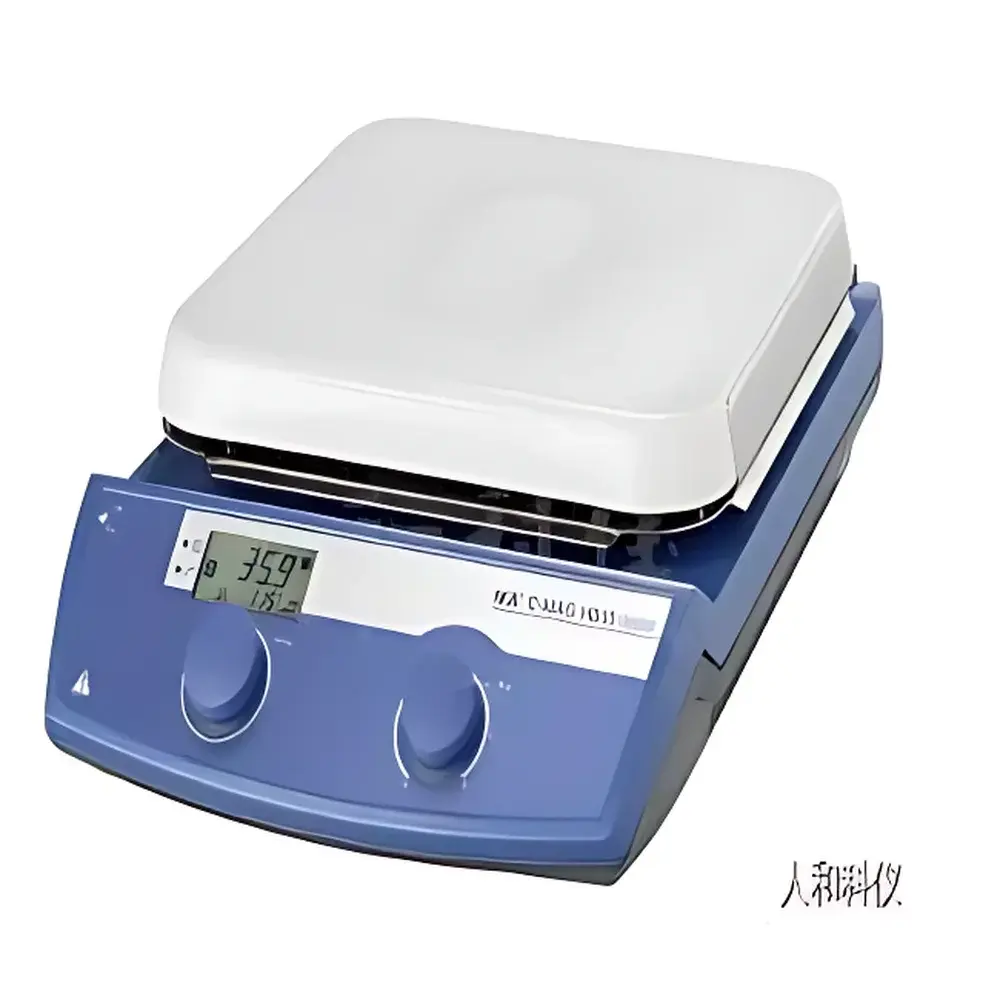
IKA C-MAG HS 10 digital Heating Magnetic Stirrer
| Brand | IKA |
|---|---|
| Origin | Germany |
| Model | C-MAG HS 10 digital |
| Maximum Stirring Volume | 15 L (H₂O) |
| Speed Range | 100–1500 rpm |
| Heating Temperature Range | 50–500 °C |
| Heating Power | 1500 W |
| Motor Power Output | 1.5 W |
| Plate Material | Ceramic |
| Plate Dimensions | 260 × 260 mm |
| Overall Dimensions | 300 × 105 × 415 mm |
| Weight | 6 kg |
| Protection Class | IP21 (per DIN EN 60529) |
| Input Voltage | 230 / 120 / 100 V, 50/60 Hz |
| External Temperature Sensor Interface | PT1000 |
| Temperature Control Accuracy (with PT1000) | ±0.5 K |
| Display Resolution (PT1000-measured medium temperature) | 0.1 K |
| Safety Cut-off Temperature | 550 °C |
| Max. Stir Bar Length | 80 mm |
| Ambient Operating Conditions | 5–40 °C, ≤80 % RH |
Overview
The IKA C-MAG HS 10 digital is a high-performance heating magnetic stirrer engineered for precision thermal and mechanical control in demanding laboratory environments. Designed around a robust ceramic heating plate and a brushless DC motor architecture, it delivers consistent torque across its full speed range while maintaining exceptional thermal stability and chemical resistance. Its operation is based on electromagnetic coupling between the rotating magnetic field generated beneath the plate and ferromagnetic stir bars immersed in the sample—enabling contactless agitation without mechanical drive shafts or seals. The integrated PT1000 sensor interface supports direct immersion temperature feedback from the reaction medium, enabling closed-loop control that meets the reproducibility requirements of method-critical applications in synthetic chemistry, materials science, and quality control laboratories.
Key Features
- Ceramic-coated heating plate (260 × 260 mm) offering superior resistance to acids, alkalis, and organic solvents—eliminating surface degradation common with stainless-steel or aluminum plates.
- Three selectable operating modes: Standard (full parameter access), Safety (restricted max temperature/speed), and Lock (prevents accidental adjustment during unattended operation).
- LCD display showing both setpoint and real-time measured temperature simultaneously—resolution of 0.1 K when paired with the supplied PT1000 probe.
- Dual-safety architecture: independent overtemperature cut-off at 550 °C plus visual thermal warning (flashing LED indicator during heating phase).
- Elevated control panel design minimizes risk of liquid ingress during vigorous stirring or accidental spills.
- Non-contact speed regulation via digital encoder feedback ensures stable rotation even under variable load conditions (e.g., viscosity changes during polymerization or crystallization).
- Compliance with IEC/EN 61000-6-3 (EMC emission standards) and IEC/EN 61000-6-2 (immunity), supporting integration into regulated lab environments.
Sample Compatibility & Compliance
The C-MAG HS 10 digital accommodates vessels up to 15 L capacity (water-equivalent), compatible with standard round-bottom flasks, beakers, and jacketed reactors (with appropriate stir bar geometry). Its ceramic surface tolerates aggressive reagents including concentrated HNO₃, HF-diluted solutions, and chlorinated solvents—making it suitable for digestion, reflux, and catalytic screening workflows. The device conforms to DIN EN 60529 (IP21 rating), ensuring protection against vertically falling drips and solid objects >12.5 mm. While not intrinsically rated for explosion-proof areas, its sealed electronics and absence of sparking components support use in general-purpose chemical fume hoods per ANSI Z9.5 guidelines. No regulatory certification for GLP/GMP audit trails is embedded; however, the unit’s deterministic behavior, fixed safety limits, and traceable PT1000 interface allow it to serve as a compliant component within validated processes when documented per internal SOPs.
Software & Data Management
This standalone instrument does not feature onboard data logging or USB/Ethernet connectivity. All operational parameters—including speed, set temperature, actual medium temperature (via PT1000), error codes, and active mode—are displayed locally on the LCD interface. Error states (e.g., E1 = sensor disconnection, E2 = overtemperature) are communicated numerically for rapid troubleshooting. For laboratories requiring electronic records, external data acquisition is achievable via analog output modules (e.g., third-party thermocouple loggers interfaced to the PT1000 signal path) or manual entry into LIMS or ELN systems. Though lacking FDA 21 CFR Part 11-compliant electronic signatures or audit trail functionality, its deterministic control logic and physical lock mode support adherence to ALCOA+ principles when used within documented procedural frameworks.
Applications
- Controlled heating and homogeneous mixing during multi-step organic syntheses, especially where exothermicity or solvent volatility necessitates precise thermal management.
- Standardized dissolution testing in pharmaceutical QC labs (aligned with USP methodology when combined with validated vessel geometry and stir bar selection).
- Preparation of uniform colloidal dispersions, nanoparticle suspensions, and polymer emulsions requiring extended agitation at elevated temperatures.
- Calibration and validation of temperature probes and thermostatic baths using NIST-traceable PT1000 reference sensors.
- Material aging studies involving long-term thermal exposure under inert or controlled-atmosphere conditions (when used inside gloveboxes or modified enclosures).
FAQ
Does the C-MAG HS 10 digital support external temperature control via RS232 or USB?
No—this model operates as a stand-alone unit with no digital communication ports. Temperature feedback is analog-only via the PT1000 input.
What is the maximum recommended viscosity for stable stirring at 1500 rpm?
Stirring performance depends on stir bar geometry and vessel shape; for aqueous glycerol solutions, stable operation is verified up to ~1000 mPa·s at full speed with an 80 mm bar in a 5 L beaker.
Can the unit be operated continuously at 500 °C?
Yes—continuous operation at maximum setpoint is permitted, provided ambient conditions remain within specification (5–40 °C, ≤80 % RH) and adequate ventilation prevents heat buildup around the base housing.
Is the supplied PT1000 sensor calibrated and certified?
The included PT1000 probe meets DIN EN 60751 Class B tolerance but is not individually calibrated or supplied with a certificate of calibration; users requiring traceability must arrange third-party calibration.
How is overheating prevented if the PT1000 sensor fails?
A redundant bimetallic thermal cutoff triggers at 550 °C independently of the sensor loop, ensuring fail-safe shutdown regardless of probe integrity.



