
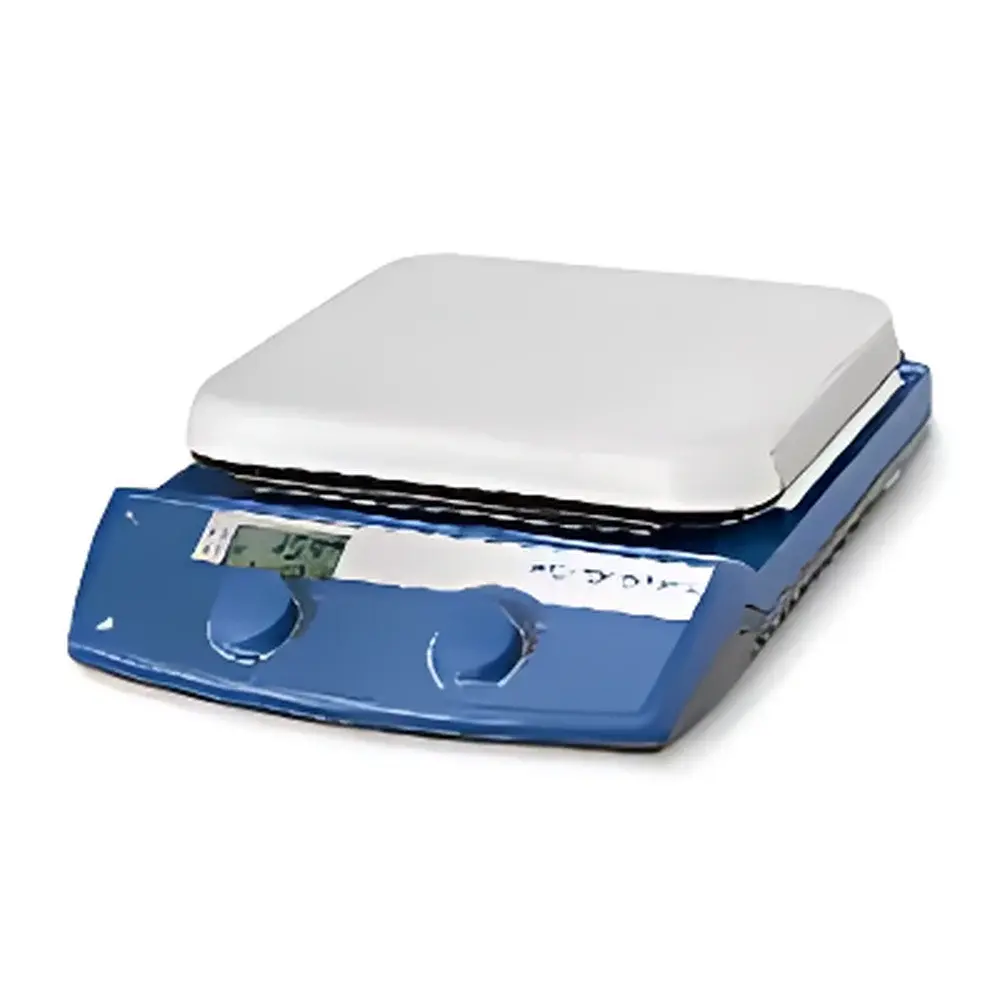
IKA C-MAG HS 10 digital Magnetic Stirrer with Heating
| Brand | IKA |
|---|---|
| Origin | Germany |
| Model | C-MAG HS 10 digital |
| Max. Stirring Volume (H₂O) | 15 L |
| Motor Output Power | 1.5 W |
| Speed Range | 100–1500 rpm |
| Speed Control | 6-step dial |
| Max. Stir Bar Length | 80 mm |
| Heating Power | 1500 W |
| Heating Temperature Range | 50–500 °C |
| Heating Rate | 5 K/min |
| Temp. Setting Accuracy (Heating Plate) | ±5 K |
| Medium Temp. Control Accuracy (with PT1000) | ±0.5 K |
| Medium Temp. Display Resolution (with PT1000) | 0.1 K |
| Safety Cut-off Temp. | 550 °C |
| Working Plate Material | Ceramic |
| Plate Dimensions | 260 × 260 mm |
| Overall Dimensions | 300 × 105 × 415 mm |
| Weight | 8.308 kg |
| Ambient Operating Temp. | 5–40 °C |
| Max. Relative Humidity | 80 % |
| Protection Class | IP21 (DIN EN 60529) |
| Voltage | 230 V, 50/60 Hz |
| Total Input Power | 1520 W |
| External Temp. Sensor Interface | PT1000 |
| Operating Modes | Standard / Safety / Lock Mode |
| Panel Height | Elevated for splash resistance |
| Thermal Warning Indicator | Flashing LED during heating |
| Error Code Display | Digital |
Overview
The IKA C-MAG HS 10 digital is a high-performance magnetic stirrer with integrated ceramic heating plate, engineered for precision temperature control and robust mixing in demanding laboratory environments. Based on the principle of rotating magnetic fields generated by a precisely wound stator coil, it drives PTFE- or glass-coated stir bars to induce homogeneous fluid motion in vessels up to 15 L capacity. Unlike basic stirrers, this model integrates a microprocessor-controlled heating system with real-time thermal feedback via an external PT1000 sensor—enabling closed-loop regulation of medium temperature rather than relying solely on surface plate readings. Its seamless ceramic top plate provides exceptional resistance to acids, alkalis, and organic solvents, meeting long-term durability requirements in chemical synthesis, pharmaceutical formulation, and materials science workflows. Designed and manufactured in Staufen, Germany, the unit complies with IEC 61010-1 safety standards for laboratory electrical equipment and carries CE marking for conformity with EU directives.
Key Features
- Seamless ceramic heating plate (260 × 260 mm) offering outstanding chemical inertness and thermal stability
- Microprocessor-based dual-display LCD showing both setpoint and real-time medium temperature (when PT1000 is connected)
- Three operational modes: Standard (full parameter access), Safety (restricted max. temp./speed), and Lock (parameter lockout to prevent accidental changes)
- Elevated control panel design minimizes risk of liquid ingress during vigorous stirring or reflux setups
- Digital error code display for rapid diagnostics (e.g., sensor disconnection, overheating, motor stall)
- Integrated thermal warning system: blinking LED alerts users to active heating state and elevated plate surface temperature
- Fixed safety cut-off at 550 °C prevents uncontrolled thermal escalation under fault conditions
- PT1000-compatible interface supports external immersion probes for accurate bulk-phase temperature measurement, essential for GLP-compliant reaction monitoring
Sample Compatibility & Compliance
The C-MAG HS 10 digital accommodates standard round-bottom flasks (up to 20 L nominal volume), beakers, and jacketed reactors equipped with compatible stir bars ≤80 mm in length. Its ceramic surface tolerates contact with concentrated HCl, HNO₃, NaOH (≤50 % w/w), acetone, ethanol, and chlorinated solvents without degradation. The instrument meets DIN EN 60529 (IP21) for protection against vertically falling drops and solid objects >12.5 mm, ensuring safe operation in general lab settings. It is suitable for use under ISO/IEC 17025-accredited quality systems when paired with calibrated PT1000 sensors traceable to national standards. While not intrinsically rated for hazardous area use, its non-sparking motor design and grounded chassis reduce ignition risks in non-classified fume hood installations.
Software & Data Management
This standalone instrument does not feature USB or Ethernet connectivity and operates without proprietary software. All configuration and monitoring occur locally via the front-panel interface. However, its analog-compatible PT1000 input enables integration into third-party data acquisition systems (e.g., LabVIEW, DeltaV, or custom SCADA) using standard 4–20 mA or 0–10 V signal conditioners. For regulated environments, manual logbook entries—including batch ID, start/end time, setpoints, observed deviations, and error codes—can be structured to satisfy FDA 21 CFR Part 11 record-keeping expectations when supported by institutional SOPs. Audit trails are maintained through physical timestamped logs; electronic audit trail functionality requires external logging hardware.
Applications
- Controlled-temperature synthesis of metal-organic frameworks (MOFs) requiring stable 80–120 °C conditions over 24+ hours
- Buffer preparation and pH adjustment in molecular biology labs where temperature-sensitive enzymes must remain inactive until final mixing
- Sol-gel processing of silica nanoparticles, where precise thermal ramping (5 K/min) and hold stability (<±0.5 K) directly influence particle nucleation kinetics
- Standardization of viscosity reference oils per ASTM D445, using water-jacketed vessels stabilized at 40.0 ± 0.1 °C
- Extraction protocols in environmental testing (e.g., EPA Method 3510C), where reproducible heating and agitation ensure complete analyte liberation from solid matrices
FAQ
Does the C-MAG HS 10 digital support external temperature feedback for medium control?
Yes—it features a dedicated PT1000 input port. When used with a calibrated immersion probe, the device regulates heater output based on actual solution temperature, not plate surface temperature.
What is the maximum recommended vessel size for optimal stirring performance?
For consistent vortex formation and homogenization, use vessels with diameters ≤180 mm and fill heights ≤150 mm. Larger formats require optimized stir bar geometry and reduced speed to avoid splashing or vortex instability.
Is the ceramic plate resistant to hydrofluoric acid (HF)?
No. While highly resistant to most common reagents, ceramic plates are vulnerable to HF attack. Use PTFE-coated hotplates or specialized quartz alternatives for HF-containing applications.
Can the unit be operated inside a CO₂ incubator?
Not recommended. The specified ambient operating range is 5–40 °C with ≤80 % RH. Incubator humidity levels often exceed this limit, risking condensation-induced electrical faults.
How is calibration verified for temperature accuracy?
Users should perform periodic verification using a NIST-traceable thermometer immersed at the same depth as the PT1000 probe. Deviations exceeding ±0.5 K at setpoints between 50–300 °C warrant service or sensor replacement.



