
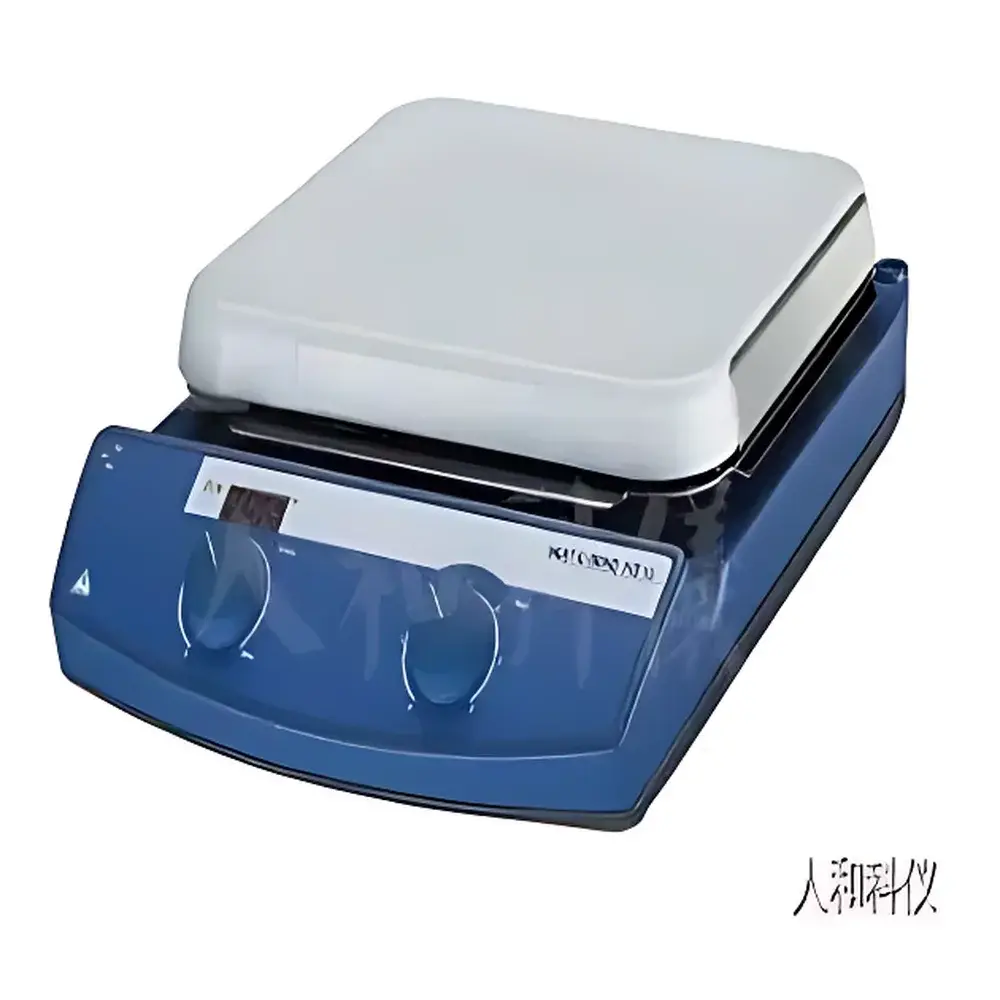
IKA C-MAG HS 10 Magnetic Stirrer with Hotplate
| Brand | IKA |
|---|---|
| Origin | Germany |
| Model | C-MAG HS 10 |
| Maximum Stirring Volume | 15 L (H₂O) |
| Speed Range | 100–1500 rpm |
| Heating Temperature Range | 50–500 °C |
| Plate Material | Ceramic |
| Power Input | 1520 W |
| Plate Dimensions | 260 × 260 mm |
| Overall Dimensions | 300 × 105 × 415 mm |
| Weight | 6 kg |
| Protection Class | IP21 (DIN EN 60529) |
| Ambient Operating Conditions | 5–40 °C, ≤80% RH |
| External Temperature Sensor Interface | ETS-D4 / ETS-D5 compatible |
| Safety Cut-off | 550 °C Fixed Overtemperature Protection |
| Heating Rate | ~5 K/min |
| Motor Output | 1.5 W |
| Rotation Direction | Counterclockwise |
| Max Stir Bar Length | 80 mm |
| Control | Microprocessor-based, Digital Display, LED Indicators |
Overview
The IKA C-MAG HS 10 is a high-performance magnetic stirrer and hotplate system engineered for precision thermal mixing in research laboratories, quality control environments, and industrial R&D settings. It integrates a robust ceramic heating plate with a digitally controlled magnetic drive system, enabling simultaneous heating and stirring of viscous or low-volume samples under reproducible conditions. The device operates on the principle of rotating magnetic fields generated by an internal stator coil to drive ferromagnetic stir bars—ensuring contactless torque transmission and eliminating mechanical wear. Its microprocessor-controlled architecture continuously monitors both motor speed feedback and surface temperature, dynamically adjusting power delivery to maintain setpoint stability within defined tolerances. Designed for continuous operation under GLP-compliant workflows, the C-MAG HS 10 supports traceable parameter logging when paired with optional external temperature probes (e.g., IKA ETS-D5), satisfying requirements for method validation under ISO/IEC 17025 and FDA 21 CFR Part 11–enabled software configurations.
Key Features
- Ceramic heating plate (260 × 260 mm) with seamless, chemically inert surface resistant to strong acids, bases, and organic solvents
- Digital microprocessor control with real-time LED display for independent adjustment of speed (100–1500 rpm) and plate temperature (50–500 °C)
- Integrated overtemperature safety circuit: automatic shutdown at 550 °C prevents thermal runaway and ensures operator protection per DIN EN 60529 IP21 classification
- Elevated control panel design minimizes liquid ingress risk during vigorous stirring and improves ergonomics for parameter readout and adjustment
- High-torque magnetic coupling optimized for viscosities up to 10,000 mPa·s; accommodates stir bars up to 80 mm in length
- External temperature sensor port compatible with IKA ETS-D4 (basic) and ETS-D5 (precision, ±0.2 °C) probes for solution-phase temperature control
- Counterclockwise rotation standard; motor output rated at 1.5 W with closed-loop speed regulation for consistent shear profile across load variations
Sample Compatibility & Compliance
The C-MAG HS 10 is validated for use with aqueous, organic, and mildly corrosive media up to 15 L volume (water-equivalent). Its ceramic plate resists degradation from HNO₃, H₂SO₄, NaOH, and acetone—making it suitable for synthesis, dissolution testing, and buffer preparation per USP and ASTM D1298 protocols. The unit conforms to IEC 61010-1 for laboratory electrical safety and carries CE marking for EMC and low-voltage directives. When operated with ETS-D5 and compliant data acquisition software, it meets audit-trail and electronic signature requirements for GMP-regulated environments. Environmental operating limits (5–40 °C, ≤80% RH) align with ISO 14644-1 Class 8 cleanroom support infrastructure.
Software & Data Management
While the C-MAG HS 10 operates as a standalone instrument, its analog/digital interface supports integration into centralized lab management systems via optional RS232 or USB-to-serial adapters. When connected to IKA Labworldsoft™ (v5.0+), users can configure multi-step heating/stirring profiles, export timestamped CSV logs of speed, surface temperature, and external probe readings, and generate PDF reports compliant with 21 CFR Part 11 Annex 11 guidelines. All parameter changes are recorded with user ID, timestamp, and reason-for-change fields—enabling full traceability during regulatory inspections.
Applications
- Kinetic studies requiring stable temperature ramping and constant agitation (e.g., polymerization initiation, enzyme reaction monitoring)
- Standardized dissolution testing of pharmaceutical tablets per USP Apparatus II methodology
- Preparation of homogeneous catalyst suspensions in fine chemical synthesis
- Heating and homogenization of culture media prior to sterilization in microbiology labs
- Calibration of viscosity standards using calibrated stir bars and reference oils (ASTM D2196)
- Extraction protocols involving heated solvent reflux with magnetic agitation
FAQ
Can the C-MAG HS 10 maintain precise solution temperature using only the built-in plate sensor?
No—the integrated sensor measures plate surface temperature only. For accurate solution-phase control, an external probe (ETS-D5) must be immersed and connected via the rear port.
Is the unit compatible with 120 V AC power supplies used in North America?
Yes—factory-configurable voltage input (100 / 120 / 230 V, 50/60 Hz) allows global deployment without external transformers.
What is the maximum allowable viscosity for reliable stirring at 1500 rpm?
Under optimal conditions (80 mm stir bar, centered vessel, 2–5 L volume), stable operation is achievable up to approximately 8,000 mPa·s; performance decreases above this threshold due to magnetic saturation limits.
Does the device support programmable ramp-hold temperature profiles?
Not natively—the front panel supports only single-point setpoints. Profile programming requires Labworldsoft™ or third-party SCADA integration.
How often should the ceramic plate be cleaned to ensure thermal accuracy?
After each use with non-volatile residues, wipe with ethanol or deionized water; avoid abrasive cleaners. Residue buildup >5 µm thickness may induce localized thermal gradients exceeding ±3 °C.



