
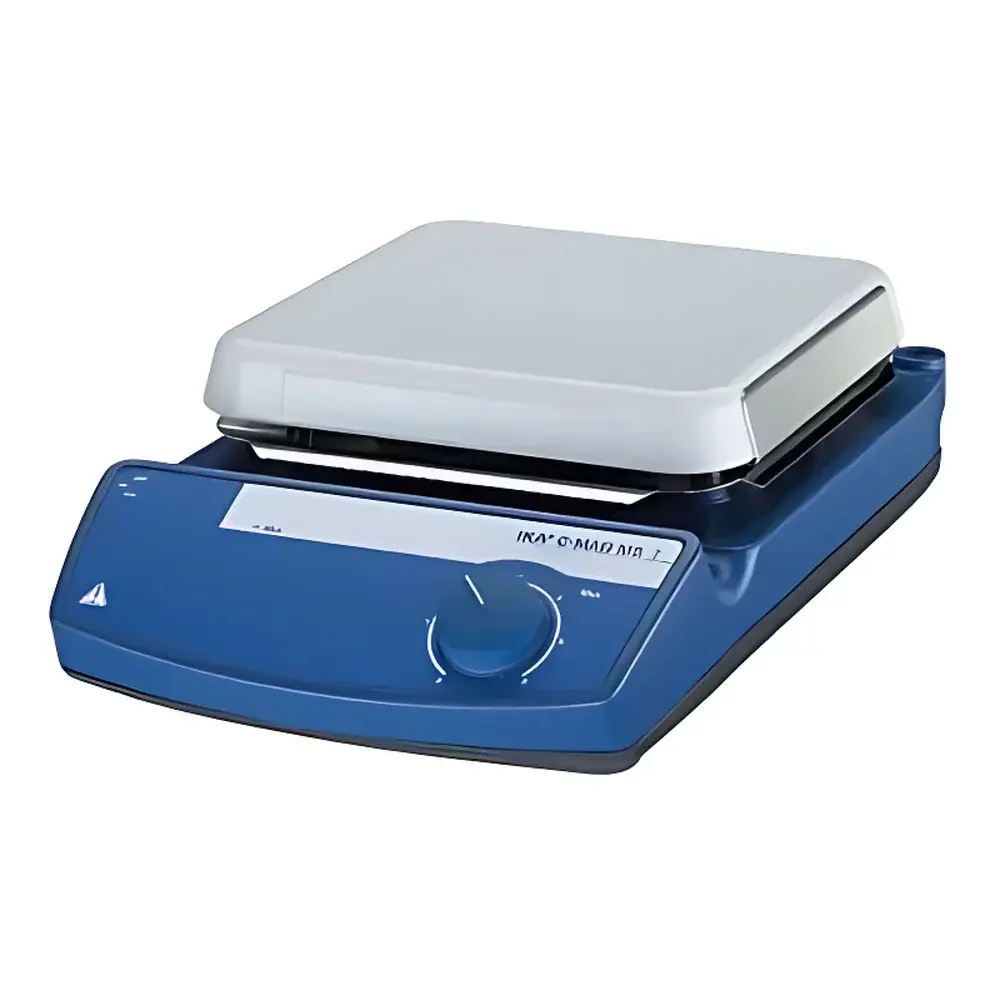
IKA C-MAG MS 7 Magnetic Stirrer
| Brand | IKA |
|---|---|
| Origin | Germany |
| Model | C-MAG MS 7 |
| Maximum Stirring Volume (H₂O) | 10 L |
| Speed Range | 100–1500 rpm |
| Temperature Control Range | 5–40 °C |
| Heating Plate Material | Ceramic |
| Plate Dimensions | 200 × 200 mm |
| Input Power | 30 W |
| Motor Output Power | 1.5 W |
| IP Rating | IP21 |
| Operating Ambient Temperature | 5–40 °C |
| Relative Humidity Limit | 80 % |
| Voltage | 230 V, 50/60 Hz |
| Weight | 5 kg |
| Stir Bar Max Length | 80 mm |
| Speed Control | Analog dial (0–6 scale) |
| Speed Display | Analog scale |
| Protection Class | DIN EN 60529 IP21 |
Overview
The IKA C-MAG MS 7 is a single-position analog magnetic stirrer engineered for precision, reliability, and chemical resistance in routine laboratory environments. Designed and manufactured in Germany, it employs a permanent magnet coupling system driven by a brushless DC motor with closed-loop speed feedback—ensuring consistent rotational output across variable load conditions, including moderately viscous aqueous and organic solutions. Unlike digitally controlled units, the C-MAG MS 7 utilizes an analog speed regulation mechanism (0–6 dial scale), calibrated to deliver stable agitation between 100 and 1500 rpm under standard conditions (water, 20 °C). Its ceramic heating plate—monolithically formed without seams—provides exceptional resistance to acids, bases, solvents, and thermal shock, making it suitable for applications requiring repeated exposure to aggressive reagents. The elevated control panel minimizes liquid ingress risk during operation while improving ergonomics for visual monitoring and manual adjustment.
Key Features
- Robust ceramic plate (200 × 200 mm) with seamless construction and high chemical inertness—resistant to HCl, NaOH, acetone, ethanol, and other common lab solvents
- Analog speed control with real-time mechanical feedback loop ensuring consistent torque delivery up to 1500 rpm
- Optimized magnetic field geometry enabling reliable engagement of stir bars up to 80 mm in length—even in vessels with thick glass walls or moderate viscosity (≤ 500 mPa·s)
- Elevated front-panel interface reducing splash exposure and enhancing readability of the analog speed scale
- IP21-rated enclosure providing protection against vertically falling drops and solid objects ≥ 12.5 mm—compliant with DIN EN 60529 for general laboratory use
- Low-noise, maintenance-free motor with 1.5 W mechanical output power and 30 W total electrical input—designed for continuous operation at ambient temperatures from 5 to 40 °C
Sample Compatibility & Compliance
The C-MAG MS 7 supports standard borosilicate glass beakers, flasks, and crystallization dishes (up to 10 L total volume, or 5 L per vessel when used in dual-vessel configurations on compatible platforms). It accommodates common PTFE- or glass-coated stir bars (e.g., cross-shaped, oval, or flea-type) with lengths up to 80 mm. While the unit does not incorporate active temperature regulation beyond ambient range stabilization, its stable platform design ensures reproducible mixing performance under GLP-aligned workflows. The device conforms to DIN EN 61010-1 (Safety Requirements for Electrical Equipment for Measurement, Control, and Laboratory Use) and carries CE marking for the European Economic Area. No integrated data logging or audit trail functionality is provided; therefore, it is intended for non-GxP-critical mixing tasks where manual process documentation suffices.
Software & Data Management
The C-MAG MS 7 operates as a standalone analog instrument with no embedded microprocessor, firmware, or digital communication interface. Consequently, it does not support USB, RS-232, or Ethernet connectivity, nor does it generate electronic records, timestamps, or user-accessible configuration logs. All operational parameters—including speed setting and runtime—are manually adjusted and observed via the front-panel analog scale. This architecture eliminates cybersecurity concerns associated with networked instruments and aligns with laboratories maintaining strict separation between analog utility equipment and regulated digital systems. For environments governed by FDA 21 CFR Part 11 or EU Annex 11, the unit may be deployed as a non-reporting auxiliary device, with mixing parameters recorded manually in bound lab notebooks or electronic lab notebooks (ELNs) compliant with ALCOA+ principles.
Applications
- Homogenization of buffer solutions, culture media, and reagent stock preparations in molecular biology and microbiology labs
- Controlled dissolution testing of pharmaceutical excipients and APIs during pre-formulation studies
- Stirring of catalyst suspensions in synthetic organic chemistry workflows
- Preparation of calibration standards and reference materials requiring low-shear, uniform dispersion
- Supporting gravimetric analysis procedures where consistent suspension of precipitates is essential prior to filtration or centrifugation
- General-purpose agitation in teaching laboratories, QC environments, and pilot-scale process development settings
FAQ
Does the C-MAG MS 7 include a built-in heater?
No. The C-MAG MS 7 is a magnetic stirrer only and does not provide heating functionality. For combined stirring and heating, consider the IKA C-MAG HS 7 or RET series.
Is the unit compatible with 110 V AC power supplies?
No. The C-MAG MS 7 is configured for 230 V, 50/60 Hz operation and requires a step-down transformer for use in North American or Japanese mains networks.
Can it maintain constant speed when viscosity changes during a reaction?
Yes—its analog feedback-controlled motor compensates for minor load variations within its torque envelope, though significant rheological shifts (e.g., polymerization onset) may exceed its dynamic response capability.
What is the maximum recommended vessel height for optimal stir bar coupling?
For reliable magnetic transmission, vessel depth should not exceed 150 mm when using standard 40–60 mm stir bars; deeper vessels require longer bars (up to 80 mm) and lower speed settings.
Is the ceramic plate resistant to hydrofluoric acid (HF)?
No. While highly resistant to most common laboratory chemicals, the alumina-based ceramic surface is not HF-compatible. Avoid direct contact with HF-containing solutions.



