
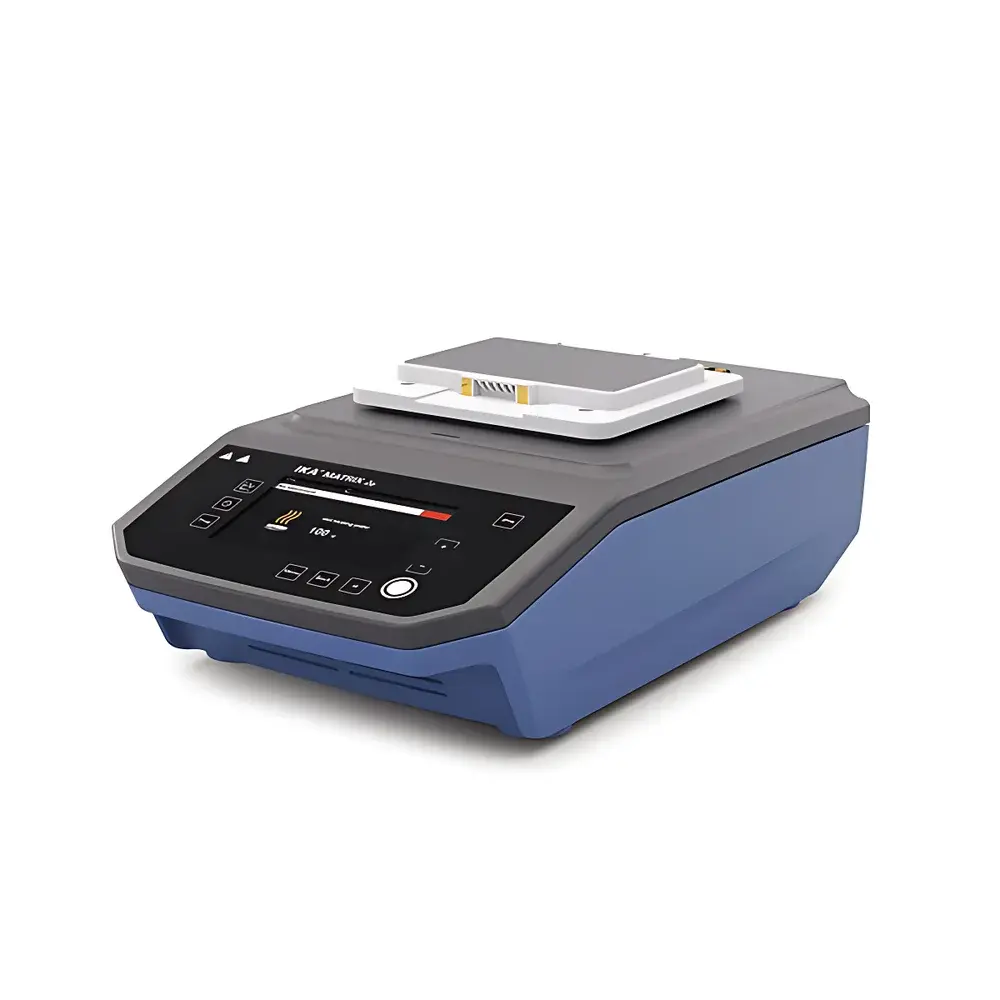
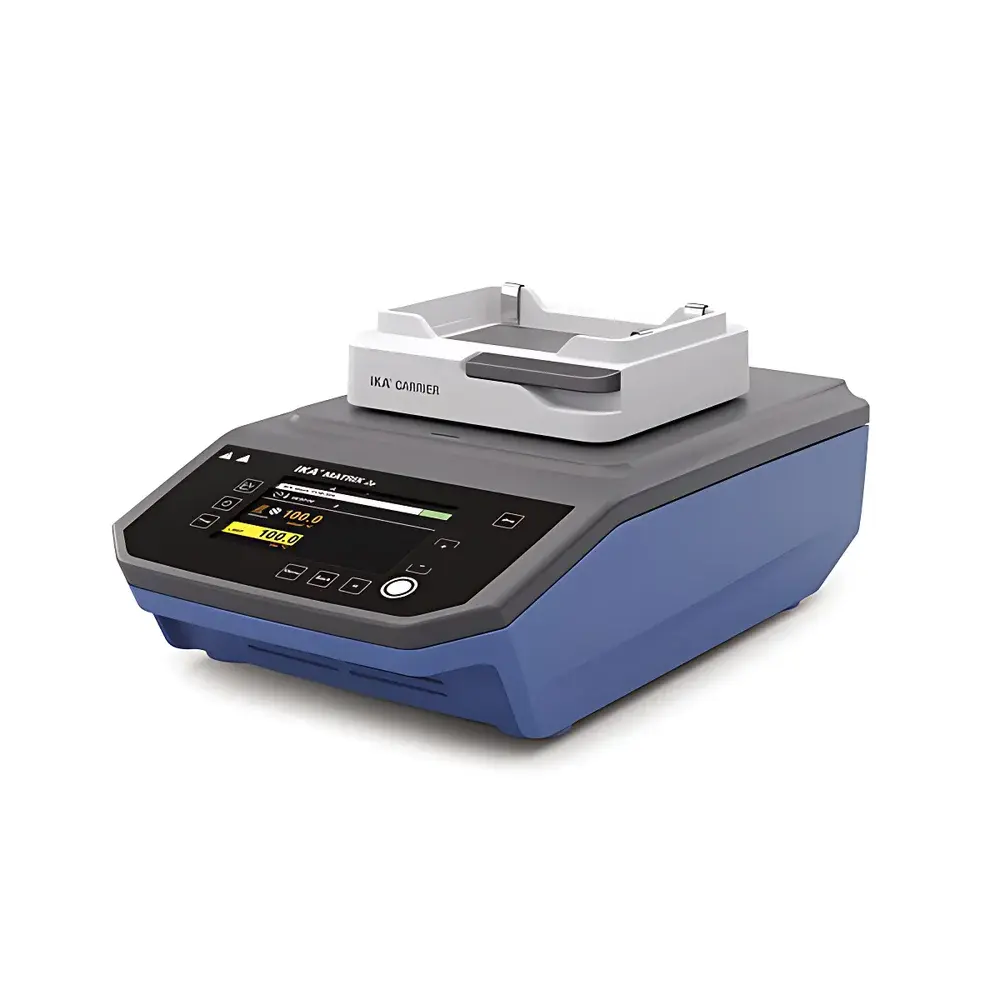
IKA Matrix Delta Plus Temperature-Controlled Dry Block Thermostat
| Brand | IKA |
|---|---|
| Origin | Germany |
| Manufacturer | IKA-Werke GmbH & Co. KG |
| Model | Matrix Delta Plus |
| Temperature Range | –30 °C to +110 °C |
| Temperature Accuracy | ±1 °C (at setpoint) |
| Temperature Stability | ±0.5 °C |
| Temperature Homogeneity | ±0.5 °C (within block) |
| Heating Rate | 5.5 °C/min (max) |
| Cooling Rate | 2 °C/min (from ambient down to –30 °C) |
| Max Load Capacity | 0.3 kg |
| Timer Range | 1 s – 6000 min |
| Display | TFT LCD |
| Programmable Ramp Rates | Yes |
| Heating Power | 100 W |
| Cooling Power | 72 W |
| Integrated Peltier Cooling | Yes |
| Interchangeable Modules | Up to 10 standard configurations |
| Safety Cut-off | 145 °C |
| Dimensions (W × D × H) | 216 × 127 × 351 mm |
| Net Weight | 9.5 kg |
| Ambient Operating Conditions | 5–40 °C, ≤80 % RH |
| Ingress Protection | IP21 |
| Interfaces | RS232, USB |
| Input Voltage | 100–240 V AC, 50/60 Hz |
| Max Input Power | 230 W |
| Operating Modes | Timer, Continuous, Program |
Overview
The IKA Matrix Delta Plus is a high-performance, Peltier-based dry block thermostat engineered for precise, bidirectional temperature control across a wide operational range—from –30 °C to +110 °C. Unlike conventional heating-only metal baths, the Matrix Delta Plus integrates solid-state thermoelectric (Peltier) technology to deliver both active heating and active cooling within a single compact aluminum die-cast housing. This architecture enables rapid thermal response (up to 5.5 °C/min heating; 2 °C/min cooling), exceptional thermal homogeneity (±0.5 °C across the block surface), and long-term stability (±0.5 °C over time), making it suitable for sensitive molecular biology workflows where thermal consistency directly impacts enzymatic activity, hybridization efficiency, or conformational integrity of nucleic acids and proteins. Its design adheres to DIN EN 60529 (IP21) environmental protection standards and supports continuous 100 % duty-cycle operation under laboratory ambient conditions (5–40 °C, ≤80 % RH).
Key Features
- Integrated Peltier cooling and resistive heating system enabling true sub-ambient operation down to –30 °C without external chillers or cryogens
- Aluminum die-cast block with optimized thermal mass and uniform heat distribution—ensuring ±0.5 °C homogeneity and ±1 °C absolute accuracy at setpoint
- TFT-LCD display with intuitive menu navigation and real-time visualization of setpoint, actual temperature, ramp rate, and remaining time
- Programmable temperature ramps and multi-step protocols (timer, continuous, or program mode) for automated cDNA synthesis, restriction digests, or ELISA incubation
- Auto-detection of interchangeable modules (e.g., 96-well PCR plates, 0.2/0.5/1.5/2.0 mL tube blocks, microcentrifuge rotor inserts) ensuring correct calibration and safety limits per configuration
- Dual digital interfaces (RS232 and USB) supporting remote control, data logging, and integration into LIMS or GLP-compliant audit trails per FDA 21 CFR Part 11 requirements
- Hardware-enforced safety features including dual independent temperature sensors, fixed overtemperature cut-off at 145 °C, and automatic module recognition to prevent misconfiguration
Sample Compatibility & Compliance
The Matrix Delta Plus accommodates a broad spectrum of sample formats via ten standardized interchangeable modules—including deep-well plates, skirted/unskirted 96-well PCR plates, and tube holders for volumes from 0.2 mL to 50 mL. It is routinely deployed in applications requiring strict thermal management: reverse transcription, ligase-mediated cloning, antibody-antigen binding steps in ELISA, controlled protein denaturation/renaturation, and gentle thawing of frozen glycerol stocks or lyophilized reagents. The instrument complies with IEC 61010-1 (safety of laboratory equipment), meets EMC directive 2014/30/EU, and carries CE marking. Its firmware architecture supports electronic record retention, user-access logs, and parameter change history—facilitating alignment with ISO/IEC 17025, CLIA, and GMP/GLP quality systems.
Software & Data Management
Through the optional IKA Labworldsoft™ software or native ASCII command protocol over RS232/USB, users can configure complex thermal profiles, export timestamped temperature logs (CSV/TXT), and synchronize instrument events with laboratory information management systems. All parameter modifications are timestamped and attributed to operator IDs when integrated with domain-authenticated network environments. Audit trail functionality records setpoint changes, module swaps, start/stop commands, and error states—meeting traceability requirements under FDA 21 CFR Part 11 for regulated environments. No proprietary drivers are required; standard CDC-class USB communication ensures plug-and-play compatibility with Windows, macOS, and Linux platforms.
Applications
- cDNA synthesis and RT-qPCR setup requiring precise 42–50 °C incubation with minimal thermal overshoot
- Restriction enzyme digestion and ligation reactions demanding stable 16–37 °C environments
- ELISA plate incubation at 37 °C with tight control to minimize well-to-well variability
- Controlled thawing of RNA samples at –20 °C → 4 °C → 25 °C gradients to prevent degradation
- Protein thermal shift assays (TSA) requiring linear ramping between 25–95 °C
- Storage and conditioning of calibration standards prior to HPLC or mass spectrometry analysis
FAQ
Does the Matrix Delta Plus require external cooling water or refrigerant gas?
No. It uses solid-state Peltier elements for both heating and cooling—no consumables, compressors, or plumbing are needed.
Can multiple temperature zones be controlled independently on one unit?
No. The Matrix Delta Plus maintains a single uniform temperature across the entire block surface; multi-zone control is not supported.
Is validation documentation (IQ/OQ/PQ) available?
Yes. IKA provides factory-issued IQ/OQ templates and certified reference thermometer calibration reports upon request for GxP-regulated installations.
What is the maximum allowable load per module?
The total mass placed on the block must not exceed 0.3 kg—including tubes, plates, adapters, and thermal interface materials.
How often does the instrument require recalibration?
Annual verification against NIST-traceable reference thermometers is recommended; built-in self-diagnostics monitor sensor drift and thermal response consistency in real time.



