
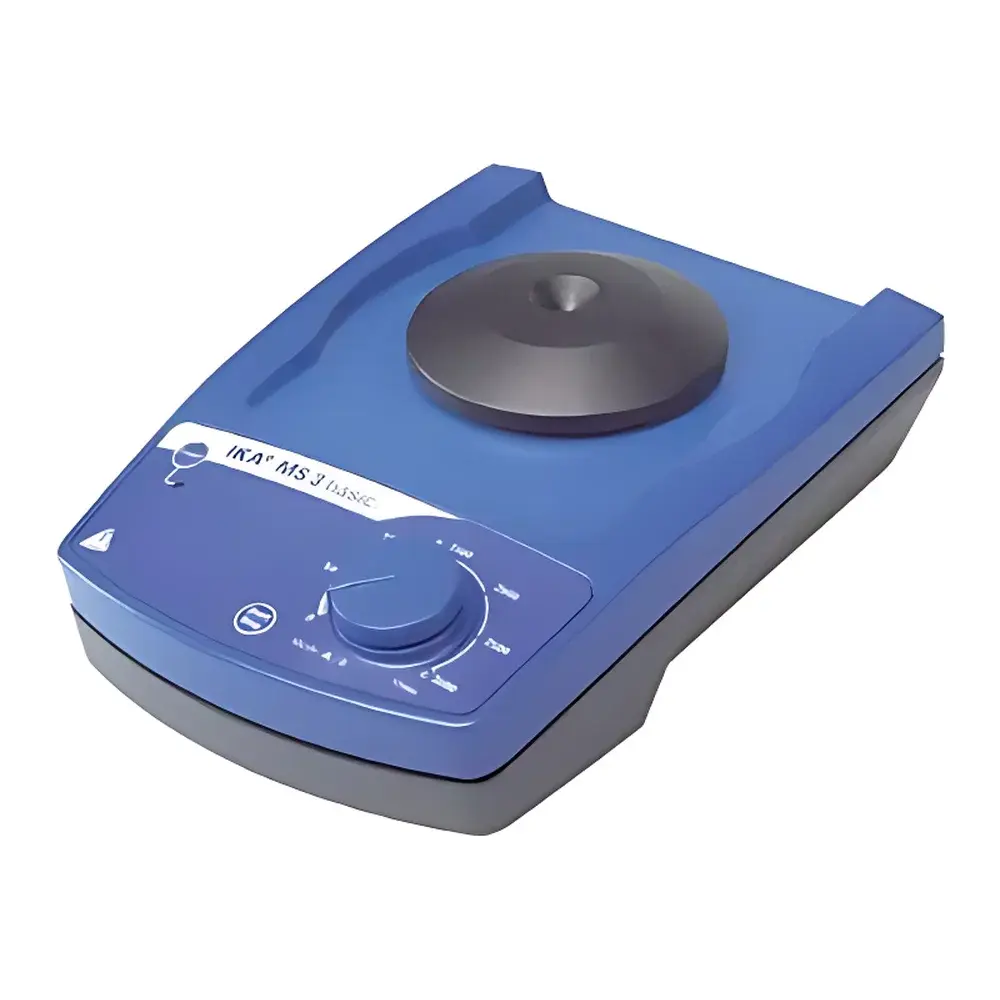
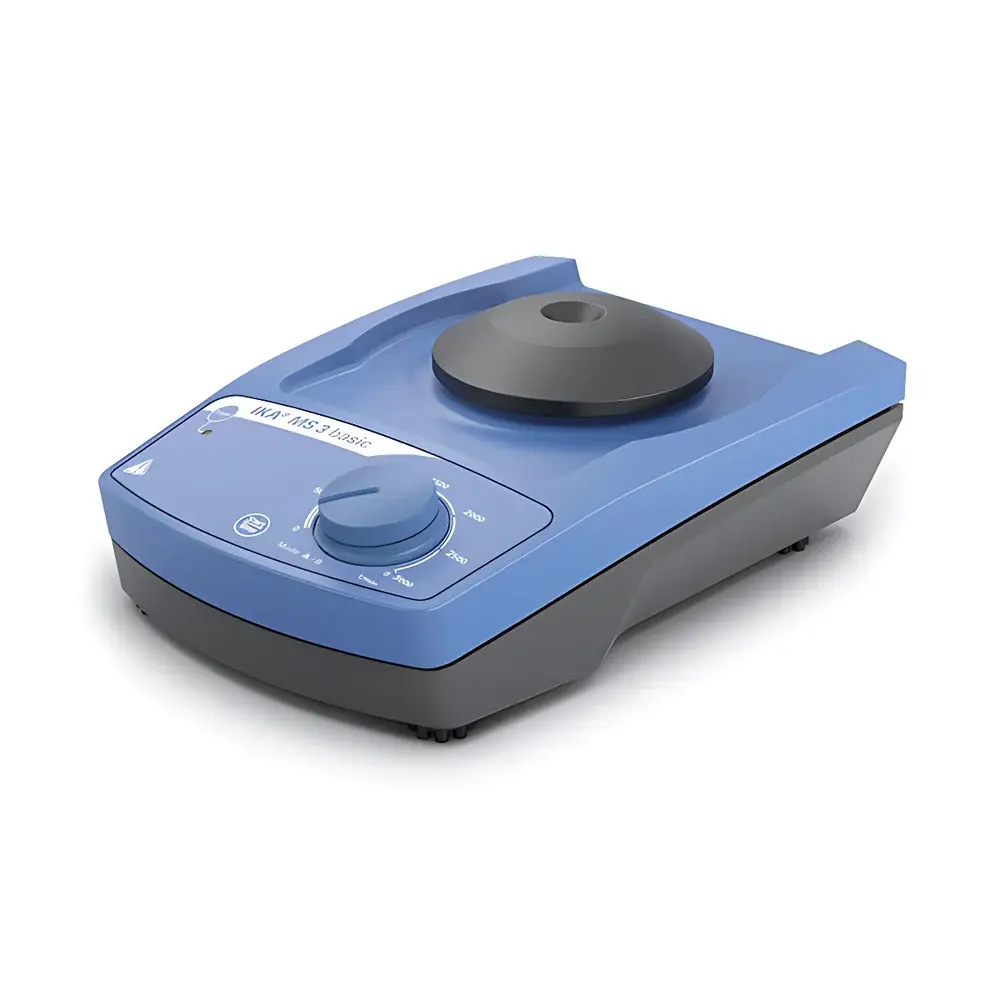
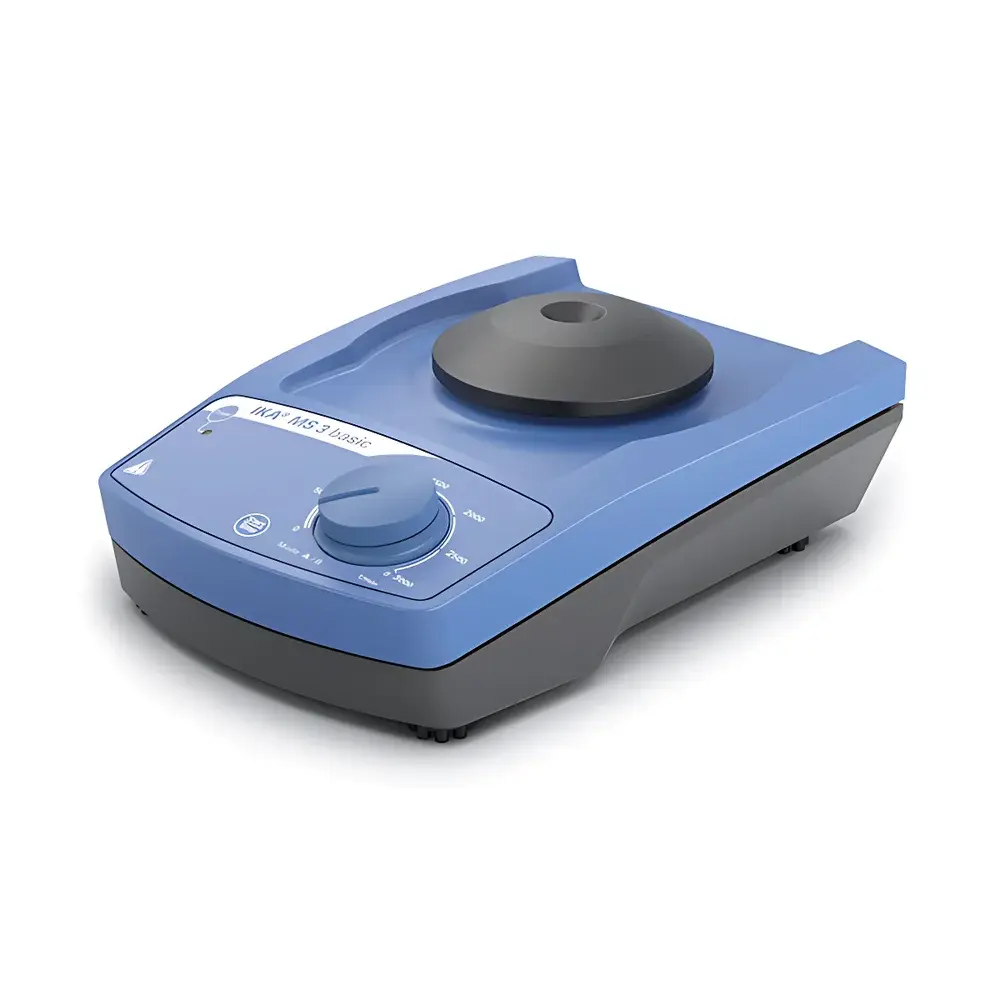
IKA MS 3 basic Orbital Shaker
| Brand | IKA |
|---|---|
| Origin | Germany |
| Manufacturer | IKA-Werke GmbH & Co. KG |
| Product Type | Orbital Shaker |
| Model | MS 3 basic |
| Oscillation Frequency | 0–3000 rpm |
| Orbit Diameter | 4.5 mm |
| Maximum Load Capacity (including clamps) | 0.5 kg |
| Operating Mode | Continuous or Pulse (with standard adapter plate) |
| Plate Quantity | 1 |
| Dimensions (W × H × D) | 148 × 205 × 63 mm |
| Weight | 2.9 kg |
| Ambient Temperature Range | 5–40 °C |
| Relative Humidity Limit | ≤80 % (non-condensing) |
| Protection Class | IP21 (per DIN EN 60529) |
| Input Voltage | 100–240 V AC, 50/60 Hz |
| Power Consumption | 20 W |
| Motor Output Power | 8 W |
| Minimum Adjustable Speed | 200 rpm |
| Housing Material | Die-cast zinc alloy |
Overview
The IKA MS 3 basic Orbital Shaker is a compact, benchtop orbital shaker engineered for precision and reliability in life science laboratories. It operates on the principle of circular orbital motion—generating uniform, low-shear agitation ideal for cell culture suspension, enzyme immunoassays (ELISA), solubility testing, and general mixing of small-volume samples in microplates, test tubes, and vials. With a fixed orbit diameter of 4.5 mm and speed control ranging from 200 to 3000 rpm, the device delivers consistent motion profiles critical for reproducible biological and biochemical workflows. Its die-cast zinc alloy housing ensures mechanical stability and long-term durability under continuous operation, while its universal mounting platform supports rapid interchange of standardized adapter plates—enabling seamless transition between microtiter plates (e.g., 96-well), PCR strips, conical tubes, and custom sample carriers.
Key Features
- Compact footprint (148 × 205 × 63 mm) optimized for space-constrained biosafety cabinets and modular lab benches
- Dual-mode operation: Mode A (safety-optimized) automatically detects standard IKA adapter plates and enforces speed limits (≤3000 rpm with certified plates; ≤1300 rpm with non-standard plates); Mode B bypasses plate detection for full-speed operation (up to 3000 rpm) with any compatible mounting surface
- Pulse (momentary) function for precise, short-duration agitation—particularly valuable during antibody incubation steps or reagent resuspension
- Robust die-cast zinc alloy chassis providing vibration damping, thermal stability, and resistance to mechanical fatigue over extended duty cycles
- Full 100% continuous-duty rating—certified for uninterrupted operation under ambient conditions compliant with ISO 14644-1 Class 8 cleanroom specifications
- Universal AC input (100–240 V, 50/60 Hz) with internal 24 V DC conversion—ensuring stable motor performance independent of regional power fluctuations
Sample Compatibility & Compliance
The MS 3 basic accommodates single-platform configurations up to 0.5 kg total load—including standard 96-well microplates, 384-well plates (with appropriate adapter), 15 mL and 50 mL conical tubes (using optional tube holders), and PCR strip carriers. All adapter plates are mechanically keyed for repeatable positioning and alignment. The unit complies with DIN EN 60529 (IP21 ingress protection), IEC 61000-6-3 (EMC emission standards), and IEC 61000-6-2 (immunity to electrostatic discharge and RF fields). While not a temperature-controlled shaker, its design meets GLP-relevant requirements for mechanical traceability: speed settings are manually set via calibrated rotary dial with tactile feedback, and operational status (on/off, pulse mode) is indicated by LED indicators—supporting audit-ready documentation when integrated into SOP-driven workflows per ISO/IEC 17025 and FDA 21 CFR Part 11 (when used with validated electronic lab notebook systems).
Software & Data Management
The MS 3 basic is a standalone analog-controlled instrument with no embedded microprocessor or digital interface. Speed adjustment is performed via a precision potentiometer with engraved scale markings (200–3000 rpm in 100-rpm increments), ensuring mechanical repeatability without software dependency. No firmware, USB port, Bluetooth, or data logging capability is included—aligning with IKA’s design philosophy for entry-level instruments where operational simplicity, electromagnetic compatibility, and regulatory transparency supersede connectivity features. This architecture eliminates cybersecurity risks, reduces validation burden in GMP environments, and facilitates straightforward IQ/OQ protocols in pharmaceutical QC labs operating under Annex 11 and USP guidelines.
Applications
- ELISA plate washing and incubation agitation in clinical diagnostics and research immunology labs
- Suspension of adherent mammalian cells prior to passaging or harvesting
- Homogenization of bacterial cultures in LB or SOC media for transformation efficiency optimization
- Equilibration of binding reactions in affinity chromatography assay development
- Rehydration and dispersion of lyophilized reagents in molecular biology workflows
- Pre-analytical sample mixing for downstream HPLC, mass spectrometry, or NGS library preparation
FAQ
Does the MS 3 basic support timer functionality?
No—the MS 3 basic model lacks built-in timing circuitry. For time-gated operation, external programmable timers or laboratory automation controllers must be used in series with the device’s power input.
Can it be used inside a CO₂ incubator?
No—it is rated for ambient operation only (5–40 °C, ≤80% RH, IP21) and is not designed for humidified, elevated-CO₂, or temperature-controlled enclosures.
Is the 4.5 mm orbit diameter adjustable?
No—the orbit is mechanically fixed and non-variable; this ensures consistent shear profile across all operating speeds and eliminates calibration drift associated with eccentric mechanisms.
What safety certifications does it hold?
It conforms to IEC 61010-1 (Safety Requirements for Electrical Equipment for Measurement, Control, and Laboratory Use) and carries CE marking under the EU Low Voltage Directive (2014/35/EU) and EMC Directive (2014/30/EU).
How is speed accuracy verified during qualification?
Speed verification is performed using a calibrated handheld tachometer or laser stroboscope against the engraved dial scale; typical deviation is ±2% of setpoint across the 200–3000 rpm range under nominal load conditions.



