
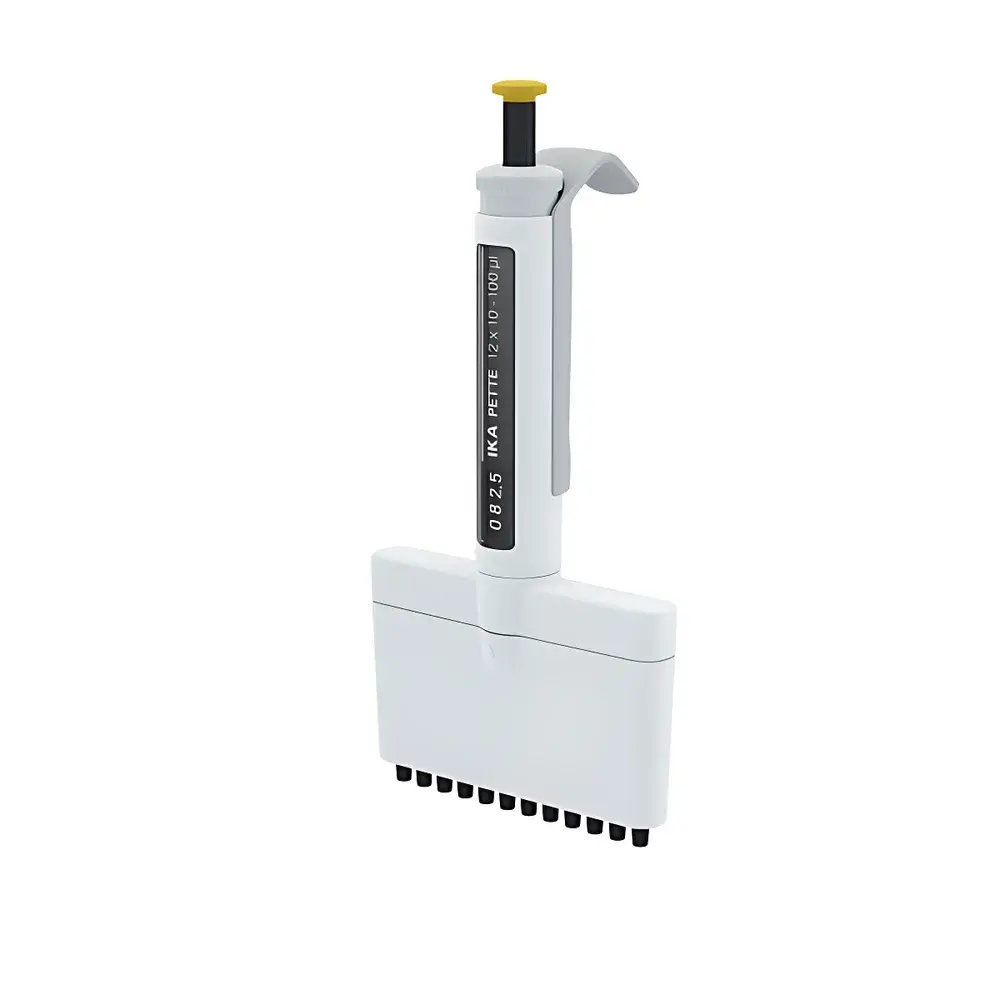
IKA Pette multi 12-Channel Adjustable Volume Pipette (10–100 µL)
| Brand | IKA |
|---|---|
| Origin | Germany |
| Manufacturer Type | Original Equipment Manufacturer (OEM) |
| Product Category | Imported Instrument |
| Model | IKA Pette multi 12 x 10–100 µL |
| Instrument Type | Multichannel Pipette |
| Automation Level | Manual |
| Number of Channels | 12 |
| Volume Range | 10–100 µL |
| Maximum Volume | 100 µL |
| Accuracy | ±0.8 µL or ±0.8 % (whichever is greater) |
Overview
The IKA Pette multi 12-channel adjustable-volume pipette is an ergonomically engineered, high-precision manual liquid handling instrument designed for reproducible, low-volume transfers in demanding laboratory environments. Based on positive displacement mechanics with a sealed piston system, it delivers consistent aspiration and dispensing across all 12 channels simultaneously—ideal for high-throughput applications such as ELISA plate preparation, PCR setup, cell culture seeding, and serial dilution workflows in 96-well and 384-well microplates. Its robust construction, chemical-resistant housing, and UV-stable materials ensure long-term dimensional stability and operational integrity under routine decontamination protocols—including full autoclaving at 121 °C, 1 bar for 20 minutes. The device operates without electronic components, eliminating battery dependency and electromagnetic interference concerns common in regulated environments.
Key Features
- Ergonomic tri-grip system: Interchangeable handles in three distinct shapes and materials accommodate left- and right-handed users, as well as varying hand sizes—reducing repetitive strain injury (RSI) risk during extended use.
- Single-hand volume adjustment: A multifunctional rotary dial enables precise, tool-free setting of volumes within the 10–100 µL range; volume lock prevents accidental changes during operation.
- DLC-coated conical tips and piston: Diamond-like carbon (DLC) coating enhances wear resistance, minimizes friction, and ensures consistent seal integrity over thousands of cycles.
- Air-gap thermal isolation: Dual-layer housing incorporates an insulating air gap between the grip zone and piston chamber to mitigate heat transfer from the operator’s hand—critical for maintaining volumetric accuracy at low ranges.
- Modular service design: The pipette core (piston, seal, and tip cone assembly) disassembles in under 60 seconds without tools; individual tip cones are replaceable per channel, extending service life and reducing total cost of ownership.
- Mechanical volume display: Large, high-contrast numerical readout remains fully visible during pipetting—enabling real-time verification without repositioning the device.
Sample Compatibility & Compliance
The IKA Pette multi series is compatible with standard conical polypropylene tips meeting ISO 8655-2 specifications. It supports both sterile and non-sterile tip types, including low-retention and filtered variants. All models comply with ISO 8655 (Pipettes — Part 1: Terms and general requirements; Part 2: Piston-operated volumetric apparatus), and performance validation adheres to ISO/IEC 17025:2017 principles when used with certified calibration services. Full autoclavability satisfies GLP and GMP requirements for aseptic workflows. While not electronically governed, its mechanical architecture inherently supports audit-ready traceability when paired with IKA’s proprietary calibration software and robotic calibration systems (“Pit” and “Patty”), which generate ISO-compliant calibration certificates with full uncertainty budgets.
Software & Data Management
IKA provides dedicated calibration management software for traceable pipette verification. The application supports scheduling, execution, and documentation of gravimetric calibration according to ISO 8655-6 and ASTM E1154 standards. It records environmental parameters (temperature, humidity, air pressure), balance metadata, operator ID, and statistical summaries (mean, SD, CV%, error vs. tolerance). Calibration reports export in PDF and CSV formats, include digital signatures, and support 21 CFR Part 11–compliant user authentication and audit trails when deployed on validated networked workstations. Data integrity is preserved via immutable timestamped logs and version-controlled calibration templates.
Applications
- High-throughput assay setup: Uniform loading of reagents into multiwell plates for drug screening, immunoassays, and nucleic acid quantification.
- Genomic workflows: Accurate parallel dispensing for qPCR master mixes, NGS library normalization, and CRISPR guide RNA transfection.
- Cell-based assays: Reproducible seeding of adherent and suspension cells into microplates with minimal inter-channel variability.
- Quality control laboratories: Routine verification of volumetric accuracy in pharmaceutical QC, clinical diagnostics, and food safety testing.
- Academic research: Teaching labs benefit from intuitive operation, durability, and compliance with international metrology standards.
FAQ
Is the IKA Pette multi 12-channel pipette autoclavable?
Yes—the entire unit is certified for full autoclaving at 121 °C, 1 bar for 20 minutes. All internal seals and DLC-coated components retain functionality post-sterilization.
Can individual channels be recalibrated independently?
No—calibration is performed per instrument using gravimetric methods defined in ISO 8655-6. However, independent tip cone replacement per channel maintains alignment and reduces drift-induced inter-channel variation.
What tip types are compatible?
Standard conical tips conforming to ISO 8655-2 dimensions (e.g., 10–200 µL universal fit); low-retention, filtered, and sterile options are supported.
Does this pipette require routine maintenance beyond cleaning?
Routine maintenance consists of visual inspection, tip cone replacement as needed, and annual calibration verification. No lubrication or internal part replacement is required under normal usage conditions.
How does the air-gap thermal isolation improve accuracy?
By decoupling the grip zone from the piston chamber, the design limits conductive heating from the operator’s hand—preventing thermal expansion of internal components that would otherwise cause volume drift, particularly below 50 µL.
Related Products



