
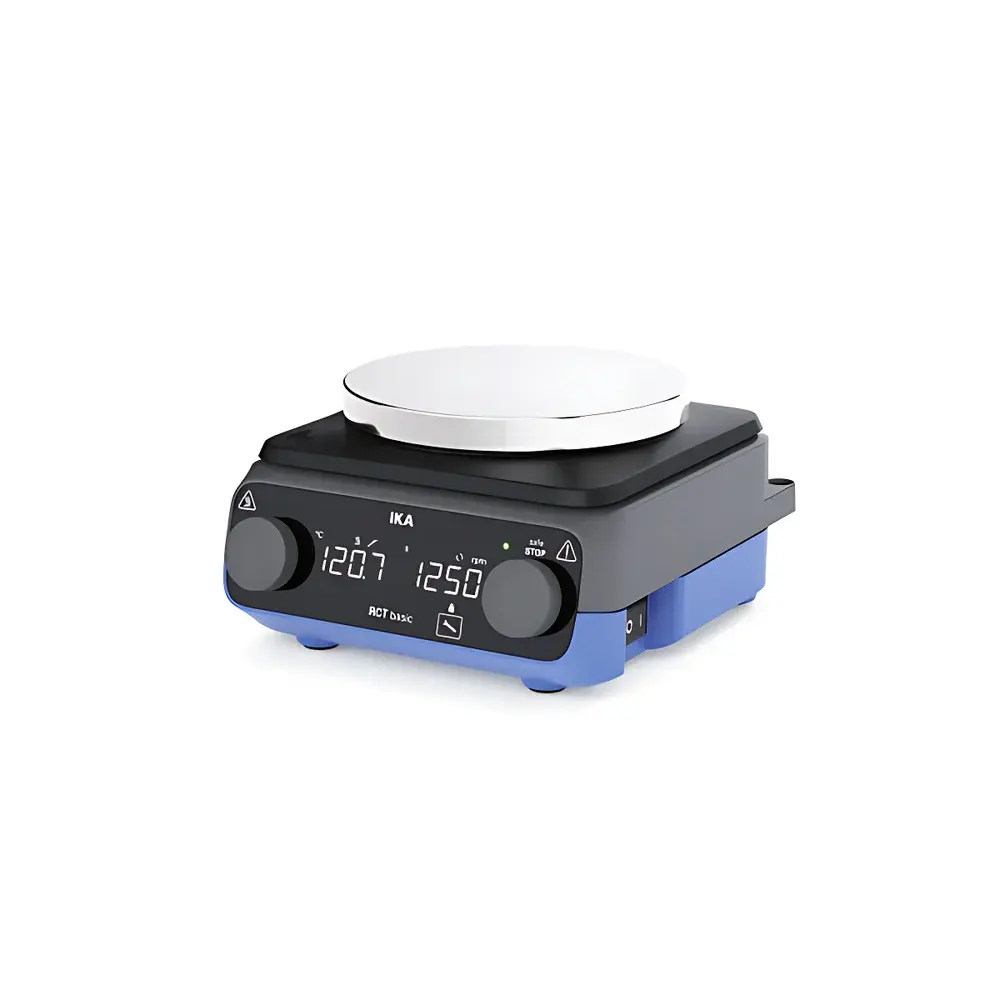
IKA RCT basic Aluminum Heating Magnetic Stirrer
| Brand | IKA |
|---|---|
| Origin | Germany |
| Model | RCT basic Aluminum |
| Power Input | 820 W |
| Max. Stirring Volume (H₂O) | 20 L |
| Max. Load Capacity | 25 kg |
| Motor Type | Brushless DC Motor |
| Speed Range | 50–1500 rpm |
| Speed Setting Accuracy | ±10 rpm |
| Speed Display | LED (set & actual) |
| Heating Temperature Range | RT + self-heating to 310 °C |
| Temp. Setting Range | 0–310 °C |
| Temp. Control Accuracy (external PT1000, 500 mL H₂O) | ±0.5 K |
| Temp. Control Accuracy (ETS-D7 or PT Wireless, same condition) | ±0.2 K |
| Heating Power | 800 W |
| Plate Material | Anodized Aluminum |
| Plate Diameter | Ø135 mm |
| Dimensions (W×D×H) | 160 × 100 × 200 mm |
| Weight | 2.3 kg |
| Protection Rating | IP54 |
| Safety Compliance | EN IEC 61010-2-010 |
| Interface | RS232, USB-C, optional WPAN (USB WD) |
| Operating Ambient | 5–40 °C, ≤80 % RH |
Overview
The IKA RCT basic Aluminum Heating Magnetic Stirrer is an engineered solution for precise, reproducible, and inherently safe thermal stirring in research, quality control, and routine laboratory workflows. Built on a brushless DC motor architecture, it delivers stable rotational motion without carbon brush wear—ensuring long-term speed consistency and reduced maintenance. Its core operation combines magnetic coupling-based agitation with resistive heating of an anodized aluminum plate, enabling simultaneous temperature control and mixing across volumes up to 20 L of aqueous media. Unlike basic stirrers, the RCT basic integrates dual independent thermal safety circuits compliant with EN IEC 61010-2-010, allowing safe handling of flammable solvents, exothermic reactions, and low-boiling-point media. The system supports both contact (PT1000, ETS-D5, ETS-D7) and wireless (PT Wireless) temperature feedback, permitting closed-loop regulation directly at the sample level—not just at the plate surface—thereby minimizing thermal lag and improving process fidelity.
Key Features
- Brushless DC motor with ±2% speed deviation (at 1500 rpm, 25°C, no load), delivering consistent torque and extended service life
- Dual-sensor thermal safety architecture: one sensor regulates setpoint temperature; the second monitors independently adjustable safety limit (50–360°C), mechanically configurable without software dependency
- Delta-T safety function: automatically disables heating if medium temperature exceeds user-defined offset from setpoint—maintaining stirring during transient thermal events
- Real-time anomaly detection: identifies abrupt temperature drops (e.g., vessel breakage or solvent evaporation) and abnormal absence of temperature rise (e.g., misplaced sensor), triggering protective shutdowns
- IP54-rated sealed housing with die-cast aluminum body, resistant to corrosive vapors and accidental spills
- Integrated timer (1 s – 5999 min) with LED display and programmable auto-stop functionality
- Two tripod mounting points for rigid, vibration-free attachment of external sensors or probes
- User-access restriction mode: configurable startup behavior and parameter lockout to prevent unintended changes in regulated environments
- Continuous stirring fail-safe: agitation remains active during error states or safety-triggered heating cutoff, mitigating bumping and boil-over risks
Sample Compatibility & Compliance
The RCT basic accommodates standard laboratory vessels—including glass beakers (up to 600 mL), round-bottom flasks, and crystallization dishes—via its 135 mm Ø aluminum heating plate. Stir bar compatibility spans 20–80 mm lengths, supporting both standard PTFE-coated and PTFE/SS composite designs. For regulatory compliance, the device meets EN IEC 61010-2-010 for laboratory equipment safety and incorporates design elements aligned with GLP/GMP operational expectations: audit-ready safety thresholds, hardware-enforced temperature limits, and deterministic response to fault conditions. While not FDA 21 CFR Part 11–certified out-of-the-box, its digital interfaces (RS232, USB-C) support integration into validated systems where electronic records are required. Environmental operating specifications (5–40°C, ≤80% RH) conform to ISO/IEC 17025 ambient requirements for accredited testing laboratories.
Software & Data Management
The RCT basic operates as a standalone instrument but is fully compatible with IKA’s ecosystem for enhanced traceability and remote oversight. When connected via RS232 or USB-C, it communicates with IKA Lab Assistant (mobile/desktop application, release pending), enabling wireless monitoring of real-time speed, plate temperature, medium temperature, and safety status across multiple instruments. Optional IKA HUB connectivity unlocks advanced features including programmable ramp-soak profiles, inter-device safety logic (e.g., automatic heating cutoff if coupled overhead stirrer falls below defined RPM), and synchronized logging of time-stamped operational parameters. All external temperature sensors—wired (PT1000, ETS-D5, ETS-D7) and wireless (PT Wireless)—provide calibrated data streams suitable for raw data archiving in LIMS or ELN platforms. No proprietary drivers are required; standard CDC-class USB communication ensures plug-and-play integration with Windows, macOS, and Linux hosts.
Applications
This stirrer serves critical functions across pharmaceutical development (e.g., dissolution testing per USP , buffer preparation, reaction screening), chemical synthesis (Grignard, esterification, polymerization under inert atmosphere), materials science (nanoparticle dispersion, polymer solution homogenization), and food & beverage QA (viscosity standardization, extract preparation). Its high-precision external temperature control (±0.2 K with ETS-D7 or PT Wireless) makes it suitable for kinetic studies requiring tight thermal windows. The robust aluminum plate withstands repeated thermal cycling and aggressive cleaning agents—ideal for shared-core facilities. In teaching labs, its mechanical safety dials and intuitive LED interface reduce training overhead while maintaining full compliance with institutional EH&S protocols.
FAQ
Does the RCT basic support external temperature feedback for closed-loop control?
Yes—it accepts PT1000, ETS-D5, ETS-D7, and PT Wireless sensors, enabling true medium-temperature regulation rather than plate-surface approximation.
What safety standards does the device comply with?
It conforms to EN IEC 61010-2-010 for laboratory electrical safety, with dual independent thermal cutoffs and mechanical safety limit adjustment.
Can multiple RCT basic units be controlled centrally?
Yes—via IKA HUB or Lab Assistant (pending release), using RS232 daisy-chaining or USB/WPAN networks for coordinated operation and unified safety logic.
Is calibration documentation available for the temperature sensors?
Calibration certificates for ETS-D5, ETS-D7, and PT1000 sensors are provided by IKA upon request and meet DIN EN 60751 Class A tolerances.
What is the maximum recommended volume for accurate temperature control with external sensing?
For ±0.2 K accuracy, use ≥500 mL aqueous solutions in standard 600 mL beakers with 40 mm stir bars at 600 rpm—conditions validated per IKA technical note TN-RCT-02.



