
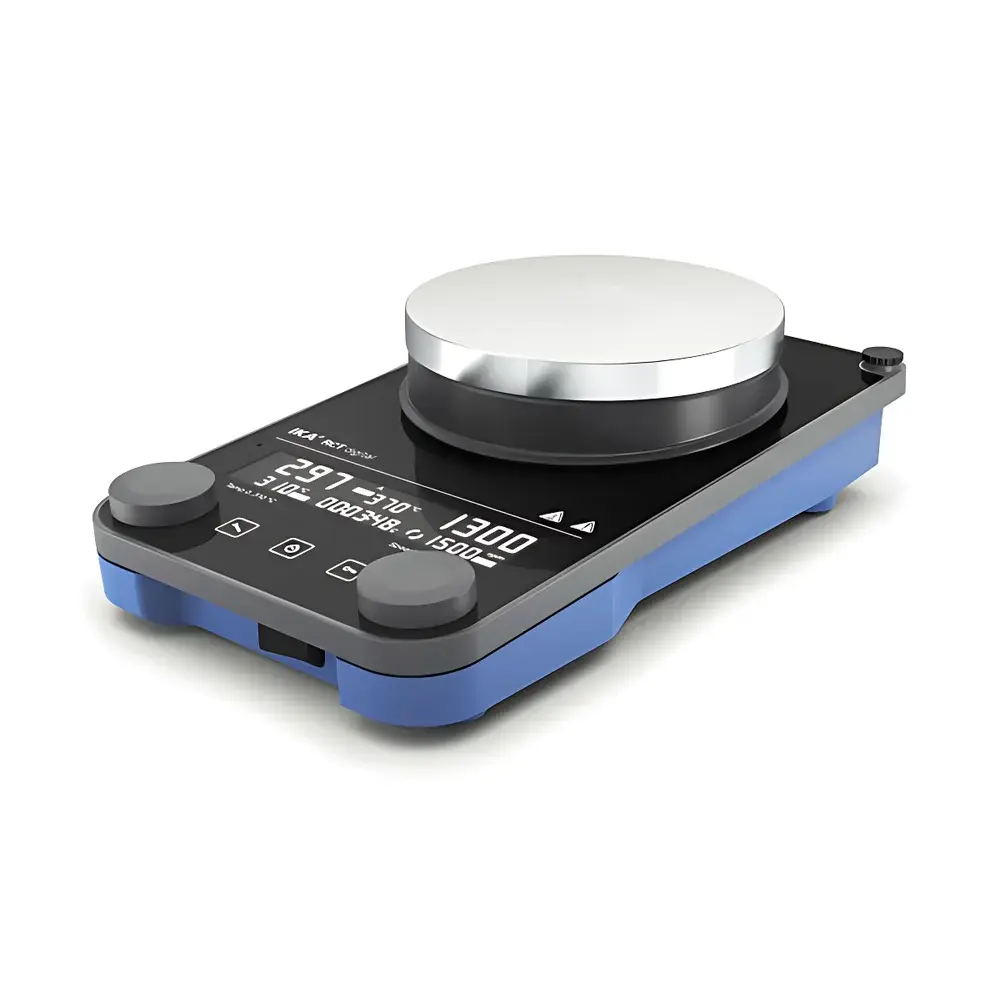
IKA RCT digital Magnetic Stirrer
| Brand | IKA |
|---|---|
| Origin | Germany |
| Manufacturer | IKA Werke GmbH & Co. KG |
| Type | Magnetic Stirrer |
| Max. Stirring Volume | 20 L |
| Speed Range | 50–1500 rpm |
| Heating Temperature Range | Ambient + Self-Heating to 310 °C |
| Motor Output Power | 9 W |
| Heater Output Power | 600 W |
| Plate Material | Anodized Aluminum |
| Plate Diameter | 135 mm |
| Dimensions (W × H × D) | 160 × 270 × 85 mm |
| Weight | 2.4 kg |
| Protection Class | IP42 |
| Interface | RS232, USB |
| Power Supply | 220–230 / 115 / 100 V, 50/60 Hz |
| Input Power | 650 W (operational), 1.6 W (standby) |
| Ambient Operating Conditions | 5–40 °C, ≤80% RH |
Overview
The IKA RCT digital is a high-precision, benchtop magnetic stirrer with integrated heating and SmartTemp® safety technology — engineered for reproducible thermal and mechanical control in demanding laboratory environments. Based on the Couette flow principle, it employs a rotating magnetic field to drive PTFE- or glass-coated stirring bars within vessels, enabling homogeneous mixing of low- to medium-viscosity liquids without mechanical shaft penetration. Its heating module utilizes resistive alloy elements embedded beneath an anodized aluminum plate, delivering rapid, uniform thermal transfer up to 310 °C. Designed for long-term reliability, the RCT digital is the first IKA magnetic stirrer backed by a lifetime warranty — reflecting its robust architecture, precision-machined components, and adherence to DIN EN 60529 (IP42) ingress protection standards.
Key Features
- SmartTemp® real-time temperature monitoring: continuously compares plate surface temperature with user-defined safety thresholds and automatically deactivates heating if critical deviation occurs — compliant with GLP safety protocols for exothermic reaction management.
- Dual-display LCD interface: simultaneously shows setpoint and actual values for both speed (rpm) and temperature (°C/°F), with 1 K resolution for thermal control and ±10 rpm accuracy in speed setting.
- Programmable timer with audible alert: supports kinetic studies requiring precise reaction duration control; configurable from 1 minute to 99 hours 59 minutes.
- Auto-reversal and intermittent stirring modes: mitigates vortex formation and sedimentation in heterogeneous suspensions, improving homogeneity during extended operations.
- External temperature sensor compatibility: accepts PT1000, ETS-D5, and ETS-D6 probes for direct medium temperature feedback — enabling closed-loop control with ±0.2 K stability (ETS-D6, 500 mL water, 600 rpm).
- Firmware-upgradable via USB: ensures long-term functionality alignment with evolving laboratory informatics requirements and regulatory expectations (e.g., audit trail readiness).
- RS232 interface for remote operation and data logging: compatible with LabVIEW™, MATLAB®, and custom SCADA systems for integration into automated workflows.
Sample Compatibility & Compliance
The RCT digital accommodates standard laboratory glassware (e.g., beakers, flasks, crystallization dishes) up to 20 L volume when used with appropriately sized stirring bars (30–80 mm). Its non-contact drive mechanism eliminates contamination risk and enables use under inert atmospheres or sealed vessels. The device conforms to IEC 61010-1 for electrical safety in laboratory equipment and meets EMC requirements per EN 61326-1. Its SmartTemp® system supports compliance with ISO/IEC 17025 clause 6.4.10 (safety interlocks) and aligns with FDA 21 CFR Part 11 principles when paired with validated data acquisition software. The IP42 rating certifies protection against solid objects >1 mm and vertically falling drops — suitable for general chemistry, pharmaceutical QA/QC, and materials synthesis labs operating within 5–40 °C ambient conditions.
Software & Data Management
While the RCT digital operates autonomously via front-panel controls, its RS232 and USB interfaces support bidirectional communication with host systems. Through IKA’s optional labworldsoft® platform (v4.0+), users can configure multi-step protocols, record time-stamped speed/temperature profiles, generate PDF reports with operator ID and timestamp metadata, and export CSV files for statistical process control (SPC) analysis. Audit trails include parameter changes, start/stop events, and safety-triggered shutdowns — fulfilling ALCOA+ (Attributable, Legible, Contemporaneous, Original, Accurate, Complete, Consistent, Enduring, Available) data integrity criteria. Firmware updates preserve calibration constants and maintain traceability to factory settings.
Applications
- Controlled synthesis of metal-organic frameworks (MOFs) and nanomaterials requiring stable thermal ramping and agitation over 12–72 hour durations.
- Standardized dissolution testing (USP ) in pharmaceutical development, where precise 37 °C bath equivalence and consistent shear rate are critical.
- Preparation of calibration standards and reference solutions in environmental and clinical labs, minimizing stratification in viscous matrices (e.g., glycerol-water mixtures).
- Enzyme kinetics assays involving temperature-sensitive catalysts, leveraging the timer + SmartTemp® combination to halt reactions at exact intervals.
- Quality control of polymer emulsions and colloidal dispersions, where intermittent mode prevents creaming while maintaining particle suspension.
FAQ
Does the RCT digital support external temperature feedback for closed-loop control?
Yes — it accepts PT1000, ETS-D5, and ETS-D6 sensors for direct medium temperature measurement and dynamic power modulation.
What is the maximum recommended stirring volume for viscous media?
For media with viscosity >1000 mPa·s, reduce max volume to ≤5 L to ensure torque stability and thermal uniformity.
Is firmware update capability retained after extended service life?
Yes — USB-based updates remain functional throughout the instrument’s operational lifespan, including post-warranty periods.
Can the device operate continuously at 310 °C?
Continuous operation at maximum temperature is permissible only with appropriate ventilation and verified thermal stability of vessel materials (e.g., borosilicate glass, ceramic).
How does SmartTemp® differ from conventional overtemperature protection?
Unlike simple cut-off thermostats, SmartTemp® continuously monitors plate-to-sensor delta and initiates graded power reduction before reaching user-defined safety limits — reducing thermal shock and preserving sample integrity.



