
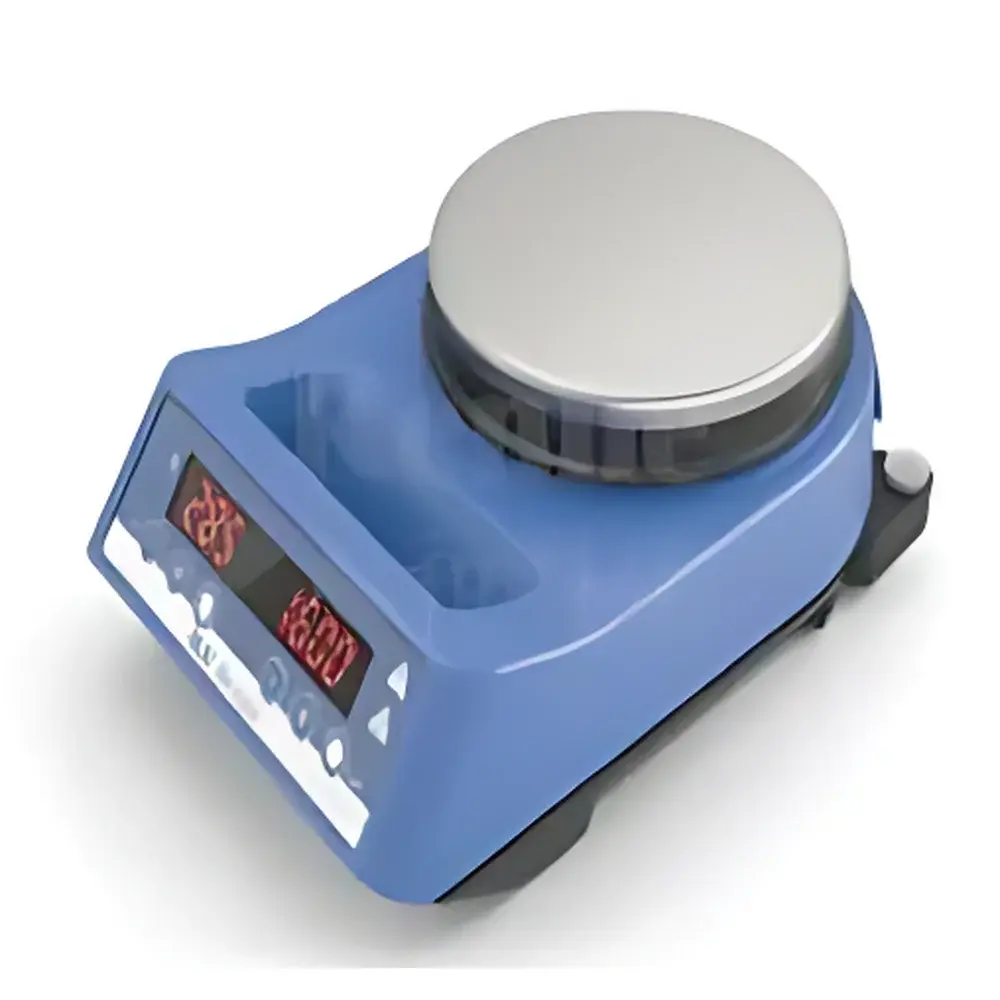
IKA RH digital Digital Hotplate Magnetic Stirrer
| Brand | IKA |
|---|---|
| Origin | Germany |
| Model | RH digital |
| Instrument Type | Magnetic Stirrer |
| Max. Stirring Volume | 15 L |
| Speed Range | 100–2000 rpm |
| Heating Temperature Range | 50–320 °C |
| Heating Power Output | 600 W |
| Plate Material | Stainless Steel 1.4301 (with Copper Sublayer) |
| Safety Overtemperature Range | 100–360 °C |
| Plate Diameter | 135 mm |
| Dimensions (W × D × H) | 160 × 100 × 250 mm |
| Weight | 2.8 kg |
| Ambient Operating Conditions | 5–40 °C, ≤80 % RH |
| Protection Class | IP21 (per DIN EN 60529) |
| Input Voltage | 230 / 115 / 100 V, 50/60 Hz |
| Total Power Consumption | 620 W |
Overview
The IKA RH digital is a precision-engineered hotplate magnetic stirrer designed for reproducible, temperature-controlled mixing in academic, industrial, and quality control laboratories. It operates on the principle of contactless magnetic coupling: a rotating permanent magnet beneath the heated ceramic-stainless steel plate induces synchronous rotation of a PTFE- or glass-coated magnetic stirring bar immersed in the sample vessel. The integrated heating system employs a stainless steel 1.4301 top plate with an embedded copper thermal layer, enabling rapid, uniform heat transfer and stable thermal gradients across the surface. Unlike basic analog stirrers, the RH digital implements closed-loop temperature control via optional external Pt100 sensors (e.g., ETS-D5), compliant with DIN 12878 probe interface standards—ensuring traceable, high-fidelity thermal regulation essential for kinetic studies, dissolution testing, and reagent synthesis.
Key Features
- Digital LED display for simultaneous real-time monitoring of set and actual speed (100–2000 rpm) and temperature (50–320 °C)
- 600 W high-power heating system with 6 K/min average ramp rate and thermal stability ±1 °C at setpoint (load-dependent)
- Adjustable safety overtemperature limit (100–360 °C) with automatic cut-off to prevent thermal runaway
- Stainless steel 1.4301 heating plate (Ø135 mm) featuring optimized copper sublayer for enhanced thermal conductivity and mechanical durability
- Gentle motor start-up sequence minimizing mechanical shock to sensitive vessels and viscous media
- Integrated error-code diagnostics (e.g., Error 5 for sensor-in-medium detection failure) supporting preventive maintenance and GLP-compliant operation
- Touch-sensitive membrane keypad with tactile feedback—designed for glove-compatible use in ISO Class 5–8 cleanrooms and fume hood environments
Sample Compatibility & Compliance
The RH digital accommodates standard laboratory glassware including beakers (up to 15 L water-equivalent volume), round-bottom flasks, and jacketed reactors. Its magnetic field strength supports stirring bars from 20 mm to 80 mm in length, suitable for low- to medium-viscosity aqueous, organic, and mildly corrosive solutions. The unit complies with DIN EN 60529 (IP21 ingress protection), IEC 61010-1 (safety requirements for electrical equipment), and meets electromagnetic compatibility (EMC) requirements per EN 61326-1. While not intrinsically safe for explosive atmospheres, it is routinely deployed in non-hazardous zones under GMP and ISO/IEC 17025-accredited quality systems. The DIN 12878-compliant sensor port enables integration with certified reference thermometers for audit-ready temperature validation per ASTM E2877 or USP .
Software & Data Management
The RH digital operates as a standalone instrument without onboard data logging or PC connectivity (no RS232, USB, or analog output). However, its deterministic control architecture—paired with calibrated external sensors—supports manual documentation workflows aligned with FDA 21 CFR Part 11 Annex 11 principles when used within validated SOPs. Temperature and speed setpoints are retained after power cycling, and the LED display provides immediate visual confirmation of operational state. For laboratories requiring electronic record generation, the device is compatible with third-party environmental monitoring systems via relay-triggered status signals (optional external interface modules required).
Applications
- Controlled-temperature dissolution testing of pharmaceutical actives (USP Apparatus II)
- Preparation of homogeneous polymer solutions and colloidal dispersions prior to rheological or particle size analysis
- Heating and mixing during buffer preparation, enzyme assays, and cell culture media conditioning
- Accelerated stability studies requiring precise thermal ramping and hold profiles
- Sample pre-treatment in environmental analysis (e.g., EPA Method 3010A acid digestion support)
- Chemical synthesis involving exothermic or temperature-sensitive steps where manual intervention must be minimized
FAQ
Does the RH digital support external temperature feedback for PID control?
Yes—when connected to a DIN 12878-compliant Pt100 probe such as the IKA ETS-D5, the unit performs active PID-based temperature regulation using the sensor signal immersed directly in the sample.
What is the maximum viscosity this stirrer can handle reliably?
While not rated for quantitative viscosity thresholds, the RH digital maintains consistent rotation with stirring bars up to 80 mm in media with dynamic viscosities up to approximately 5,000 mPa·s (e.g., 30% w/w glycerol/water at 25 °C), assuming optimal bar geometry and vessel geometry.
Is calibration certificate included with the instrument?
No factory calibration certificate is supplied by default; however, the unit is supplied with traceable manufacturing test records. Third-party accredited calibration (e.g., DKD/DAkkS) is available upon request for compliance with ISO/IEC 17025 requirements.
Can the safety overtemperature limit be disabled?
No—the overtemperature safety circuit is hardware-enforced and non-bypassable, in accordance with IEC 61010-1 Clause 11.3 for protection against abnormal operating conditions.
Is the heating plate compatible with aluminum or ceramic-coated vessels?
Yes—the magnetic coupling and thermal design accommodate borosilicate glass, aluminum, and ceramic-bottomed containers; however, thermal efficiency and maximum achievable temperature may vary depending on vessel thermal mass and conductivity.



