
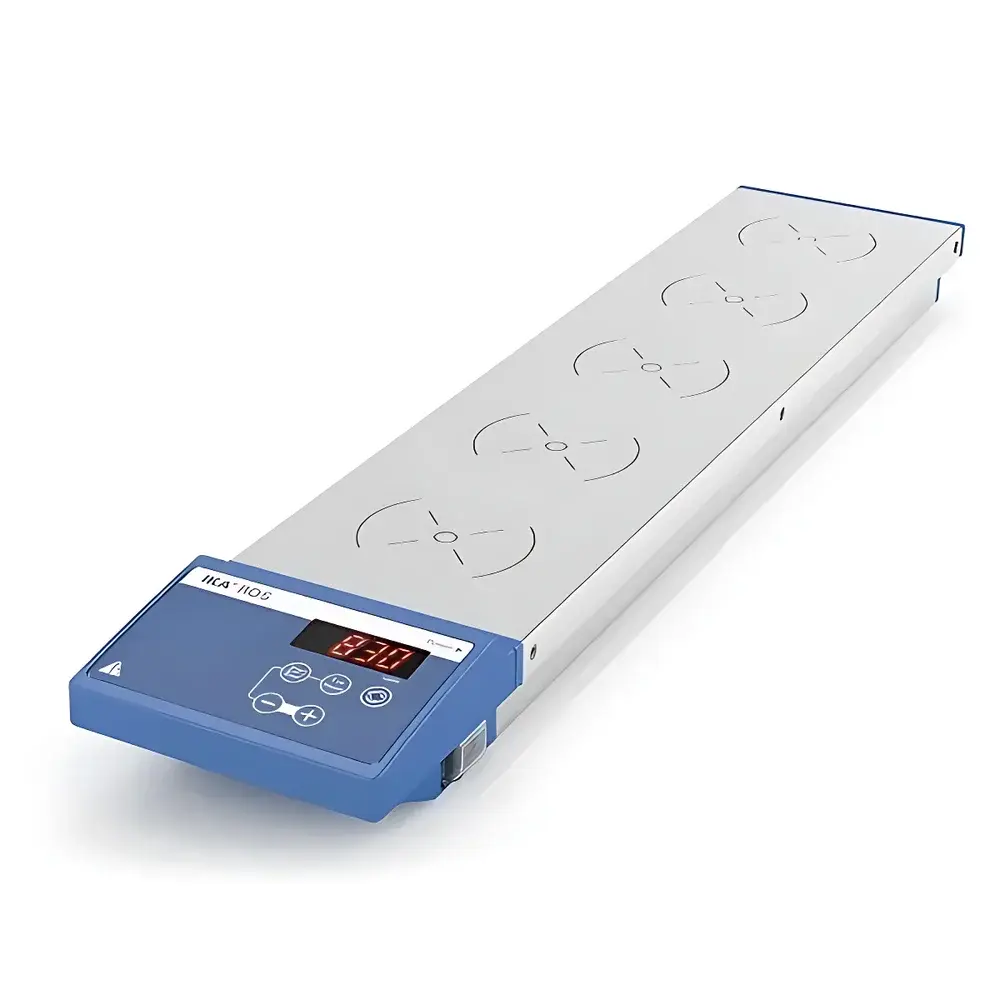
IKA RO 5 Five-Point Digital Magnetic Stirrer
| Brand | IKA |
|---|---|
| Origin | Germany |
| Model | RO 5 |
| Stirring Positions | 5 |
| Position Spacing | 90 mm |
| Speed Range | 0–1200 rpm |
| Speed Control Resolution | 10 rpm steps |
| Speed Deviation per Position | 0 % |
| Max. Stirring Volume (H₂O) | 0.4 L |
| Stir Bar Length Compatibility | 25–30 mm |
| Plate Material | Stainless Steel 1.4301 |
| Plate Dimensions | 120 × 470 mm |
| Overall Dimensions | 120 × 60 × 570 mm |
| Weight | 3.66 kg |
| Ambient Temperature Range | 5–40 °C |
| Relative Humidity Limit | ≤80 % |
| Ingress Protection | IP40 (per DIN EN 60529) |
| Input Voltage | 100–240 V AC, 50/60 Hz |
| Power Consumption | 13 W |
| DC Supply | 24 V |
| Features | Touch-key operation, bidirectional rotation control, error code display, non-wearing magnetic coil technology, removable transparent anti-slip mat, no heating function |
Overview
The IKA RO 5 is a precision-engineered five-point digital magnetic stirrer designed for laboratories requiring synchronized, reproducible agitation across multiple vessels under identical conditions. Unlike conventional multi-stirrer systems that rely on mechanical coupling or shared drive mechanisms, the RO 5 employs independently controlled, non-wearing magnetic coils—each embedded beneath its dedicated stirring position—to deliver true parallel operation with zero speed deviation (<0.0 %) between points. This architecture ensures consistent shear input and mixing efficiency across all five positions, critical for comparative studies, replicate sample preparation, or high-throughput assay workflows. The device operates on a brushless DC motor principle, converting 24 V DC power into stable rotating magnetic fields without mechanical contact, eliminating wear, audible noise, and torque drop under variable load. Its compact, fully enclosed chassis—constructed from impact-resistant polymer housing and a corrosion-resistant stainless steel (1.4301) work surface—provides structural integrity while meeting IP40 ingress protection standards for resistance against solid objects ≥1 mm and limited vertical dripping water.
Key Features
- Five independent stirring positions with uniform 90 mm center-to-center spacing—optimized for standard 50 mL to 250 mL laboratory glassware.
- True digital speed regulation with 10 rpm resolution across a full 0–1200 rpm range; maintains setpoint accuracy regardless of viscosity or vessel load changes.
- Non-contact magnetic drive system using encapsulated, thermally stabilized coils—ensures >10,000 hours of maintenance-free operation with no rotor wear or electromagnetic interference.
- Touch-sensitive membrane keypad with intuitive icon-based navigation, real-time LED status indicators, and automatic error-code feedback (e.g., overload, sensor fault, thermal shutdown).
- Bidirectional rotation control—programmable clockwise/counterclockwise switching at user-defined intervals for enhanced suspension homogeneity and particle dispersion.
- Removable transparent anti-slip silicone mat—chemically inert, autoclavable (up to 121 °C), and dimensionally stable under repeated thermal cycling.
Sample Compatibility & Compliance
The RO 5 accommodates standard cylindrical and conical labware (e.g., beakers, Erlenmeyer flasks, test tubes) up to 0.4 L total volume per position when using recommended stir bars (25–30 mm length, PTFE-coated or ceramic-core). Its stainless steel plate complies with ISO 8502-3 for surface cleanliness validation and resists common solvents including ethanol, acetone, and dilute acids/bases. The unit conforms to IEC 61010-1:2010 for laboratory electrical safety, carries CE marking per EU Directive 2014/30/EU (EMC) and 2014/35/EU (LVD), and meets RoHS 2011/65/EU material restrictions. While not classified as a medical device or GLP/GMP-critical instrument, its traceable calibration protocol (via external tachometer verification) supports audit-ready documentation in regulated environments following ISO/IEC 17025 guidelines.
Software & Data Management
The RO 5 operates as a standalone instrument with no embedded software stack or network interface. All operational parameters—including speed setpoint, direction mode, runtime counter, and error logs—are retained in volatile memory and displayed via front-panel LEDs. For integration into automated workflows, optional IKA Labworldsoft® v5.0 (sold separately) enables remote monitoring and parameter logging via RS232 serial connection, supporting CSV export for LIMS compatibility. Audit trails are maintained through timestamped event records (e.g., “Speed changed to 850 rpm at 14:22:03”), satisfying basic 21 CFR Part 11 requirements when paired with validated electronic signature protocols.
Applications
- Parallel dissolution testing of pharmaceutical tablets across five dissolution vessels (USP Apparatus II).
- Synchronized buffer equilibration in molecular biology workflows—e.g., simultaneous lysis of bacterial cultures in 5× 50 mL Falcon tubes.
- Controlled reagent mixing during titration method development where inter-vessel consistency directly impacts endpoint detection reproducibility.
- Environmental sample preparation: homogenization of sediment suspensions or wastewater aliquots prior to filtration or spectrophotometric analysis.
- Materials science: dispersion of nanomaterials (e.g., graphene oxide, TiO₂ nanoparticles) in aqueous or organic media under defined shear history.
FAQ
Does the RO 5 support temperature control or heating functionality?
No—the RO 5 is a non-heating magnetic stirrer. It must be used in conjunction with external heating plates or water baths if thermal activation is required.
Can the stirrer accommodate vessels taller than 150 mm?
Yes—its 570 mm overall height and open-top design allow compatibility with tall-form cylinders and graduated cylinders, provided the stir bar remains centered and submerged.
Is the anti-slip mat chemically resistant to strong oxidizers like nitric acid?
The transparent silicone mat is rated for intermittent exposure to ≤30 % nitric acid; prolonged contact is not recommended—use glass or PTFE-coated alternatives for aggressive chemistry.
What maintenance is required for long-term reliability?
No routine maintenance is needed beyond periodic cleaning of the stainless steel plate with isopropanol and inspection of stir bar magnetism using a reference ferrous object.
How is speed calibration verified in a quality-controlled lab?
Calibration is performed externally using a handheld optical tachometer aligned with a reflective marker on the stir bar; documented results should be archived per internal SOP-INST-027.



