
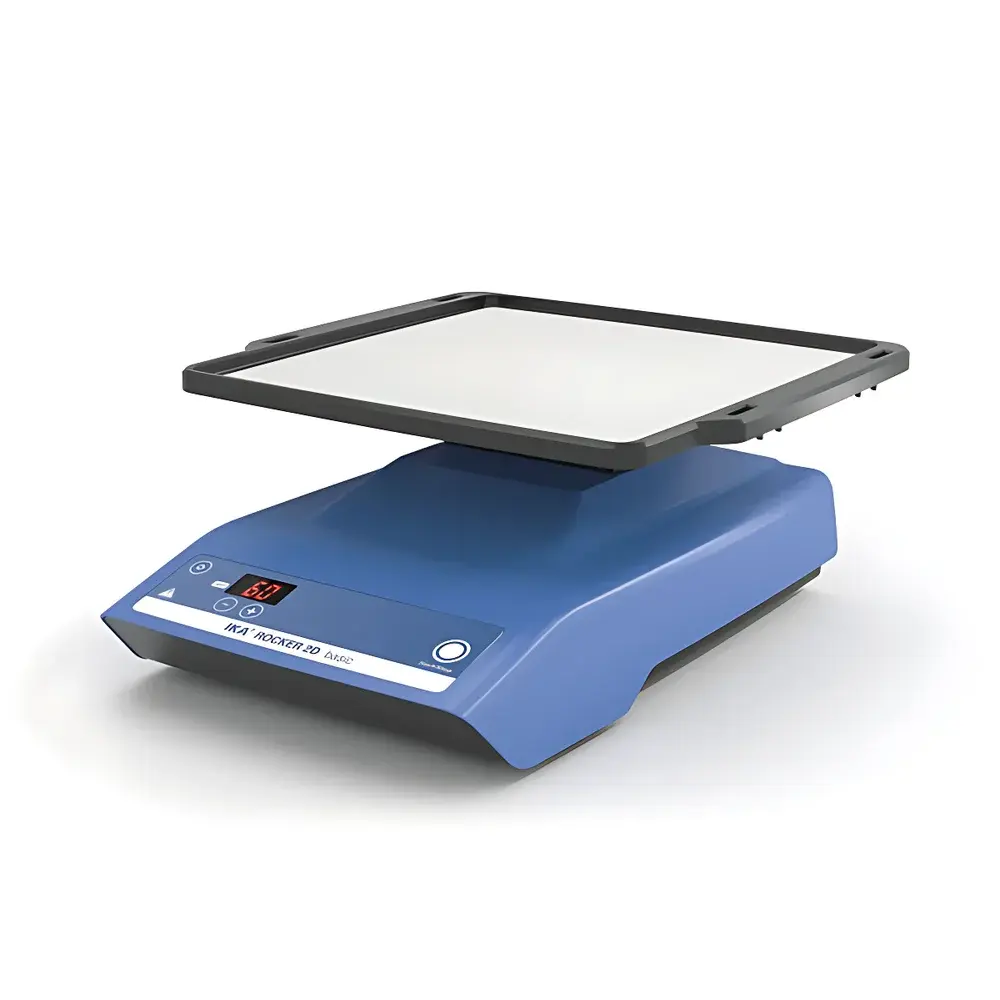
IKA ROCKER 2D basic Rocking Mixer
| Brand | IKA |
|---|---|
| Origin | Germany |
| Manufacturer | IKA Werke GmbH & Co. KG |
| Product Type | Rocking Mixer (2D Oscillation) |
| Model | ROCKER 2D basic |
| Operating Principle | Unidirectional Rocking Motion with Fixed 8° Tilt Angle |
| Speed Range | 0–80 rpm (adjustable in 1 rpm increments) |
| Speed Display | LED, 7-segment |
| Load Capacity | 2 kg (including clamps) |
| Continuous Operation | 100% duty cycle |
| Stackable Platform | Yes (30 mm height per deck) |
| Dimensions (W × D × H) | 280 × 150 × 330 mm |
| Weight | 2.2 kg |
| Ambient Operating Conditions | 4–50 °C, ≤80 % RH |
| Ingress Protection | IP21 (per DIN EN 60529) |
| Power Supply | 100–240 V AC, 50/60 Hz |
| Input Power | 24 W |
| DC Output | 24 V =, 1000 mA |
| Compliance | CE-marked, RoHS-compliant, designed and manufactured in Staufen, Germany |
Overview
The IKA ROCKER 2D basic is a precision-engineered rocking mixer designed for gentle, reproducible sample agitation in life science laboratories. Unlike orbital or reciprocating shakers, this device employs a unidirectional rocking motion with a fixed 8° tilt angle—ensuring consistent fluid displacement across the vessel bottom without splashing or foaming. Its brushless DC motor delivers stable rotational speed control from 0 to 80 rpm in precise 1-rpm increments, maintaining set velocity under variable load conditions and minor input voltage fluctuations. Engineered for long-term reliability, the ROCKER 2D basic supports uninterrupted 100% duty-cycle operation and is certified for continuous use inside incubators (4–50 °C), making it ideal for cell culture maintenance, hybridization protocols, blotting procedures, and low-shear suspension of sensitive biological samples.
Key Features
- Fixed 8° rocking angle ensures high experimental repeatability across users and time—critical for standardized assays and regulatory workflows.
- Brushless DC motor provides torque stability and eliminates mechanical wear, supporting >20,000 hours of operational lifetime under typical lab conditions.
- LED-based 7-segment display enables real-time speed monitoring; intuitive touch-sensitive controls simplify parameter entry and reduce accidental input errors.
- Stackable platform design allows vertical integration of multiple units—up to three decks (30 mm spacing each)—maximizing incubator or benchtop footprint efficiency.
- IP21-rated enclosure protects internal electronics against vertically falling drips and solid objects ≥12.5 mm, meeting minimum safety requirements for humid or temperature-controlled environments.
- Universal power input (100–240 V AC, 50/60 Hz) with integrated 24 V DC conversion ensures compatibility with global laboratory infrastructure and minimizes electromagnetic interference.
Sample Compatibility & Compliance
The ROCKER 2D basic accommodates standard labware including Petri dishes (up to 150 mm), multi-well plates (6–96-well), flasks (up to 2 L), and tube racks—when used with optional IKA clamps (e.g., universal plate holder, flask clamp, or microtube adapter). Its non-vibratory rocking profile prevents sediment resuspension artifacts and preserves fragile cell monolayers during staining or washing steps. The device complies with EU directives 2014/30/EU (EMC), 2014/35/EU (LVD), and 2011/65/EU (RoHS), and bears the CE marking. While not explicitly validated for GMP or GLP environments, its stable speed control, absence of timers or software logs, and mechanical simplicity support traceable manual SOP execution in QC labs adhering to ISO/IEC 17025 or USP analytical instrument qualification guidelines.
Software & Data Management
The ROCKER 2D basic operates as a standalone hardware-only system with no embedded firmware, network interface, or data logging capability. This architecture eliminates cybersecurity risks, software validation burdens, and firmware update dependencies—aligning with risk-averse laboratory policies where instrument qualification focuses solely on mechanical performance verification (e.g., speed accuracy ±2 rpm at all setpoints, angular consistency verified via inclinometer). Users perform periodic operational qualification (OQ) using calibrated tachometers and digital inclinometers; IKA provides factory calibration certificates upon request. No FDA 21 CFR Part 11 compliance is applicable due to absence of electronic records or signatures.
Applications
- Western/Northern/Southern blotting: uniform buffer exchange and antibody incubation without membrane distortion.
- Cell culture maintenance: gentle agitation of adherent cells during media changes or passaging preparations.
- Molecular hybridization: controlled mixing during DNA/RNA probe binding in hybridization ovens.
- Enzyme-linked immunoassays (ELISA): consistent plate washing and substrate incubation prior to spectrophotometric readout.
- Tissue section staining: agitation during hematoxylin-eosin or immunohistochemistry protocols to enhance reagent penetration.
- Reagent preparation: homogenization of viscous buffers, agarose solutions, or gel matrices prior to casting.
FAQ
Does the ROCKER 2D basic include a timer function?
No. It is designed for continuous operation only and does not feature an integrated timer or programmable start/stop functionality.
Can it be used inside a CO₂ incubator?
Yes—provided the incubator’s internal humidity remains ≤80 % RH and ambient temperature stays within 4–50 °C. The unit’s IP21 rating and sealed electronics permit safe placement in non-condensing incubator environments.
Is speed calibration traceable to national standards?
IKA provides optional factory calibration reports traceable to PTB (Physikalisch-Technische Bundesanstalt) standards; end-users may verify speed accuracy using NIST-traceable handheld tachometers during IQ/OQ.
What clamps are compatible with this model?
IKA offers dedicated accessories including the universal plate holder (Cat. No. 0000100000), flask clamp (Cat. No. 0000100001), and microtube rack adapter (Cat. No. 0000100002); all mount via standardized M4 threaded inserts on the rocker platform.
Does stacking multiple units affect thermal dissipation or motor performance?
No—each unit operates independently with passive convection cooling. The 30 mm inter-deck spacing ensures adequate airflow; no derating of speed or load capacity is required when stacked.




