
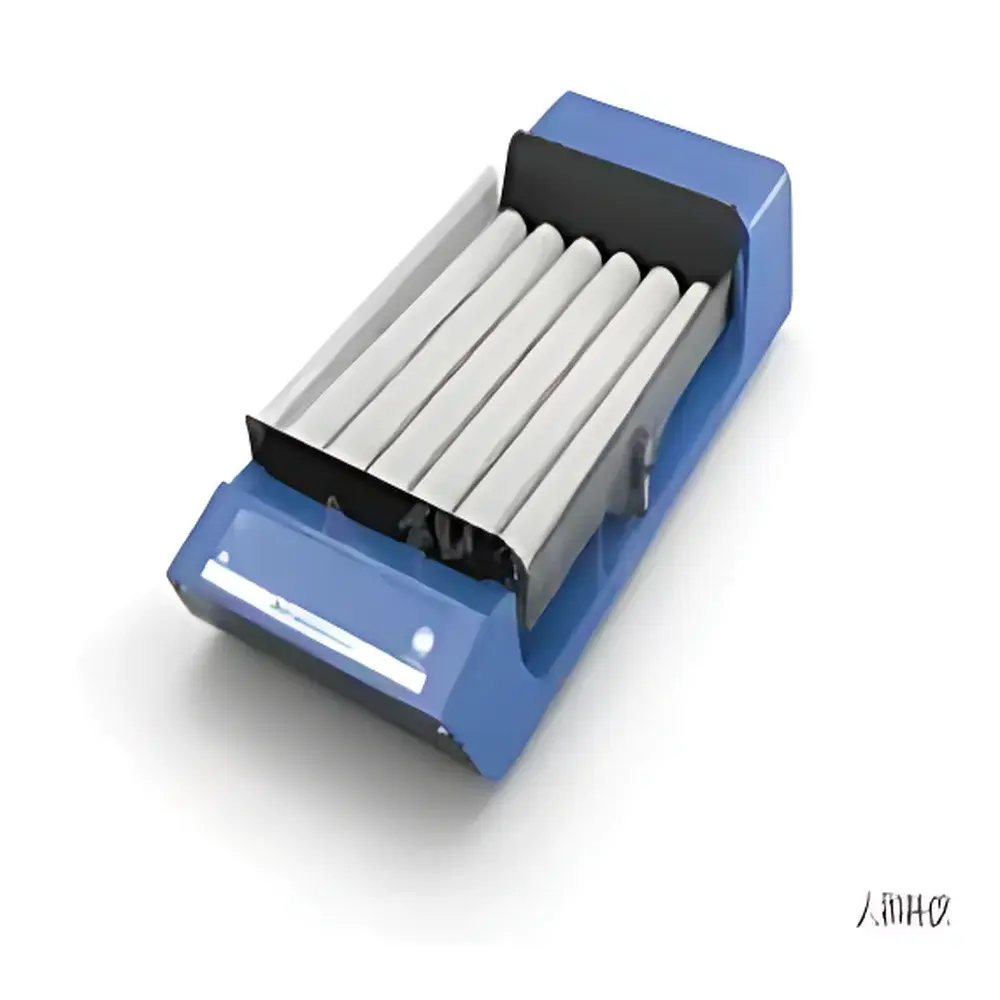
IKA ROLLER 6 basic 6-Axis Rolling Mixer
| Brand | IKA |
|---|---|
| Origin | Germany |
| Model | ROLLER 6 basic |
| Oscillation Frequency | 30 rpm |
| Oscillation Amplitude | 16 mm |
| Temperature Range | 4–50 °C |
| IP Rating | IP21 |
| Power Supply | 100–240 V, 50/60 Hz |
| Input Power | 24 W |
| Dimensions (W × H × D) | 240 × 115 × 545 mm |
| Weight | 4 kg |
| Roll Diameter | 32 mm |
| Roll Length | 327 mm |
| Platform Length | 350 mm |
| Tilt Angle | 3° |
| Max. Roll End Travel | 16 mm |
| Roll Quantity | 6 |
| Roll Mounting | Removable & Replaceable |
| Stacking Capability | Yes |
| Operating Ambient Temperature | 4–50 °C |
| Relative Humidity Limit | ≤80 % RH |
| Compliance | DIN EN 60529 |
Overview
The IKA ROLLER 6 basic is a precision-engineered 6-axis rolling mixer designed for gentle, consistent, and contamination-free homogenization of sensitive biological samples. Unlike orbital or vortex shakers, this device employs a dual-mode motion profile—combining controlled rocking with axial rotation—to generate low-shear, laminar mixing ideal for fragile suspensions. Its fixed-speed operation at 30 rpm ensures reproducible rotational kinetics without speed drift or calibration dependency, making it particularly suitable for standardized workflows in clinical diagnostics, biobanking, and upstream bioprocessing. The unit is engineered for continuous-duty operation within temperature-controlled environments—including incubators and cold rooms—supporting long-term sample equilibration across the full 4–50 °C range. Constructed in Germany to IKA’s industrial quality standards, the ROLLER 6 basic integrates robust mechanical architecture with minimal power consumption (24 W), enabling energy-efficient deployment in multi-unit laboratory configurations.
Key Features
- Six independently mounted, removable 32 mm-diameter rollers with 327 mm length and precisely engineered 3° tilt angle—optimized for uniform torque distribution and minimal sample sedimentation.
- Gentle 16 mm end-to-end oscillation amplitude ensures effective mixing of viscous fluids, whole blood, cell suspensions, and agarose gels without foaming or phase separation.
- Fixed 30 rpm rotational speed eliminates variability from user input or electronic speed control—enhancing inter-laboratory reproducibility and reducing operator-induced error.
- IP21-rated enclosure provides protection against vertically falling drips and solid objects >12.5 mm, ensuring safe operation in humid incubator chambers and shared core facilities.
- Compact footprint (240 × 115 × 545 mm) and stackable platform design support space-constrained environments; units can be vertically integrated for high-density sample processing.
- Tool-free roller disassembly enables rapid decontamination after spills or cross-sample carryover—critical for GLP-compliant sample handling and ISO 15189-accredited clinical labs.
Sample Compatibility & Compliance
The ROLLER 6 basic accommodates standard cylindrical containers including 12–15 mL conical tubes, 50 mL centrifuge tubes, glass vials (10–30 mL), and serum bottles up to Ø32 mm diameter. Its low-shear motion preserves cellular integrity in peripheral blood mononuclear cell (PBMC) preparations and prevents denaturation of antibody-antigen complexes during ELISA plate pre-incubation steps. The device complies with DIN EN 60529 for ingress protection and meets essential safety requirements under IEC 61010-1 for laboratory electrical equipment. While not intrinsically rated for sterile environments, its smooth anodized aluminum housing and non-porous surfaces support validated cleaning protocols using 70% ethanol or hydrogen peroxide vapor—facilitating alignment with ISO 13485 quality management systems for in vitro diagnostic (IVD) manufacturing.
Software & Data Management
The ROLLER 6 basic operates as a stand-alone analog instrument with no embedded microprocessor, software interface, or digital data logging capability. This design prioritizes operational reliability, electromagnetic compatibility (EMC), and long-term serviceability in regulated environments where firmware validation and cybersecurity controls impose overhead. Absence of timers, displays, or network interfaces eliminates configuration drift, audit trail complexity, and 21 CFR Part 11 compliance burdens—making it well-suited for QC/QA labs operating under simplified SOPs or legacy GMP frameworks. All operational parameters (e.g., speed, tilt, amplitude) are mechanically fixed and factory-verified, supporting traceable performance verification via periodic mechanical inspection rather than electronic calibration.
Applications
- Continuous mixing of anticoagulated whole blood prior to hematocrit measurement or flow cytometry staining.
- Homogenization of high-viscosity reagents such as glycerol stocks, PCR master mixes, and protein purification buffers.
- Equilibration of immunoassay plates during antigen-coating or blocking steps to minimize edge effects.
- Long-duration incubation support for microbial culture tubes (e.g., Mycobacterium tuberculosis growth monitoring) under controlled temperature conditions.
- Pre-analytical sample conditioning in clinical chemistry workflows requiring phase stability in lipemic or hemolyzed specimens.
FAQ
Does the ROLLER 6 basic support variable speed control?
No. It operates exclusively at a fixed 30 rpm, engineered for consistency and reduced mechanical wear.
Can it be used inside a CO₂ incubator?
Yes—provided ambient humidity remains ≤80 % RH and the incubator maintains stable airflow to prevent condensation on internal components.
Is the unit compatible with autoclavable rollers?
Rollers are not autoclavable; however, they are chemically resistant to common lab disinfectants and may be sterilized via ethylene oxide or vaporized hydrogen peroxide cycles.
What maintenance is required?
Annual visual inspection of roller bearings and tilt mechanism; no lubrication or recalibration is necessary due to fixed-mechanism design.
Does it meet FDA or ISO regulatory requirements for clinical use?
It conforms to general safety standards (IEC 61010-1, DIN EN 60529) and supports compliance with ISO 15189 and CLIA when integrated into validated laboratory procedures—but carries no FDA 510(k) clearance or CE-IVD marking.
Related Products




