
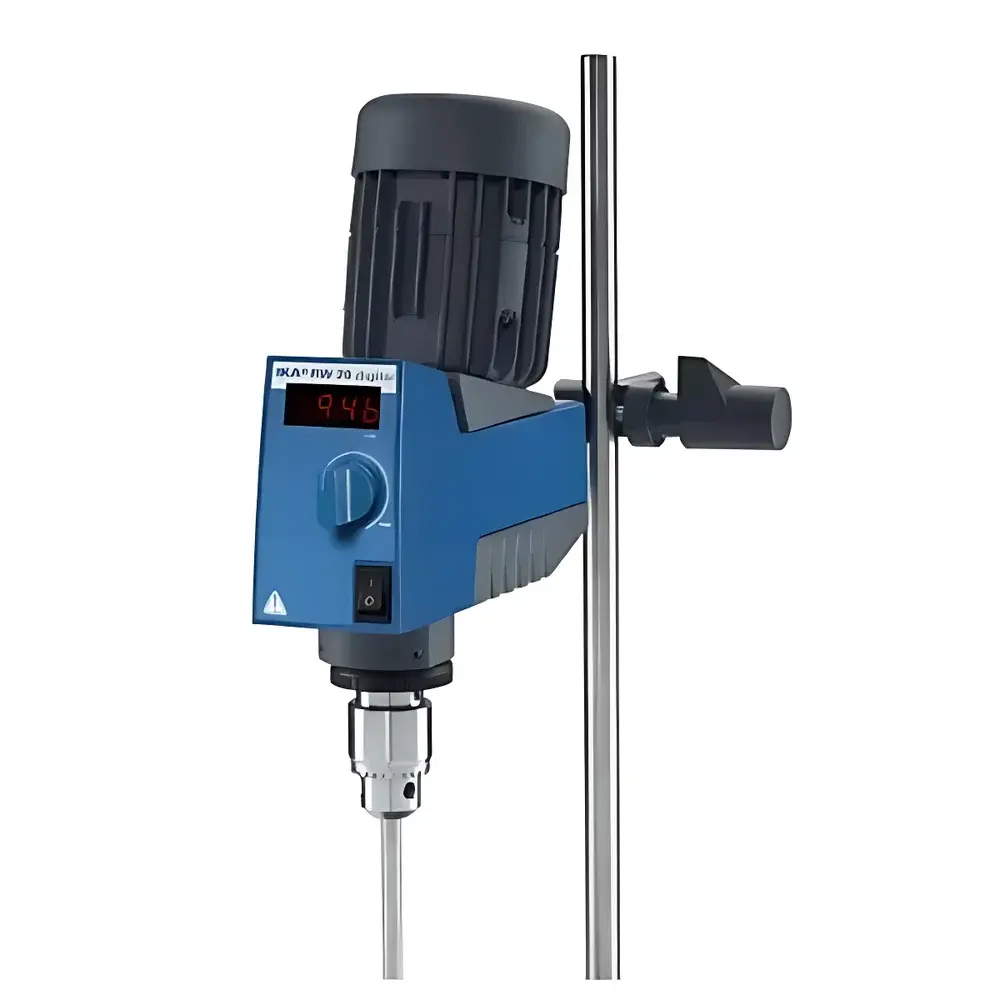
IKA RW 20 digital Overhead Stirrer
| Brand | IKA |
|---|---|
| Origin | Germany |
| Model | RW 20 digital |
| Max. Stirring Volume (H₂O) | 20 L |
| Motor Input Power | 70 W |
| Motor Output Power | 35 W |
| Speed Range | 60–2000 rpm |
| Speed Display | LED |
| Max. Viscosity | 10,000 mPa·s |
| Max. Output Power at Stirring Shaft | 26 W |
| Continuous Duty Cycle | 100 % |
| Max. Torque at Shaft | 150 N·cm (at 100 rpm), 300 N·cm (overload at 60 rpm), 24 N·cm (at 1000 rpm) |
| Speed Control | Infinitely Variable |
| Speed Setting Accuracy | ±1 rpm |
| Speed Measurement Deviation | ±30 rpm |
| Clamp Type | Fixed Chuck |
| Clamp Jaw Range | 0.5–10 mm |
| Hollow Stirring Shaft ID | 10.5 mm |
| Hollow Shaft Insertion (stationary) | Yes |
| Support Arm Diameter | 13 mm |
| Support Arm Length | 160 mm |
| Rated Torque | 1.5 N·m |
| Dimensions (W×H×D) | 88 × 294 × 212 mm |
| Weight | 3.1 kg |
| Ambient Temperature Range | 5–40 °C |
| Relative Humidity Limit | 80 % |
| Protection Class | IP20 per DIN EN 60529 |
| Voltage | 220–240 V |
| Frequency | 50/60 Hz |
| Instrument Input Power | 72 W |
Overview
The IKA RW 20 digital is a high-performance overhead stirrer engineered for precision mixing and dispersion tasks in research laboratories, quality control environments, and pilot-scale production settings. Based on the proven mechanical architecture of the RW20 series, this digitally enhanced model integrates robust torque delivery, dual-speed-range operation, and real-time LED speed monitoring to ensure consistent shear input across diverse fluid systems — from low-viscosity aqueous solutions to highly structured non-Newtonian suspensions up to 10,000 mPa·s. Its core operating principle relies on direct-coupled electromagnetic motor drive with mechanical speed regulation, delivering stable rotational energy without electronic feedback loops — a design choice prioritizing long-term reliability, electromagnetic compatibility (EMC), and operational simplicity under continuous duty conditions. The unit operates within standard laboratory ambient parameters (5–40 °C, ≤80 % RH) and complies with DIN EN 60529 (IP20) for protection against solid ingress, making it suitable for general-purpose benchtop use in ISO 17025-accredited labs and GMP-aligned facilities where equipment qualification and traceable performance are required.
Key Features
- Two selectable speed ranges: Range I (60–500 rpm at 50 Hz / 72–600 rpm at 60 Hz) optimized for high-torque, low-speed mixing; Range II (240–2000 rpm at 50 Hz / 288–2400 rpm at 60 Hz) for rapid dispersion and homogenization
- Infinitely variable mechanical speed control with ±1 rpm setting resolution and LED-based digital speed readout for operator verification
- Hollow stainless-steel stirring shaft (ID 10.5 mm) enabling insertion of temperature probes, pH electrodes, or sampling needles during stationary operation — supporting in-process monitoring without interrupting setup
- Fixed chuck design with 0.5–10 mm jaw capacity, compatible with standard IKA and third-party stirring elements including propellers, anchors, and dissolving blades
- 100% continuous duty rating supported by thermally optimized motor winding and passive convection cooling — validated for unattended overnight operation in validated workflows
- Ergonomic vertical form factor (294 mm height) minimizing benchtop footprint while maximizing clearance above vessels up to 20 L capacity
Sample Compatibility & Compliance
The RW 20 digital accommodates a broad spectrum of sample types including aqueous buffers, polymer solutions, colloidal dispersions, catalyst slurries, and viscous organic media. Its mechanical torque profile ensures effective agitation of both Newtonian and shear-thinning fluids without cavitation or vortex instability when paired with appropriate impeller geometry and vessel aspect ratio. The device meets essential electrical safety requirements per IEC 61010-1 and carries CE marking for use in EU-regulated laboratories. While not intrinsically rated for hazardous area use, its IP20 enclosure is appropriate for cleanroom-adjacent environments and aligns with general laboratory infrastructure standards referenced in ISO/IEC 17025:2017 clause 6.4.1 (equipment suitability). Documentation packages support IQ/OQ protocols and can be integrated into lab-wide asset management systems for audit readiness.
Software & Data Management
As a stand-alone electromechanical instrument, the RW 20 digital does not feature embedded firmware, network connectivity, or data logging capabilities. All operational parameters — including set speed, range selection, and runtime — are manually configured and visually confirmed via front-panel LED display. This architecture eliminates cybersecurity surface area and simplifies 21 CFR Part 11 compliance pathways: no electronic records are generated, thus eliminating requirements for audit trails, electronic signatures, or system validation. For labs requiring traceability, external timers or process loggers may be employed in conjunction with manual entry into ELN or LIMS platforms. Calibration verification is performed using certified tachometers per ASTM E2813–19 (Standard Practice for Verification of Speed Measuring Instruments), with documented intervals aligned to internal SOPs.
Applications
- Preparation of homogeneous buffer solutions and reagent stocks in analytical and clinical chemistry labs
- Dispersion of nanoparticles and pigment concentrates in R&D for coatings and pharmaceutical formulations
- Emulsification trials involving oil-in-water and water-in-oil systems under controlled shear history
- Viscosity benchmarking of polymer melts and gels prior to rheological characterization
- Cell culture media conditioning and dissolution testing of extended-release tablets (USP )
- Stirred-tank bioreactor seeding and nutrient suspension in microbiology and fermentation studies
FAQ
Is the RW 20 digital compatible with glass reactor jackets or heating mantles?
Yes — its rigid support arm (13 mm diameter, 160 mm length) and vertical mounting configuration allow secure integration with standard laboratory reactor stands and thermal enclosures, provided mechanical stability and center-of-gravity alignment are maintained.
Can the hollow shaft accommodate PT100 sensors during active stirring?
No — sensor insertion is only permitted when the shaft is stationary. Rotation while an object is inserted through the hollow bore risks mechanical interference, imbalance, or damage to the sensor or shaft bearing assembly.
What maintenance intervals are recommended for long-term reliability?
IKA recommends visual inspection of chuck integrity and shaft runout every 500 operating hours, lubrication of support arm pivot points annually, and verification of torque consistency using a calibrated dynamometer every 12 months or per internal QA schedule.
Does the unit support external analog/digital control signals?
No — speed adjustment is exclusively manual via the front-panel dial. No 0–10 V, 4–20 mA, or RS-232 interfaces are provided.
Is calibration certification included with purchase?
Factory calibration data is supplied with each unit; however, formal accredited calibration (e.g., DAkkS or UKAS) must be arranged separately through authorized service partners or metrology laboratories.



