
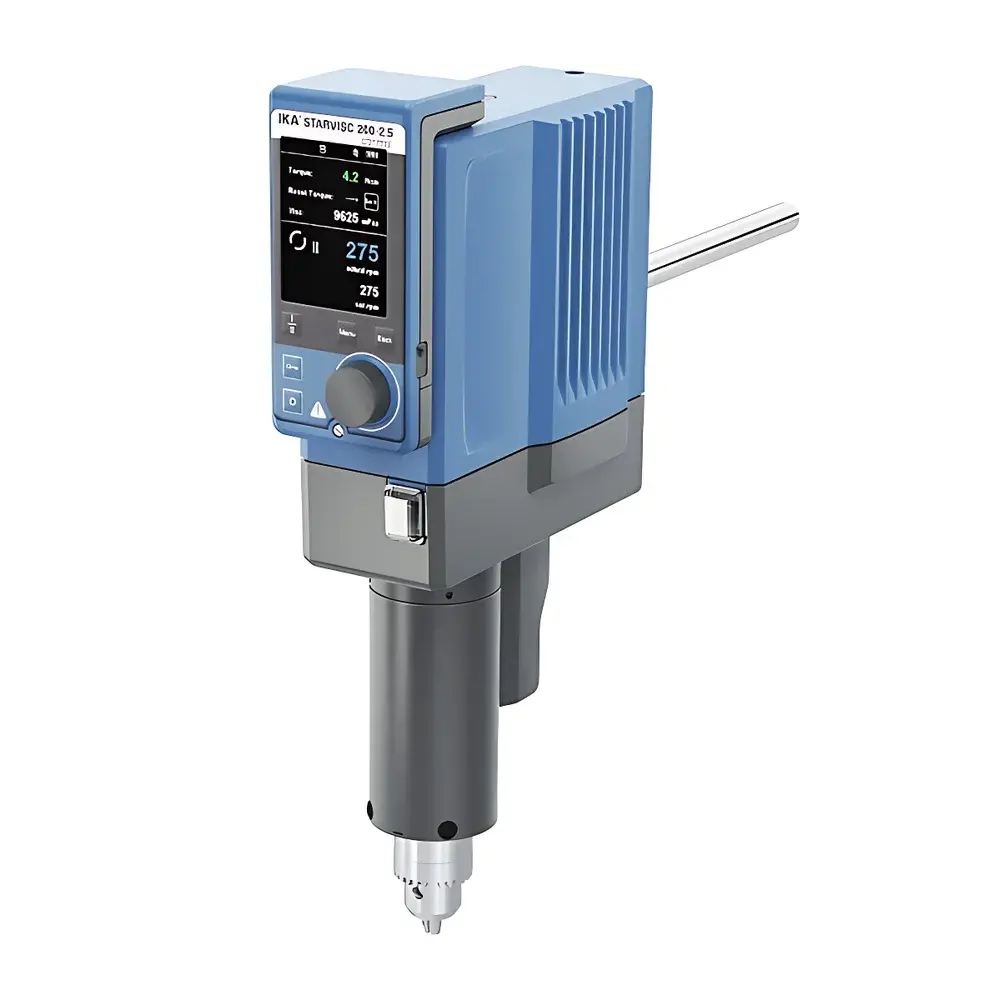
IKA STARVISC 200-2.5 control Torque-Based Viscosity Measurement System
| Brand | IKA |
|---|---|
| Origin | Germany |
| Manufacturer Type | Original Equipment Manufacturer (OEM) |
| Origin Category | Imported Instrument |
| Model | STARVISC 200-2.5 control |
| Max. Stirring Volume (H₂O) | 100 L |
| Motor Input Power | 130 W |
| Motor Output Power | 84 W |
| Drive Type | Brushless DC Motor |
| Speed Range I (50/60 Hz) | 6–400 rpm |
| Speed Range II (50/60 Hz) | 30–2000 rpm |
| Speed Control | Continuously Variable |
| Speed Accuracy | ±1 rpm (n > 300 rpm) |
| Speed Measurement Deviation | ±1% (n > 300 rpm) |
| Max. Torque Range I | 200 N·cm |
| Max. Torque Range II | 40 N·cm |
| Torque Measurement Deviation | ±2.5 N·cm |
| Viscosity Range | Up to 100,000 mPa·s |
| Temperature Measurement | PT1000 sensor (DIN IEC 751 Class A), -10 to +350 °C, accuracy ±0.5 K |
| Temp. Resolution | 0.1 K |
| Housing | Cast aluminum with thermoplastic polymer coating |
| IP Rating | IP40 |
| Dimensions (W×H×D) | 91 × 395 × 231 mm |
| Weight | 5.9 kg |
| Ambient Operating Conditions | 5–40 °C, ≤80% RH |
| Interfaces | RS232, USB |
| Remote Control Range | Up to 150 m (line-of-sight dependent) |
| Continuous Duty Cycle | 100% |
| Hollow Shaft Diameter | 10.3 mm |
| Clamp Jaw Range | 0.5–10 mm |
| Extension Arm | Ø16 mm × 220 mm |
| Timer Range | 1–6000 min |
| Certifications | DIN EN 60529, CE-compliant |
Overview
The IKA STARVISC 200-2.5 control is an integrated torque-based viscosity measurement system engineered for real-time rheological assessment during mechanical agitation. Unlike conventional offline viscometers requiring sample withdrawal and re-introduction, the STARVISC 200-2.5 control directly correlates motor torque output—measured via high-stability strain-gauge transducers—with hydrodynamic resistance of the stirred medium. This principle enables continuous, in-process viscosity estimation under dynamic shear conditions, supporting process development, formulation optimization, and batch consistency verification in R&D and pilot-scale environments. The system operates on Couette-type flow assumptions within defined impeller geometry and vessel configuration, delivering reproducible torque-derived viscosity values traceable to SI units when calibrated against reference standards (e.g., ISO 2555, ASTM D2196). Its brushless DC motor architecture ensures low thermal drift, minimal maintenance, and stable torque delivery across its dual-speed operating ranges.
Key Features
- Real-time torque-to-viscosity conversion with on-device calculation and TFT-displayed numerical output
- Dual-range speed control (6–400 rpm / 30–2000 rpm) with continuously variable adjustment and ±1 rpm setting precision above 300 rpm
- High-torque capability: 200 N·cm maximum in Range I; 40 N·cm in Range II—optimized for both high-viscosity pastes and low-viscosity dispersions
- Hollow shaft design (10.3 mm internal diameter) enabling simultaneous temperature probe insertion (PT1000) without interrupting agitation
- Integrated temperature monitoring with Class A PT1000 sensor (DIN IEC 751), resolution 0.1 K, and total system uncertainty ≤ ±(0.15 + 0.002|T|) K
- Remote operation via bidirectional wireless interface (up to 150 m line-of-sight range), supporting safe operation in fume hoods or hazardous-area setups
- Full-digital data logging: torque, speed, temperature, time, and calculated viscosity stored internally and exportable via USB or RS232
- IP40-rated cast aluminum housing with thermoplastic polymer coating for chemical resistance and mechanical robustness
- 100% duty cycle rating with active thermal management—suitable for extended unattended operation
Sample Compatibility & Compliance
The STARVISC 200-2.5 control accommodates a broad spectrum of Newtonian and non-Newtonian samples—including polymer melts, ceramic slurries, pharmaceutical gels, food emulsions, and battery electrode slurries—within vessels up to 100 L (water-equivalent volume). Its torque-based methodology does not require fluid homogeneity at rest, making it especially valuable for structurally evolving systems (e.g., curing resins, hydrating clays, or shear-thinning biopolymers). The instrument complies with DIN EN 60529 (IP40 ingress protection), CE marking directives (2014/30/EU EMC, 2014/35/EU LVD), and supports audit-ready documentation workflows aligned with GLP and GMP principles. While not inherently 21 CFR Part 11 compliant, its digital log files—including timestamped operator ID fields, parameter change history, and electronic signatures via optional software modules—can be configured to meet FDA-regulated data integrity requirements when deployed with validated third-party LIMS integration.
Software & Data Management
Data acquisition and analysis are supported through IKA’s proprietary lab software (compatible with Windows 10/11), which provides synchronized multi-parameter visualization (torque vs. time, viscosity vs. temperature, shear rate profiles), customizable report templates, and CSV/PDF export. All measurements include embedded metadata: date/time stamp, user ID (if authenticated), calibration status flag, and environmental conditions (ambient temp/RH). Raw torque signals are sampled at ≥10 Hz and digitally filtered to suppress mechanical vibration artifacts. Audit trails record every parameter modification—including speed setpoint changes, torque range switching, and calibration coefficient updates—with immutable timestamps. USB mass-storage mode allows direct file transfer without driver installation; RS232 serial communication enables integration into SCADA or MES platforms using Modbus RTU protocol.
Applications
- R&D formulation screening: rapid viscosity mapping across concentration gradients or solvent blends
- Reaction monitoring: tracking viscosity evolution during polymerization, crosslinking, or enzymatic gelation
- QC release testing: verifying batch-to-batch rheological equivalence without offline sampling delays
- Process scale-up support: correlating lab-scale torque curves with pilot-plant agitator power numbers (P/ρN³D⁵)
- Temperature-dependent rheology: simultaneous heating/cooling studies using external circulators interfaced via PT1000 feedback loop
- Yield stress approximation: evaluating onset of flow via controlled ramp-up torque protocols
- Educational use: demonstrating fundamental relationships between shear stress, shear rate, and apparent viscosity in physical chemistry labs
FAQ
Can the STARVISC 200-2.5 control measure absolute viscosity without calibration?
No. Absolute viscosity determination requires system-specific calibration using Newtonian reference fluids (e.g., silicone oils certified to ISO 8502) to establish the torque–viscosity conversion factor for a given impeller geometry and vessel configuration.
Is the hollow shaft compatible with all standard temperature probes?
It accepts any rigid, straight-shaft PT1000 sensor with outer diameter ≤10 mm and length sufficient to reach the sample bulk; IKA recommends their own certified probe (Order No. 3012000) for optimal thermal contact and positional repeatability.
Does the instrument support automated viscosity reporting per ISO 2555?
Yes—the software includes preconfigured test sequences that enforce standardized spindle immersion depth, equilibration time, and shear rate selection per ISO 2555 Annex B, generating reports with pass/fail flags against specified tolerance bands.
What is the minimum detectable torque resolution?
The system resolves torque increments of 0.1 N·cm across both ranges, with full-scale linearity error <±0.5% of reading per NIST-traceable calibration certificate.
Can multiple STARVISC units be synchronized for parallel testing?
Not natively—but external TTL trigger inputs (via optional I/O module) allow master-slave timing coordination for comparative studies under identical thermal or compositional conditions.
Related Products



