
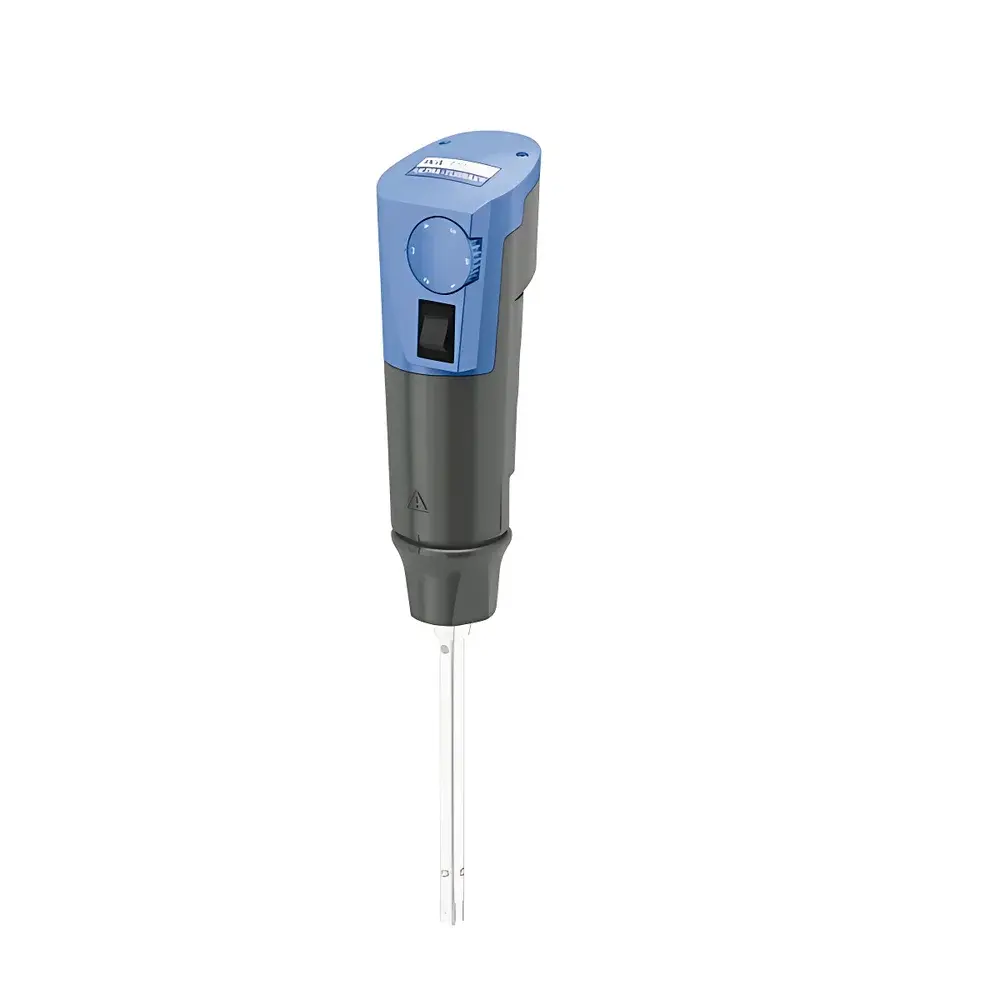
IKA T10 basic ULTRA-TURRAX® Disperser
| Brand | IKA |
|---|---|
| Origin | Germany |
| Model | T10 basic ULTRA-TURRAX® |
| Motor Input Power | 125 W |
| Motor Output Power | 75 W |
| Volume Range (H₂O) | 0.5–100 mL |
| Max. Viscosity | 5000 mPa·s |
| Speed Range | 8000–30,000 rpm |
| Speed Control | Continuously Variable |
| Speed Display | Calibrated Scale |
| Noise Level (without dispersing tool) | 65 dB(A) |
| Extension Arm Diameter | 8 mm |
| Extension Arm Length | 100 mm |
| Operation Mode | Batch Processing |
| Duty Cycle | 10 min ON / 5 min OFF |
| Dimensions (W×H×D) | 56 × 178 × 66 mm |
| Weight | 0.61 kg |
| Ambient Temperature Range | 5–40 °C |
| Relative Humidity Limit | ≤80% RH |
| Ingress Protection | IP30 per DIN EN 60529 |
| Voltage | 230 V AC, 50/60 Hz (optional 115 V / 100 V versions available) |
Overview
The IKA T10 basic ULTRA-TURRAX® is a compact, high-speed batch disperser engineered for reproducible homogenization, emulsification, and cell disruption in research and quality control laboratories. Utilizing shear-driven rotor-stator hydrodynamic principles, it generates intense mechanical energy through controlled turbulent flow within the sample volume. Its design centers on precision speed delivery across a wide operational range (8,000–30,000 rpm), enabling consistent linear tip speeds even with small-diameter dispersing tools—critical for scalable process development from microscale to pilot scale. The instrument operates without external controllers or power adapters, integrating directly into standard laboratory AC mains infrastructure. Its lightweight construction (0.61 kg), ergonomic handheld form factor, and intuitive mechanical speed adjustment make it suitable for routine manual operation across diverse sample types—from aqueous suspensions and polymer solutions to biological lysates and pharmaceutical suspensions.
Key Features
- High-efficiency brush motor delivering 75 W mechanical output from 125 W electrical input, optimized for thermal stability during repeated duty cycles (10 min ON / 5 min OFF)
- Continuously variable mechanical speed control with calibrated analog scale—no electronics or digital interface required, ensuring robustness and long-term calibration stability
- ULTRA-TURRAX®-compatible quick-release coupling system enables tool exchange in under 5 seconds without tools; supports both reusable stainless-steel and disposable dispersing tools
- IP30-rated housing per DIN EN 60529 provides protection against solid objects ≥2.5 mm; suitable for general laboratory environments with ambient temperatures of 5–40 °C and ≤80% RH
- Low-noise operation (65 dB(A) without dispersing tool) achieved via balanced rotor dynamics and vibration-damped housing design
- Two disposable dispersing tool options (S-shaped and conical geometries) certified for PCR-grade applications—eliminating cross-contamination risk in nucleic acid workflows
Sample Compatibility & Compliance
The T10 basic accommodates sample volumes from 0.5 mL to 100 mL in standard laboratory glassware (e.g., beakers, test tubes, centrifuge tubes). Its rotor-stator geometry delivers uniform shear profiles across low- to medium-viscosity fluids (up to 5000 mPa·s), including surfactant-stabilized emulsions, nanoparticle dispersions, and tissue homogenates. While not designed for continuous-flow or GMP manufacturing environments, its mechanical simplicity and absence of embedded firmware support traceable use in GLP-compliant settings when paired with documented SOPs. Stainless-steel dispersing tools are autoclavable (121 °C, 20 min) and compatible with common lab cleaning agents; disposable variants comply with ISO 8573-1 Class 3 air purity requirements for sterile processing.
Software & Data Management
This model operates independently of software—intentionally omitting digital connectivity, data logging, or remote control functionality. Such design eliminates cybersecurity exposure vectors and ensures uninterrupted operation in regulated environments where electronic validation (e.g., FDA 21 CFR Part 11) would otherwise require extensive documentation. All operational parameters—including speed setting, run duration, and tool identification—are manually recorded by the user in laboratory notebooks or LIMS-integrated paperless systems. For laboratories requiring audit trails, integration is achieved externally via time-stamped video capture or third-party environmental monitoring systems.
Applications
- Routine dispersion of pigments, carbon nanotubes, and ceramic nanoparticles in solvent-based or aqueous media
- Preparation of stable oil-in-water and water-in-oil emulsions for cosmetic and food R&D
- Cell lysis and subcellular fractionation in molecular biology workflows, particularly where protease inhibitors or cold-chain integrity must be preserved
- Homogenization of polymer melts and thermoplastic composites prior to rheological or DSC analysis
- QC testing of suspension stability in pharmaceutical oral liquid formulations per USP <701>
- Microsample preparation for SEM/TEM grid coating and MALDI matrix application
FAQ
Is the T10 basic ULTRA-TURRAX® compliant with FDA 21 CFR Part 11?
No—it contains no electronic data storage, user authentication, or audit trail generation capabilities. Its mechanical architecture satisfies ALCOA+ principles only when used with externally validated procedural controls.
Can it be operated continuously for >10 minutes?
No. Thermal limits mandate a 10-minute maximum runtime followed by a 5-minute cooldown period to prevent motor overheating and ensure long-term torque consistency.
What is the minimum recommended sample volume for effective dispersion?
0.5 mL using the 5-mm-diameter S-shaped disposable tool; lower volumes risk cavitation and incomplete mixing due to insufficient fluid inertia.
Are replacement dispersing tools traceable to lot-specific certificates of conformance?
Yes—stainless-steel tools include material certification (EN 10088-1 1.4301); disposable tools ship with ISO 13485–certified manufacturing documentation.
Does IKA provide IQ/OQ documentation for this model?
Not as standard. However, vendor-supplied mechanical verification protocols (e.g., speed calibration against NIST-traceable tachometer) are available upon request for internal qualification.



