
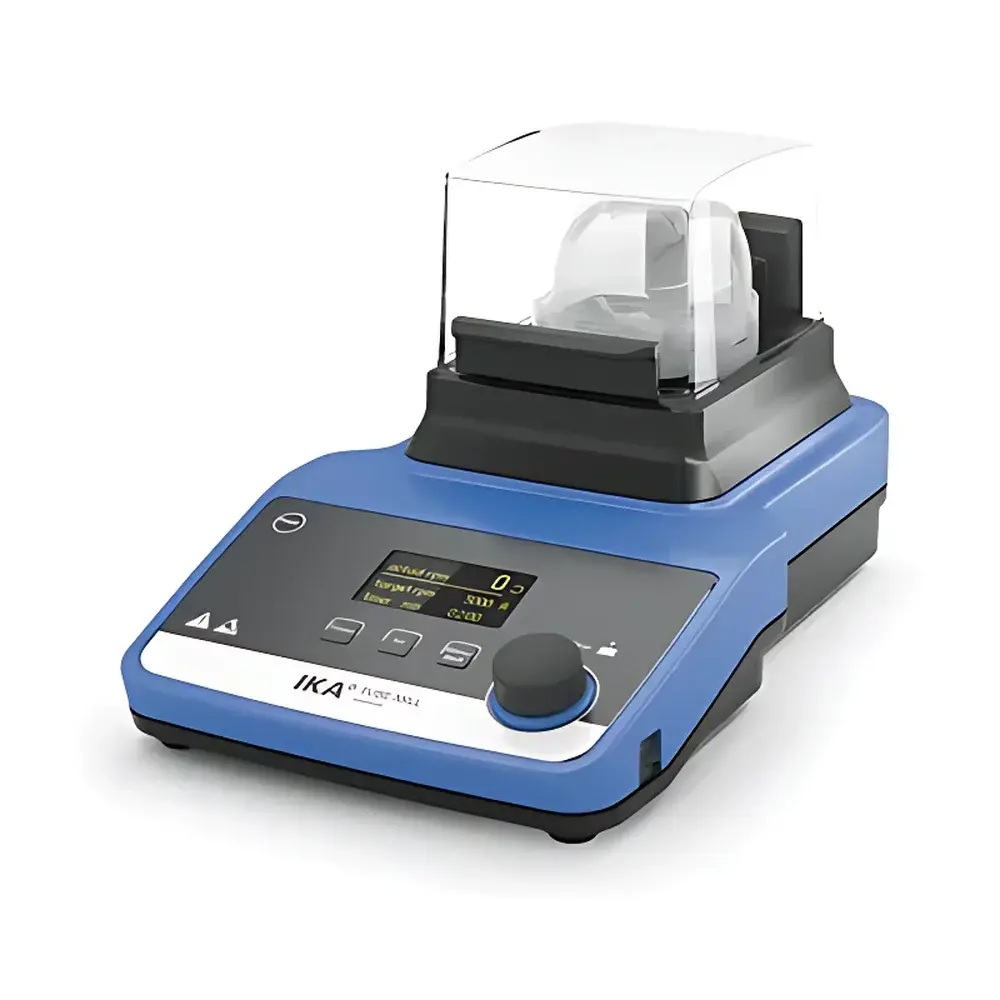
IKA Tube Mill control Batch Grinder
| Brand | IKA |
|---|---|
| Origin | Germany |
| Manufacturer Type | Manufacturer |
| Origin Category | Imported |
| Model | Tube Mill control |
| Instrument Type | Grinder |
| Sample Applicability | Hard Samples |
| Output Particle Size | 0.01–0.5 mm |
| Feed Particle Size | <10 mm |
| Final Output Particle Size | <100 µm |
| Batch Capacity | 40 mL |
| Grinding Media | Included Grinding Media |
Overview
The IKA Tube Mill control is a precision-engineered, batch-type laboratory grinder designed for reproducible, contamination-free size reduction of hard, brittle, and dry materials. Operating on a high-speed rotor-stator principle, it combines shear and impact forces to achieve consistent particle size distribution in a controlled, closed-system environment. Unlike continuous-feed mills, the Tube Mill control processes samples in discrete, single-use grinding tubes—eliminating cross-contamination between runs and removing the need for time-consuming cleaning protocols. Its patented tube-based architecture, developed and manufactured in Staufen, Germany, reflects IKA’s long-standing commitment to safety, traceability, and operational integrity in regulated laboratory environments. The device complies with DIN EN 60529 (IP30) for protection against solid objects and is engineered for routine use in QC labs, seed analysis facilities, pharmaceutical R&D, and materials science workflows where sample integrity and operator safety are non-negotiable.
Key Features
- Patented single-use transparent grinding tubes (40 mL capacity) enable real-time visual monitoring and eliminate carryover contamination
- Interlocked safety system: operation only initiates when the protective hood is fully closed and the grinding tube is correctly seated; automatic shutdown if opened mid-cycle
- Labyrinth seal between motor shaft and grinding chamber prevents dust ingress into the drive mechanism and ensures operator exposure minimization
- Variable speed control from 5,000 to 25,000 rpm with ±2% speed accuracy and programmable run time (5 s – 3 min)
- OLED display with multilingual interface (English, German, French, Spanish, Chinese) supports intuitive parameter entry and error code diagnostics
- USB port enables remote operation via PC, automated data logging (timestamped speed/time profiles), and firmware updates
- Three operational modes: continuous, intermittent (pulse), and programmable multi-step sequences with stored method recall
- Adjustable safety limits—including maximum speed and runtime—can be set per user profile to enforce SOP compliance
- Acoustically optimized housing and balanced rotor design ensure low-noise operation (<65 dB(A) at 1 m)
Sample Compatibility & Compliance
The Tube Mill control is validated for grinding hard, friable, and anhydrous samples with Mohs hardness up to 5—suitable for cereal grains (e.g., maize, wheat, barley), mineral powders, pharmaceutical tablets, polymer granules, and botanical tissues. Feed particles must be ≤10 mm; final output typically achieves D90 <100 µm under standard operating conditions (20,000 rpm, 60 s, ambient temperature). Optional dry ice cooling of the grinding chamber is supported for thermolabile samples. The instrument meets IEC/EN 61000-6-3 (EMC) and IEC/EN 61000-6-2 (immunity) standards. Its design facilitates GLP/GMP-aligned documentation: all executed methods—including speed, duration, and error events—are timestamped and exportable via USB for audit trails. While not intrinsically compliant with FDA 21 CFR Part 11, its data logging architecture supports integration into validated LIMS or ELN systems requiring electronic record integrity.
Software & Data Management
No proprietary software installation is required—the Tube Mill control communicates natively over USB CDC (Communication Device Class), appearing as a virtual COM port. Users may develop custom scripts (Python, LabVIEW, MATLAB) to trigger runs, read status registers, and log parameters including actual RPM, elapsed time, and fault codes (e.g., E01 = lid open, E03 = tube misalignment). All settings—including up to 10 user-defined methods—are retained in non-volatile memory after power-off. The OLED interface logs the last 10 execution records with timestamps, enabling rapid verification of recent processing history without external tools.
Applications
- Seed quality testing: homogenization of intact kernels prior to moisture, protein, or mycotoxin analysis
- Pharmaceutical pre-formulation: rapid batch milling of excipients and active ingredients for dissolution studies
- Geochemical sample prep: pulverization of rock chips and soil aggregates for XRF or ICP-MS digestion
- Food authenticity screening: preparation of uniform flour fractions for NIR calibration modeling
- Materials research: size reduction of ceramic precursors and composite feedstocks prior to sintering or rheological characterization
FAQ
Is the grinding tube autoclavable?
No—grinding tubes are single-use disposable components made from impact-resistant polycarbonate and are not designed for sterilization cycles.
Can liquid nitrogen be used for cryogenic grinding?
No—only dry ice cooling of the external chamber is supported; LN₂ poses condensation and embrittlement risks to seals and electronics.
What maintenance is required?
Routine inspection of the labyrinth seal and hood interlock switch every 200 operating hours; no lubrication or calibration is needed due to brushless DC motor design.
Does the device support ASTM D7482 or ISO 13320-compliant particle sizing validation?
It does not perform particle size analysis directly but produces consistent, narrow-distribution powders suitable as input for laser diffraction (e.g., Mastersizer) or sieve analysis per those standards.
How is method reproducibility ensured across different operators?
By storing fully defined protocols—including speed ramp profiles, dwell times, and safety thresholds—in instrument memory, eliminating manual setting variability.



