
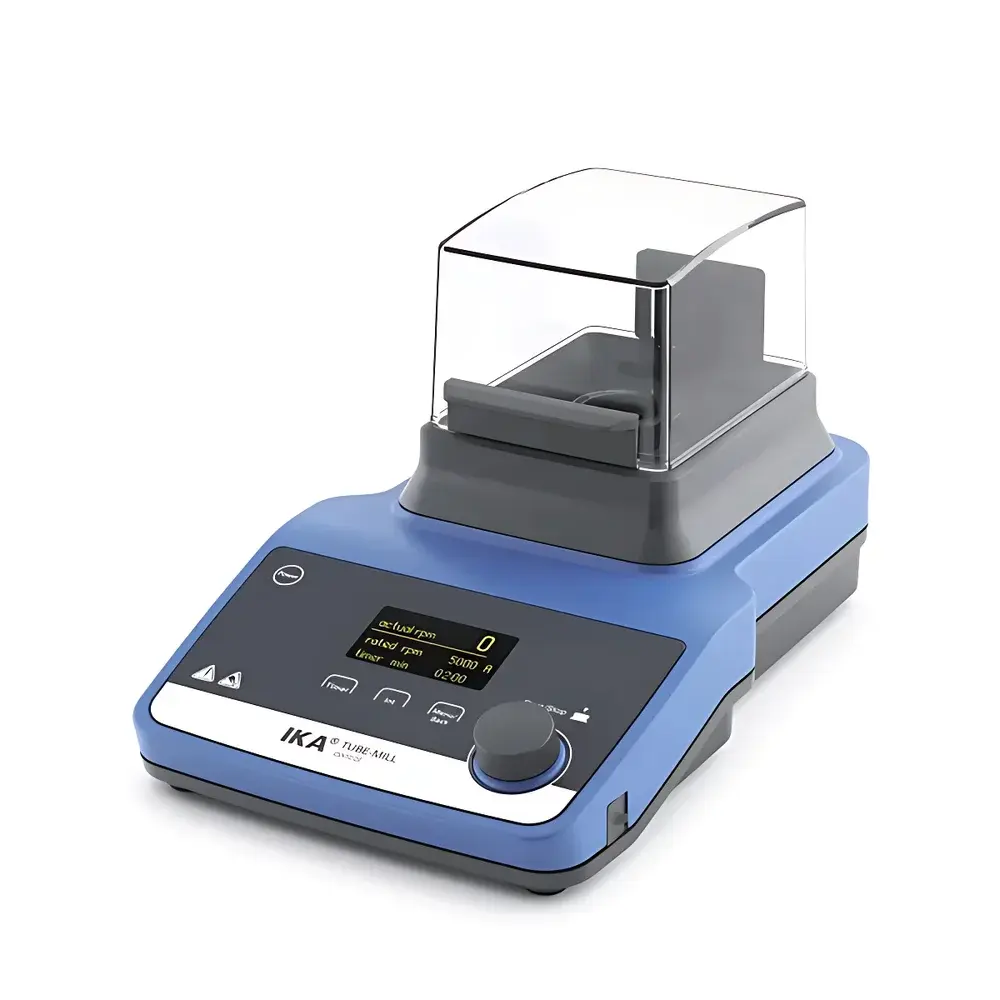
IKA Tube Mill control Benchtop Cryogenic Grinding Mill
| Brand | IKA |
|---|---|
| Origin | Germany |
| Model | Tube Mill control |
| Motor Input Power | 100 W |
| Motor Output Power | 80 W |
| Speed Range | 5000 – 25,000 rpm |
| Speed Deviation | ±2 % |
| Max. Peripheral Speed | 65 m/s |
| Max. Sample Volume | 40 mL |
| Max. Feed Hardness | 5 Mohs |
| Max. Feed Particle Size | 10 mm |
| Batch Processing Time (Max. Continuous) | 3 min |
| Cooling | Dry Ice-Compatible Grinding Chamber |
| Dimensions (W × D × H) | 180 × 170 × 300 mm |
| Weight | 2.7 kg |
| Ambient Temperature Range | 5 – 40 °C |
| Relative Humidity Limit | 80 % RH |
| Ingress Protection | IP 30 (DIN EN 60529) |
| Power Supply | 220 – 240 V, 50/60 Hz |
| Optional Voltage | 100 – 120 V |
| Display | Multilingual OLED |
| Timing Range | 5 s – 3 min |
| Interface | USB for Remote Control & Data Logging |
| Operation Modes | Continuous, Intermittent, Programmable |
| Safety Features | Adjustable Speed Limit, Adjustable Time Limit, Error Code Display |
| Included Accessories | One 40 mL Disposable Grinding Vial, One 40 mL Reusable Stainless Steel Grinding Vial |
Overview
The IKA Tube Mill control is a compact, high-speed benchtop cryogenic grinding mill engineered for reproducible, controlled size reduction of temperature-sensitive and brittle materials in laboratory environments. Operating on the principle of high-energy impact and shear forces generated by rapid rotation of grinding elements within a sealed vial, it delivers consistent particle size distribution without thermal degradation—enabling reliable preparation of samples for downstream analytical techniques including X-ray diffraction (XRD), scanning electron microscopy (SEM), polymer characterization, and pharmaceutical solid-state analysis. Its design integrates precision motor control with cryogenic compatibility, allowing dry ice cooling of the grinding chamber to maintain sub-ambient temperatures during operation—a critical capability for preserving thermolabile compounds, preventing agglomeration, and minimizing amorphous phase formation in crystalline APIs.
Key Features
- High-speed rotor system delivering speeds from 5,000 to 25,000 rpm with ±2 % speed stability, ensuring repeatable mechanical energy input across batches.
- Cryogenic-ready grinding chamber compatible with dry ice cooling, supporting low-temperature milling down to –78 °C for heat-sensitive biological tissues, polymers, and pharmaceutical excipients.
- Programmable operation modes: continuous, intermittent (pulse), and fully customizable time/speed profiles stored in device memory for method traceability.
- Intuitive multilingual OLED display with touch-sensitive interface enables real-time parameter monitoring, error diagnostics (via alphanumeric fault codes), and quick navigation through settings.
- Adjustable safety limits—including maximum rotational speed and run duration—support compliance with internal SOPs and risk-based operational protocols.
- IP 30-rated dust-protected enclosure ensures long-term reliability in standard laboratory environments; acoustically optimized housing maintains noise levels below 72 dB(A) at 1 m distance.
- USB interface supports bidirectional communication for remote parameter configuration, automated data logging (timestamped speed/time profiles), and firmware updates.
Sample Compatibility & Compliance
The Tube Mill control accommodates feed materials up to 10 mm in initial particle size and hardness ≤5 Mohs (e.g., graphite, talc, limestone, freeze-dried proteins, plant tissues, and soft metals). It is not intended for abrasive or highly ductile materials exceeding this specification. The instrument complies with DIN EN 60529 (IP 30), IEC 61000-6-3 (EMC emission standards), and IEC 61000-6-2 (immunity). Its programmable parameters, audit-trail-capable USB logging, and configurable safety thresholds align with GLP-aligned workflows and support documentation requirements under ISO/IEC 17025 and FDA 21 CFR Part 11 when integrated into validated laboratory information management systems (LIMS).
Software & Data Management
While the Tube Mill control operates autonomously via its embedded controller, its native USB interface enables integration with third-party laboratory software platforms for centralized method deployment and electronic record retention. Logged data includes start/stop timestamps, set speed, actual speed (averaged per second), total runtime, and error event codes—all exportable as CSV files. No proprietary software is required; standard serial communication protocols (VCP over USB) allow scripting via Python or LabVIEW for automated sequence execution in high-throughput screening applications.
Applications
- Preparation of homogeneous powders for XRD and Raman spectroscopy, where crystallinity preservation is essential.
- Routine homogenization of lyophilized biologics prior to dissolution testing or residual moisture analysis.
- Size reduction of polymer blends for melt flow index (MFI) testing and rheological characterization.
- Cell disruption and tissue pulverization under cryogenic conditions for metabolomics and proteomics sample prep.
- Quality control grinding of pharmaceutical tablets and capsules to assess content uniformity and dissolution behavior.
- Material science research involving brittle intermetallics, ceramics, and composite precursors requiring sub-100 µm particle size distributions.
FAQ
Is the Tube Mill control suitable for wet grinding?
No—it is designed exclusively for dry or cryogenic grinding. Liquid media are incompatible with the sealed vial system and motor enclosure.
Can the stainless steel grinding vial be autoclaved?
Yes, the included 40 mL stainless steel vial is autoclavable at 121 °C for 20 minutes; however, repeated sterilization may affect surface passivation and should be verified per institutional biocompatibility protocols.
What maintenance is required?
Routine cleaning of the vial holder and chamber interior is recommended after each use; no lubrication or calibration is required—the speed control system is factory-calibrated and drift-free over its service life.
Does the device meet electromagnetic compatibility (EMC) requirements for regulated laboratories?
Yes—it conforms to IEC 61000-6-3 (emissions) and IEC 61000-6-2 (immunity), making it suitable for installation in shared instrumentation rooms alongside sensitive analytical equipment.
How is method reproducibility ensured across different operators?
Via programmable, password-protected method storage (up to 10 user-defined protocols), combined with real-time speed verification and error-code-driven troubleshooting—minimizing operator-dependent variability in routine QC workflows.



