
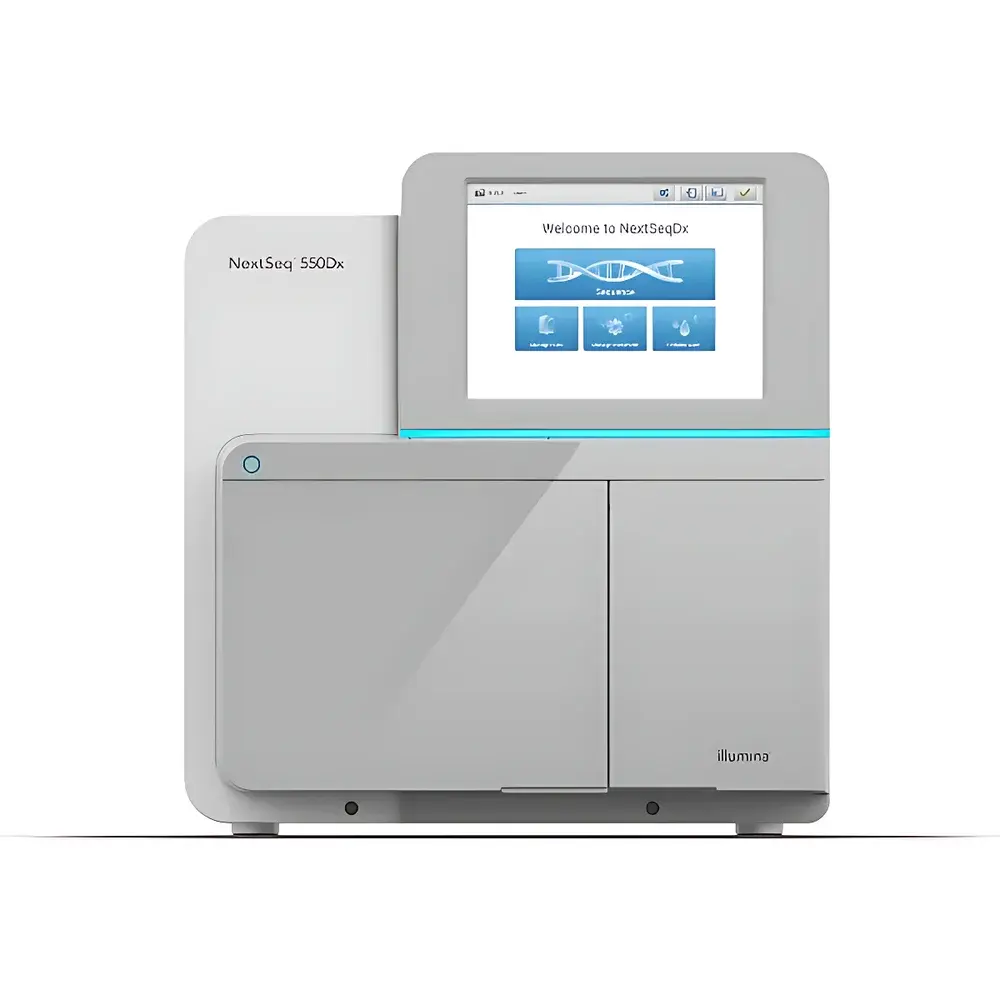
Illumina NextSeq 550Dx Sequencing System
| Brand | Illumina |
|---|---|
| Origin | USA |
| Manufacturer Type | Original Equipment Manufacturer (OEM) |
| Product Category | Imported Instrument |
| Model | NextSeq 550 |
| Instrument Class | Second-Generation (NGS) Sequencer |
| Regulatory Status | FDA-cleared IVD Device (Class II) |
| Form Factor | Benchtop Sequencing Platform |
| Integrated Functionality | NGS + Cytogenomic Microarray Scanning |
| Compliance | CE-IVD, FDA 510(k) cleared (K182913), ISO 13485 certified |
Overview
The Illumina NextSeq 550Dx Sequencing System is a dual-function, benchtop next-generation sequencing (NGS) and cytogenomic microarray scanning platform engineered for clinical diagnostic laboratories operating under stringent regulatory oversight. It implements Illumina’s proven two-channel SBS (Sequencing by Synthesis) chemistry with reversible terminators and fluorescent nucleotide detection, delivering high-fidelity base calling across diverse genomic applications—including whole-genome sequencing (WGS), whole-exome sequencing (WES), RNA-Seq, targeted resequencing, and somatic/germline variant detection. Unlike research-only instruments, the NextSeq 550Dx is specifically designed and validated to meet clinical-grade performance requirements: it supports FDA-cleared IVD assays, enforces audit-trail-enabled instrument operation, and maintains full traceability from sample loading to final variant call—essential for CLIA-certified labs and ISO 15189-accredited environments.
Key Features
- Dual-Mode Operation: Seamlessly switch between NGS sequencing and high-resolution cytogenomic microarray scanning on a single integrated platform—enabling orthogonal validation of copy number variants (CNVs) and structural rearrangements without requiring separate instrumentation.
- Clinical-Grade Workflow Integrity: Pre-configured, locked-down software modes restrict user-modifiable parameters to ensure assay reproducibility; all runs generate immutable metadata logs compliant with 21 CFR Part 11 and ISO 17025 documentation standards.
- Flexible Throughput Management: Supports two flow cell configurations—High Output (up to 120 Gb per run) and Mid Output (up to 40 Gb per run)—allowing precise alignment of sequencing capacity with sample batch size and clinical reporting timelines.
- Benchtop Footprint & Lab Integration: Compact design (76 cm × 61 cm × 66 cm) enables deployment in standard molecular pathology or clinical genomics labs without dedicated HVAC, electrical upgrades, or cleanroom infrastructure.
- Regulatory-Ready Architecture: Manufactured under ISO 13485 quality management system; hardware and firmware validated per IEC 62304; supports GLP/GMP-aligned instrument qualification (IQ/OQ/PQ) protocols.
Sample Compatibility & Compliance
The NextSeq 550Dx accepts standard Illumina-compatible library preparations—including TruSight Oncology, TruSight Hereditary, and VeriSeq NIPT kits—across input types such as FFPE-derived DNA, plasma cfDNA, peripheral blood mononuclear cells (PBMCs), and cultured fibroblasts. All supported assays are accompanied by analytical validation reports documenting limit of detection (LoD), precision (inter- and intra-run CV), specificity, and robustness per CLSI EP17-A2 and EP05-A3 guidelines. The system complies with FDA 21 CFR Part 11 for electronic records and signatures, supports role-based access control (RBAC), and generates ALCOA+ (Attributable, Legible, Contemporaneous, Original, Accurate, Complete, Consistent, Enduring, Available) data packages required for regulatory submissions.
Software & Data Management
Instrument control, run monitoring, and primary data processing are managed through the FDA-cleared NextSeq Control Software (NCS), which enforces version-controlled, locked workflows. Raw BCL files are automatically transferred to BaseSpace Sequence Hub—Illumina’s HIPAA-compliant, SOC 2 Type II–certified cloud platform—or optionally routed to on-premises deployments via BaseSpace Enterprise. Secondary analysis pipelines—including DRAGEN Bio-IT Platform—are pre-validated for clinical use and support automated variant annotation against ClinVar, COSMIC, gnomAD, and ACMG guideline-mapped interpretation frameworks. Audit logs capture every user action, parameter change, and file transfer event with cryptographic timestamping and digital signature verification.
Applications
- Clinical oncology testing: Detection of SNVs, indels, CNVs, and gene fusions in solid tumors and hematologic malignancies
- Inherited disease diagnostics: Comprehensive carrier screening, exome-based rare disease evaluation, and pharmacogenomic profiling
- Non-invasive prenatal testing (NIPT): High-sensitivity aneuploidy and microdeletion screening from maternal plasma
- Transplant monitoring: Chimerism assessment and minimal residual disease (MRD) tracking using error-corrected sequencing
- Microbial identification & resistance profiling: Metagenomic pathogen detection in immunocompromised patients
FAQ
Is the NextSeq 550Dx approved for in vitro diagnostic use in the U.S.?
Yes—the system holds FDA 510(k) clearance (K182913) for use with specific IVD assays, including TruSight Oncology 500 and VeriSeq NIPT Solution.
Can research-use-only (RUO) libraries be processed on the NextSeq 550Dx?
No—only FDA-cleared or CE-IVD–marked library prep kits and associated bioinformatics pipelines may be used in diagnostic mode; RUO workflows require separate research-grade instrument configuration.
Does the system support LIMS integration?
Yes—via standardized HL7 v2.x and ASTM E1384 interfaces for bidirectional sample tracking, result export, and QC status synchronization.
What level of bioinformatics expertise is required to operate the platform?
Minimal—BaseSpace Sequence Hub provides push-button analysis with preconfigured clinical pipelines; bioinformaticians are only needed for custom pipeline development or advanced interpretation.
How is instrument performance monitored over time?
Through built-in QC metrics (phasing/pre-phasing rates, cluster density, Q30 scores) and automated daily calibration checks; all metrics feed into a centralized instrument health dashboard accessible via BaseSpace.



